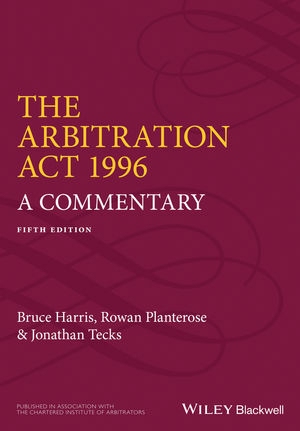
The Arbitration Act 1996 (eBook)
John Wiley & Sons (Verlag)
978-1-118-85338-2 (ISBN)
-Arbitration
When first published, The Arbitration Act 1996: A Commentary was described by Lord Bingham as 'intensely practical and admirably user-friendly'. It remains the most readable, useful, practical and user-friendly guide to the Arbitration Act 1996.
The courts - particularly the Commercial and the Technology & Construction Courts - continue to grapple with many questions relating to the Act, with many judgments reported since the previous edition was published. While many of these do not add to the wisdom on this legislation, for the fifth edition the authors have considered some 330 new cases, resulting in extensive changes throughout much of the commentary. Many of the cases going to court concern challenges to awards and as a result the commentary on the relevant sections of the Act (ss. 67, 68, 70 and 72) has been subject to very substantial revision indeed. The details of all of these changes are of great importance to practitioners, whether lawyers or arbitrators.
In addition there have been some significant changes to the Model Law since publication of the previous edition, which are fully documented and commented upon. Alterations to the CPR, the new UNCITRAL Rules (2010), the new ICC Rules (2012) and the new ICE Arbitration Procedure (2010) are also covered.
Written by three practising arbitrators, the fifth edition continues to be the essential handbook for all concerned with English arbitration.
Bruce Harris is a full-time commercial and maritime arbitrator who has been involved in close to 10000 arbitrations and made more than 2000 awards.
Rowan Planterose is a former practising barrister, now a solicitor, Chartered Arbitrator, adjudicator and a partner at DAC Beachcroft LLP.
Jonathan Tecks is a barrister, Chartered Arbitrator and mediator, with a dispute resolution practice covering a broad range of construction, property and commercial matters
"e;There should not be a practitioner who does not have a copy ... highly recommended."e; Arbitration When first published, The Arbitration Act 1996: A Commentary was described by Lord Bingham as "e;intensely practical and admirably user-friendly"e;. It remains the most readable, useful, practical and user-friendly guide to the Arbitration Act 1996. The courts particularly the Commercial and the Technology & Construction Courts continue to grapple with many questions relating to the Act, with many judgments reported since the previous edition was published. While many of these do not add to the wisdom on this legislation, for the fifth edition the authors have considered some 330 new cases, resulting in extensive changes throughout much of the commentary. Many of the cases going to court concern challenges to awards and as a result the commentary on the relevant sections of the Act (ss. 67, 68, 70 and 72) has been subject to very substantial revision indeed. The details of all of these changes are of great importance to practitioners, whether lawyers or arbitrators. In addition there have been some significant changes to the Model Law since publication of the previous edition, which are fully documented and commented upon. Alterations to the CPR, the new UNCITRAL Rules (2010), the new ICC Rules (2012) and the new ICE Arbitration Procedure (2010) are also covered. Written by three practising arbitrators, the fifth edition continues to be the essential handbook for all concerned with English arbitration.
Bruce Harris is a full-time commercial and maritime arbitrator who has been involved in close to 10000 arbitrations and made more than 2000 awards. Rowan Planterose is a former practising barrister, now a solicitor, Chartered Arbitrator, adjudicator and a partner at DAC Beachcroft LLP. Jonathan Tecks is a barrister, Chartered Arbitrator and mediator, with a dispute resolution practice covering a broad range of construction, property and commercial matters
Biographical Note viii
Foreword to Fifth Edition ix
Preface to Fifth Edition xi
References and Abbreviations xiii
1. Materials 1
A. Arbitration Clauses 1
B. Agreements Prior to or on Constitution of Arbitration 3
C. Agreements as to Tribunal and Court Powers 8
D. Checklist for Preliminary Meetings 10
E. Agreement with Arbitrator on Resignation 13
F. Checklist for Awards 14
G. Agreements as to Costs 16
H. General Note on Arbitration Claims 17
2. The Arbitration Act 1996 21
Text of the Act and Commentary 21
Arrangement of Sections 23
3. Appendices 509
The Arbitration Act 1996 (Commencement No. 1) Order 1996 511
The Unfair Terms in Consumer Contracts Regulations 1999 513
The Arbitration Act 1950, Part II 523
Table of Cases 531
Index to Commentary 547
Part 1
Materials
A. Arbitration Clauses
Examples
We have prepared two sample arbitration clauses specifically designed for use with the Act. In each case they are intended simply to establish the arbitration tribunal and do not embark upon the possible powers that the tribunal might have.
It should be noted that both these clauses anticipate another clause in the relevant contract which provides for a notice to be given that will determine when the arbitration starts. In the absence of such a provision, the default provisions in s.14(3) to (5) will apply.
Clause (1) — Sole arbitrator
‘Any dispute or difference arising out of or in connection with this contract shall be referred to the arbitration of a sole arbitrator to be appointed in accordance with s.16(3) of the Arbitration Act 1996 (‘the Act’), the seat of such arbitration being hereby designated as London, England. In the event of failure of the parties to make the appointment pursuant to s.16(3) of the Act, the appointment shall be made by the President for the time being of the Chartered Institute of Arbitrators. The arbitration will be regarded as commenced for the purposes set out in s.14(1) of the Act when one party sends to the other the notice described in clause [ ] of this contract. The arbitrator shall decide the dispute according to the substantive laws of England and Wales.’
Clause (2) — Two arbitrators and a chairman
‘Any dispute or difference arising out of or in connection with this contract shall be referred to the arbitration of two arbitrators and a chairman to be appointed in accordance with s.16(5) of the Arbitration Act 1996 (“the Act”), the seat of such arbitration being hereby designated as London, England. S.17 of the Act shall not apply. In the event of failure of either of the parties to make the appointment pursuant to s.16(5) of the Act, or in the event of failure by the arbitrators to appoint a chairman, such appointment shall be made by the President for the time being of the Chartered Institute of Arbitrators who shall have the powers otherwise given to the court under s.18(3) of the Act. The arbitration will be regarded as commenced for the purposes set out in s.14(1) of the Act when one party sends to the other the notice described in clause [ ] of this contract. Save that in respect of matters of procedure (other than where the parties are agreed) decisions or orders may be made by the chairman acting alone, s.20(3) and (4) of the Act shall apply. The arbitrators shall determine the dispute in accordance with the substantive laws of England and Wales.’
B. Agreements Prior to or on Constitution of Arbitration
Introduction
This is one of a number of checklists of points arising for consideration or agreement designed to assist with implementing the Act.
Whilst the lists have been drawn up broadly by reference to the different stages or aspects of an arbitration, such an exercise is arbitrary since many such points may be addressed at more than one stage or in relation to more than one aspect. We have therefore tried to identify those matters which we think most likely to be addressed at certain stages.
Dealing with preliminary meetings and awards, the checklists are, of course, primarily addressed to the arbitrator.
Checklist for agreements prior to or on constitution of the arbitration
Seat of the arbitration — (s.3)
- The parties may designate the seat;
- The parties may empower an arbitral institution or other person to designate the seat;
- The parties may authorise the tribunal to designate the seat;
- Otherwise, the court will determine the seat.
General means of providing for non-mandatory provisions — (s.4)
- The parties may make their own agreement or agreements dealing with specific non-mandatory provisions;
- The parties may adopt institutional rules;
- The parties may adopt the laws of another state;
- The parties may use a combination of the above;
- Otherwise, default provisions apply.
Separability of arbitration agreement — (s.7)
- The parties may agree that an arbitration clause is not separable from the main agreement;
- Otherwise, it is so separable.
Death of a party — (s.8)
- The parties may agree that an arbitration agreement is discharged by the death of a party and so may not be enforced by or against the personal representatives of that party;
- Otherwise, it is not so discharged.
Commencement of arbitral proceedings — (s.14)
- The parties may agree when arbitral proceedings are to be regarded as commenced for the purposes of Part I of the Act and of the Limitation Acts;
- Otherwise, default provisions apply.
Arbitral tribunal — (s.15)
- The parties may agree on the number of arbitrators to form the tribunal and whether there is to be a chairman or umpire;
- Where the parties have agreed on an even number of arbitrators, they may agree that there should be no additional arbitrator as chairman (otherwise an agreement for two arbitrators is understood as requiring the appointment of a third, as chairman);
- In default of agreement as to number, there will be a sole arbitrator.
- (Note, therefore, that if the parties require more than one arbitrator, agreement is essential.)
Procedure for appointment of arbitrators — (s.16)
- The parties may agree on the procedure for appointing the arbitrator or arbitrators, including the procedure for appointing any chairman or umpire;
- Default provisions apply if there is no agreement, or only an agreement covering some of these matters.
Appointment of sole arbitrator in case of default — (s.17)
- The parties may agree that s.17 (appointment of first party’s arbitrator as sole arbitrator where second party fails to make an appointment) does not apply.
Failure of appointment procedure — (s.18)
- The parties may agree what is to happen in the event of a failure of the procedure for the appointment of the arbitral tribunal;
- Default provisions apply if or to the extent that there is no agreement.
Chairman — (s.20)
- Where there is to be a chairman, the parties may agree his functions as to the making of decisions, orders and awards;
- Default provisions apply if or to the extent that there is no agreement.
Umpire — (s.21)
- Where there is to be an umpire, one should be appointed once the party-appointed arbitrators are in place, absent agreement to some other effect;
- Where there is to be an umpire, the parties may agree his functions;
- Default provisions apply if or to the extent that there is no agreement.
Decision making where there is no chairman or umpire — (s.22)
- The parties may agree how the tribunal is to make decisions, orders and awards where they have previously agreed that there shall be two or more arbitrators with no chairman or umpire;
- In the absence of such an agreement, decisions are made by all arbitrators or a majority.
Revocation of arbitrator’s authority — (s.23)
- The parties may agree in what circumstances the authority of an arbitrator may be revoked;
- Default provisions apply to the extent that there is no agreement.
Jurisdiction of the arbitral tribunal — (s.30)
- The parties may agree that the tribunal cannot rule on its own substantive jurisdiction;
- Otherwise, it can.
Consolidation — (s.35)
- The parties may agree on consolidation of arbitrations or concurrent hearings, or that the tribunal shall have power so to order;
- Otherwise, the tribunal has no such power.
Representation — (s.36)
- The parties may agree that rights to representation be limited;
- Otherwise, they may be represented by a lawyer or other person.
Appointing experts, legal advisers or assessors — (s.37)
- The parties may agree that the tribunal may not appoint experts, etc.;
- Otherwise, the tribunal has such power of appointment;
- The parties may agree they should not be given a reasonable opportunity to comment on the output of such an expert.
- (Note that s.37(2), in relation to the fees and expenses of such experts, is mandatory.)
General powers of tribunal — (s.38)
- The parties may agree on the powers exercisable by the tribunal;
- But the powers in subss.(3) to (6) will apply unless a contrary agreement can be spelt out.
Power to make provisional orders — (s.39)
- The parties may agree that the tribunal shall have power to order on a provisional basis any relief...
| Erscheint lt. Verlag | 31.3.2014 |
|---|---|
| Sprache | englisch |
| Themenwelt | Recht / Steuern ► EU / Internationales Recht |
| Recht / Steuern ► Privatrecht / Bürgerliches Recht ► Zivilverfahrensrecht | |
| Technik ► Bauwesen | |
| Schlagworte | Act • Alternative Beilegung von Rechtsstreitigkeiten • Alternative Dispute Resolution • arbitration • Arbitration & Mediation • Authors • Bauingenieur- u. Bauwesen • Baurecht • Bingham • changes • Civil Engineering & Construction • Commentary • commercial • Construction • construction law • continue • Courts • Edition • Fifth • Guide • judgments • Law • Legislation • Lord • many • new cases • Practical • previous • questions • Rechtswissenschaft • Schlichtung u. Mediation • Technology • wisdom |
| ISBN-10 | 1-118-85338-5 / 1118853385 |
| ISBN-13 | 978-1-118-85338-2 / 9781118853382 |
| Informationen gemäß Produktsicherheitsverordnung (GPSR) | |
| Haben Sie eine Frage zum Produkt? |
 EPUB (Adobe DRM)
Kopierschutz: Adobe-DRM
Adobe-DRM ist ein Kopierschutz, der das eBook vor Mißbrauch schützen soll. Dabei wird das eBook bereits beim Download auf Ihre persönliche Adobe-ID autorisiert. Lesen können Sie das eBook dann nur auf den Geräten, welche ebenfalls auf Ihre Adobe-ID registriert sind.
Details zum Adobe-DRM
Dateiformat: EPUB (Electronic Publication)
EPUB ist ein offener Standard für eBooks und eignet sich besonders zur Darstellung von Belletristik und Sachbüchern. Der Fließtext wird dynamisch an die Display- und Schriftgröße angepasst. Auch für mobile Lesegeräte ist EPUB daher gut geeignet.
Systemvoraussetzungen:
PC/Mac: Mit einem PC oder Mac können Sie dieses eBook lesen. Sie benötigen eine
eReader: Dieses eBook kann mit (fast) allen eBook-Readern gelesen werden. Mit dem amazon-Kindle ist es aber nicht kompatibel.
Smartphone/Tablet: Egal ob Apple oder Android, dieses eBook können Sie lesen. Sie benötigen eine
Geräteliste und zusätzliche Hinweise
Buying eBooks from abroad
For tax law reasons we can sell eBooks just within Germany and Switzerland. Regrettably we cannot fulfill eBook-orders from other countries.
aus dem Bereich