


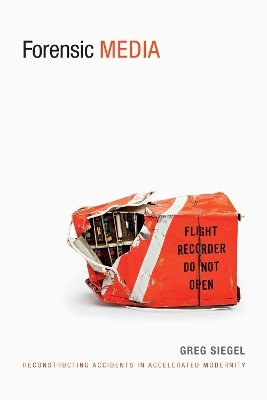
Forensic Media
Reconstructing Accidents in Accelerated Modernity
Seiten
2014
Duke University Press (Verlag)
978-0-8223-5753-7 (ISBN)
Duke University Press (Verlag)
978-0-8223-5753-7 (ISBN)
This provocative book considers how photographic, electronic, and digital media have been used to record and reconstruct accidents, particularly high-speed crashes and catastrophes, and argues that "forensic media" thereby transmute disruptive chance occurrences into reassuring narratives of causal succession.
In Forensic Media, Greg Siegel considers how photographic, electronic, and digital media have been used to record and reconstruct accidents, particularly high-speed crashes and catastrophes. Focusing in turn on the birth of the field of forensic engineering, Charles Babbage's invention of a "self-registering apparatus" for railroad trains, flight-data and cockpit voice recorders ("black boxes"), the science of automobile crash-testing, and various accident-reconstruction techniques and technologies, Siegel shows how "forensic media" work to transmute disruptive chance occurrences into reassuring narratives of causal succession. Through historical and philosophical analyses, he demonstrates that forensic media are as much technologies of cultural imagination as they are instruments of scientific inscription, as imbued with ideological fantasies as they are compelled by institutional rationales. By rethinking the historical links and cultural relays between accidents and forensics, Siegel sheds new light on the corresponding connections between media, technology, and modernity.
In Forensic Media, Greg Siegel considers how photographic, electronic, and digital media have been used to record and reconstruct accidents, particularly high-speed crashes and catastrophes. Focusing in turn on the birth of the field of forensic engineering, Charles Babbage's invention of a "self-registering apparatus" for railroad trains, flight-data and cockpit voice recorders ("black boxes"), the science of automobile crash-testing, and various accident-reconstruction techniques and technologies, Siegel shows how "forensic media" work to transmute disruptive chance occurrences into reassuring narratives of causal succession. Through historical and philosophical analyses, he demonstrates that forensic media are as much technologies of cultural imagination as they are instruments of scientific inscription, as imbued with ideological fantasies as they are compelled by institutional rationales. By rethinking the historical links and cultural relays between accidents and forensics, Siegel sheds new light on the corresponding connections between media, technology, and modernity.
Greg Siegel is Associate Professor of Film and Media Studies at the University of California, Santa Barbara.
Acknowledgments ix
Introduction. Accidents and Forensics 1
1. Engineering Detectives 31
2. Tracings 65
3. Black Boxes 89
4. Tests and Split Seconds 143
Epilogue. Retrospective Prophecies 195
Notes 215
Bibliography 237
Index 251
| Reihe/Serie | Sign, Storage, Transmission |
|---|---|
| Zusatzinfo | 57 illustrations |
| Verlagsort | North Carolina |
| Sprache | englisch |
| Maße | 152 x 229 mm |
| Gewicht | 376 g |
| Themenwelt | Geschichte ► Teilgebiete der Geschichte ► Technikgeschichte |
| Recht / Steuern ► Strafrecht ► Kriminologie | |
| Sozialwissenschaften ► Kommunikation / Medien | |
| Technik ► Bauwesen | |
| Technik ► Fahrzeugbau / Schiffbau | |
| ISBN-10 | 0-8223-5753-4 / 0822357534 |
| ISBN-13 | 978-0-8223-5753-7 / 9780822357537 |
| Zustand | Neuware |
| Informationen gemäß Produktsicherheitsverordnung (GPSR) | |
| Haben Sie eine Frage zum Produkt? |
Mehr entdecken
aus dem Bereich

aus dem Bereich
eine Geschichte der Fehlbarkeit von Mensch und Technologie
Buch | Hardcover (2025)
C.H.Beck (Verlag)
CHF 44,75
von Gutenberg bis zum Smartphone
Buch | Hardcover (2025)
Klett-Cotta (Verlag)
CHF 33,55
Buch | Softcover (2024)
Lehmanns Media (Verlag)
CHF 27,90


