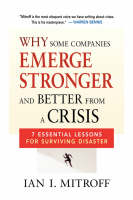
Why Some Companies Emerge Stronger and Better from a Crisis (eBook)
256 Seiten
Amacom (Verlag)
9780814416303 (ISBN)
Like many companies over the last few years, yours has probably done a great deal to reassess its physical, strategic, and financial vulnerabilities. But there is a huge difference between business continuity planning and true crisis management. Do your company and employees have the necessary ''IQ'' not only to withstand a crisis but also to come through it with strength and confidence?
Ian Mitroff, recognized around the world as an authority in crisis management, has created a plan that goes well beyond 'disaster preparedness' to help your company get accustomed to working in the face of some unsettling facts:
In an age of terror, cyberattacks, large-scale corporate fraud and more, crisis is no longer a question of if, but of when.Your company, no matter its size, industry, or location, is not immune from this reality.Your contingency planning will only be as effective as the human beings charged with putting it into action.
Mitroff outlines seven distinct competencies your organization needs to handle crises effectively:
Right Heart (emotional IQ): By accepting crisis as an inevitability, you can process much of the shock and grief beforehand, and avoid making the effects of the crisis even worse through an unconstructive response.Right Thinking (creative IQ): ''Crises don't give a damn for the ways in which we have organized the world,'' so out-of-the-box thinking is essential.Right Social and Political IQ: Understand that your business is subject not only to the particular pitfalls of its industry, but also to the universal and complex challenges that threaten all companies.Right Integration (integrative IQ): Realize that crises are perceived differently by different stakeholders, and are never simple ''exercises'' that can be ''solved.'' Identify and reconcile these perceptions now so that the path is clear when the crisis strikes.Right Technical IQ: ''Think like a controlled paranoid'' to uncover ways in which malicious forces could cause a crisis in your company. Question every assumption about what is ''normal,'' ''impossible,'' or ''absurd.''Right Aesthetic IQ: Reconsider the classic design of the corporation, which is meant to address problems as they arise, and move toward one in which crisis management is an overarching discipline on a par with, for example, finance.Spiritual IQ: Reject the notion that people's physical, mental, and spiritual beings are completely separate, recognize that crises cause us to question the very meaning of our lives and what we do, and establish ahead of time why our work is, and must remain, important to us on many different levels.
Although crisis management has taken on new urgency in recent turbulent times, the need for careful planning did not originate on September 11, 2001. Mitroff's examples, drawn from interviews conducted both after the 2001 attacks and during his 25-year career as an expert in crisis management, demonstrate the need for action — and offer a blueprint for taking it.
Do your company and employees have the necessary "e;IQ"e; not only to withstand a crisis but also come through it with strength and confidence?Like many companies over the last few years, yours has probably done a great deal to reassess its physical, strategic, and financial vulnerabilities. However, there is a huge difference between business continuity planning and true crisis management. Ian Mitroff outlines seven distinct competencies your organization needs to handle crises effectively:Right Heart (emotional IQ): By accepting crisis as an inevitability, you can process much of the shock and grief beforehand, and avoid making the effects of the crisis even worse through an unconstructive response.Right Thinking (creative IQ): "e;Crises don't care about the ways in which we have organized the world,"e; so out-of-the-box thinking is essential.Right Social and Political IQ: Understand that your business is subject not only to the pitfalls of its industry, but to the universal and complex challenges that threaten all companies.Right Integration (integrative IQ): Realize that crises are perceived differently by different stakeholders, and are never simple "e;exercises"e; that can be "e;solved."e; Identify and reconcile these perceptions now so that the path is clear when the crisis strikes.Right Technical IQ: "e;Think like a controlled paranoid"e; to uncover ways in which malicious forces could cause a crisis in your company. Question every assumption about what is "e;normal,"e; "e;impossible,"e; or "e;absurd."e;Right Aesthetic IQ: Reconsider the classic design of the corporation, which is meant to address problems as they arise, and move toward one in which crisis management is an overarching discipline on a par with, for example, finance.Spiritual IQ: Reject the notion that people's physical, mental, and spiritual beings are completely separate; and establish ahead of time why our work is, and must remain, important to us on many different levels.Although crisis management has taken on new urgency in recent turbulent times, the need for careful planning did not originate on September 11, 2001. Mitroff's examples, drawn from interviews conducted both before and after the 2001 attacks during his 25 years of experience, demonstrate the need for action -- and offer a blueprint for taking it.
| Erscheint lt. Verlag | 21.1.2008 |
|---|---|
| Sprache | englisch |
| Themenwelt | Naturwissenschaften |
| Recht / Steuern ► EU / Internationales Recht | |
| Recht / Steuern ► Privatrecht / Bürgerliches Recht ► Zivilverfahrensrecht | |
| Sozialwissenschaften ► Politik / Verwaltung ► Europäische / Internationale Politik | |
| Wirtschaft ► Betriebswirtschaft / Management ► Unternehmensführung / Management | |
| ISBN-13 | 9780814416303 / 9780814416303 |
| Informationen gemäß Produktsicherheitsverordnung (GPSR) | |
| Haben Sie eine Frage zum Produkt? |
 EPUB (Adobe DRM)
Kopierschutz: Adobe-DRM
Adobe-DRM ist ein Kopierschutz, der das eBook vor Mißbrauch schützen soll. Dabei wird das eBook bereits beim Download auf Ihre persönliche Adobe-ID autorisiert. Lesen können Sie das eBook dann nur auf den Geräten, welche ebenfalls auf Ihre Adobe-ID registriert sind.
Details zum Adobe-DRM
Dateiformat: EPUB (Electronic Publication)
EPUB ist ein offener Standard für eBooks und eignet sich besonders zur Darstellung von Belletristik und Sachbüchern. Der Fließtext wird dynamisch an die Display- und Schriftgröße angepasst. Auch für mobile Lesegeräte ist EPUB daher gut geeignet.
Systemvoraussetzungen:
PC/Mac: Mit einem PC oder Mac können Sie dieses eBook lesen. Sie benötigen eine
eReader: Dieses eBook kann mit (fast) allen eBook-Readern gelesen werden. Mit dem amazon-Kindle ist es aber nicht kompatibel.
Smartphone/Tablet: Egal ob Apple oder Android, dieses eBook können Sie lesen. Sie benötigen eine
Geräteliste und zusätzliche Hinweise
Buying eBooks from abroad
For tax law reasons we can sell eBooks just within Germany and Switzerland. Regrettably we cannot fulfill eBook-orders from other countries.
aus dem Bereich