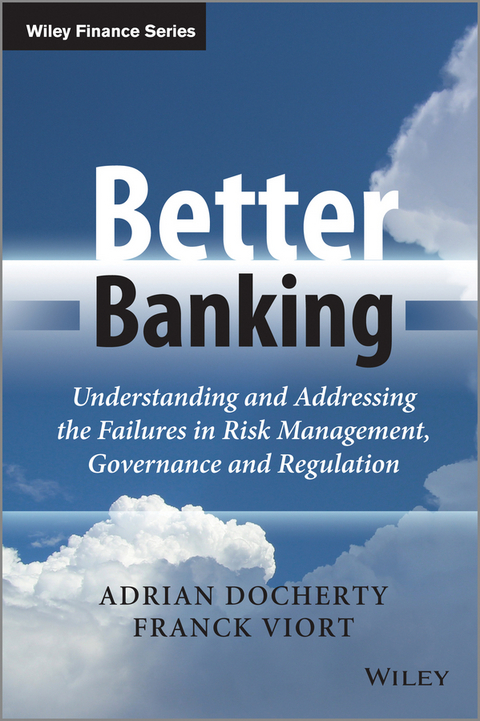
Better Banking (eBook)
John Wiley & Sons (Verlag)
978-1-118-65133-9 (ISBN)
Why did the financial crisis happen? Why did no one see it coming? And how did our banks lose so much of our money? What's being done to sort out the banking industry? And will it work?
These are the questions that industry experts Adrian Docherty and Franck Viort cover in Better Banking: Understanding and Addressing the Failures in Risk Management, Governance and Regulation. They give a clear and thorough run-through of some of the key concepts and developments in banking, to enable the reader to understand better this vital yet perilous industry. Without excessive detail or jargon, they explain the most important issues in risk management, regulation and governance and build a comprehensive description of how failings in these areas resulted in the current financial crisis. In order to make the diagnosis clear, the authors illustrate their descriptions with a series of informative case studies. The book revolves around a critique of the current regulatory developments, which the authors feel will be ineffective in fixing the structural flaws in banking. Crucially, and as the title of the book suggests, they set out their own series of proposals to contribute to the development of a better, safer and more effective banking industry.
Docherty and Viort's book fills an important gap in the literature on banking and its role in the current financial crisis. It is at once a history, a primer, a critique and a manifesto. It does not take sides but works through a constructive diagnosis towards ideas that could lead to major improvements in the quality and stability of the financial world.
Better Banking: Understanding and Addressing the Failures in Risk Management, Governance and Regulation is a technical yet accessible book that seeks to engage interested readers of all kinds -- students, professionals, bankers and regulators but also politicians and the broader audience of citizens outside the banking industry, who are keen to inform themselves and understand what needs to be done to avoid a repeat of this crisis.
Praise for Better Banking:
“Better Banking by Adrian Docherty and Frank Viort is an outstanding introduction to the recent financial crisis. It starts from first principles and provides many useful new insights, delivering detailed case studies of the banks that got in trouble as well as critiques of past and proposed regulations. I recommend the book to those who want to learn the basics about banking crises and to those looking for a fresh and sophisticated perspective on risk taking by banks.”
Douglas W. Diamond, Merton H. Miller Distinguished Service Professor of Finance, University of Chicago Booth School of Business
'Adrian Docherty and Franck Viort make a compelling and timely case for Better Banking. They provide a critical analysis of recent banking history and an informed challenge to those developing future policy. With the banking crisis far from over, Better Banking is required reading for all those with an interest in a sustainable financial system.'
Tim Wright, CEO, Willis International
'Better Banking is a fresh and insightful primer on the financial crisis, based on first-hand experience of the banking industry. Docherty and Viort's blueprint for action is an entirely new contribution to the global debate on financial regulation.'
Benoît Coeuré, Member of the Executive Board, European Central Bank
'This book is a page-turner on banking regulation, which in itself makes it a must-read. It goes beyond conventional wisdom and questions the very essence of what banks are here for in the first place. In that sense, it also has broader implications and I, for one, would very much like Adrian Docherty's and Franck Viort's ideas to be implemented in regulating the insurance sector and in the financial area more generally.'
Pierre Michel, Deputy-CEO, Caisse Centrale de Réassurance / Former Insurance and Pension Funds Expert, European Commission
“Docherty and Viort have a clear understanding of what went wrong in the financial crisis, and why. They also offer some thought provoking ideas for more robust bank regulation in the future. Furthermore, they write in an accessible and lucid way about complex problems.”
Howard Davies, Professor, Sciences-Po / Former Chairman, FSA
“Bankers and regulators should read this book. That way, they might get it right next time around”
Adam Seale, CEO, Interactive Investor
Adrian Docherty and Franck Viort have, in aggregate, 40 years of experience serving and advising the financial services sector on strategic issues, in a variety of economic conditions and in many different countries around the world. Their professional focus is on helping to improve the financial management and risk performance of banks and insurance companies. Better Banking is their first book, though their views are regularly quoted in the press and they are frequent presenters at industry conferences. Adrian holds a master’s degree from Cambridge University and lives with his wife, son and daughter in Kent. Franck has a degree from Sciences-Po in Paris and an MBA from the University of Chicago and lives in London with his wife and three daughters.
Why did the financial crisis happen? Why did no one see it coming? And how did our banks lose so much of our money? What's being done to sort out the banking industry? And will it work? These are the questions that industry experts Adrian Docherty and Franck Viort cover in Better Banking: Understanding and Addressing the Failures in Risk Management, Governance and Regulation. They give a clear and thorough run-through of some of the key concepts and developments in banking, to enable the reader to understand better this vital yet perilous industry. Without excessive detail or jargon, they explain the most important issues in risk management, regulation and governance and build a comprehensive description of how failings in these areas resulted in the current financial crisis. In order to make the diagnosis clear, the authors illustrate their descriptions with a series of informative case studies. The book revolves around a critique of the current regulatory developments, which the authors feel will be ineffective in fixing the structural flaws in banking. Crucially, and as the title of the book suggests, they set out their own series of proposals to contribute to the development of a better, safer and more effective banking industry. Docherty and Viort's book fills an important gap in the literature on banking and its role in the current financial crisis. It is at once a history, a primer, a critique and a manifesto. It does not take sides but works through a constructive diagnosis towards ideas that could lead to major improvements in the quality and stability of the financial world. Better Banking: Understanding and Addressing the Failures in Risk Management, Governance and Regulation is a technical yet accessible book that seeks to engage interested readers of all kinds -- students, professionals, bankers and regulators but also politicians and the broader audience of citizens outside the banking industry, who are keen to inform themselves and understand what needs to be done to avoid a repeat of this crisis.
Adrian Docherty and Franck Viort have, in aggregate, 40 years of experience serving and advising the financial services sector on strategic issues, in a variety of economic conditions and in many different countries around the world. Their professional focus is on helping to improve the financial management and risk performance of banks and insurance companies. Better Banking is their first book, though their views are regularly quoted in the press and they are frequent presenters at industry conferences. Adrian holds a master's degree from Cambridge University and lives with his wife, son and daughter in Kent. Franck has a degree from Sciences-Po in Paris and an MBA from the University of Chicago and lives in London with his wife and three daughters.
Acknowledgements xi
1 Introduction 1
1.1 Overview and Objectives 1
1.2 Quick Start Guide to Banking Concepts and Regulation 4
2 The Global Financial Crisis 7
2.1 From Deregulation to dotcom Crash 7
2.2 The Seeds of a Crisis 9
2.3 "Why Didn't Anyone See This Coming?"
14
2.4 The Beginnings of a Crisis 17
2.5 The Crisis Intensifies 20
2.6 Meltdown: The Lehman Bankruptcy 21
2.7 Massive Intervention Internationally 23
2.8 Sovereign Crises 29
2.9 Aftershocks and Skeletons in the Cupboard 32
2.10 Who is to Blame? 34
3 Methodologies and Foundations 37
3.1 How do Banks Make or Lose Money? 37
3.2 What's a Bank Worth? Key Issues in Accounting for
Banks 41
3.3 What is Risk? 47
3.4 What is an RWA? 55
3.5 What is Capital? 61
3.6 What are Liquidity and Funding? 68
3.7 What is a Derivative? 84
3.8 Mark-to-Market and Procyclicality 90
3.9 Role of Regulation, Supervision and Support 96
3.10 Ratings Agencies and Credit Ratings 101
3.11 Analysts, Investors and Financial Communication 109
4 Regulation of the Banking Industry 113
4.1 The Relevance of Bank Regulation and Supervision 113
4.2 Regulation and Supervision of the Banking Industry Prior to
"Basel I" 113
4.3 The Basel Capital Accord aka "Basel I" 117
4.4 Basel II 122
4.5 Basel III 141
4.6 Resolution Regimes 163
4.7 Other Current Regulatory Workstreams 171
5 Case Studies 175
5.1 RBS 176
5.2 Dexia 179
5.3 HBOS 184
5.4 HSBC 189
5.5 Bear Stearns 192
5.6 Merrill Lynch 196
5.7 AIG 200
5.8 JP Morgan 207
5.9 Barclays 213
5.10 UBS 217
5.11 Northern Rock 221
5.12 Bankia-BFA 223
5.13 Australia 228
5.14 Canada 233
5.15 Summary of "Lessons Learned" from the Case
Studies 236
6 Objectives and Design Principles 239
6.1 Free Market versus State Capitalism 240
6.2 Are There Alternatives to Banks? 242
6.3 Benefi ts and Limitations of Finance 250
6.4 How Much Risk Can We Tolerate? 251
6.5 The Role of Regulation and Supervision 254
6.6 The Role of "the Market" 256
6.7 Conclusions: Proposed Objectives and Design Criteria 258
7 A Blueprint for "Basel IV" 259
7.1 Risk Management 261
7.2 The Guardian Angel 269
7.3 Human Capital 275
7.4 Governance 287
7.5 Capital 291
7.6 Liquidity and Funding 299
7.7 The "Pillar 2" Mindset 303
7.8 Glasnost: Market Discipline and "Pillar 3"
311
7.9 Industry Structure 313
8 Challenges 327
8.1 Industry Entrenchment 327
8.2 Human Behaviour 329
8.3 Performance Management for Good Risk Management 332
8.4 Timing 333
8.5 A Positive Challenge: Technological and Social Progress
333
9 What Next? A Call to Arms 335
Glossary & Jargon Lookup 339
Disclaimer Regarding Excerpts from S&P Materials 349
Index 351
1 Introduction
1.1 Overview and Objectives
If the terrain and the map do not agree, follow the terrain.1
Today, the world is in its sixth year of a deep and damaging financial crisis. The cause of this crisis was a massive failure of risk management and governance: quite simply, we lost control of our financial system. As a result, we experienced a debt-fuelled boom that turned rapidly into an economic “bust”. Millions are suffering as a consequence: for example, youth unemployment has risen in the last ten years from 17.8% to 22.8% in the EU and from 12.0% to 16.2% in the United States.2
The problems could have been greater. The bankruptcy of Lehman Brothers could have led our modern, global economy to freeze. Such problems have been averted by the pumping of huge amounts of extra money into the financial system by central banks at low interest rates. These monetary policies are sure to have painful side-effects in the long term, but they have succeeded in keeping our economies moving and bought time to fix the causes of this financial crisis.
Banks are lead actors in the crisis. In many countries, large swathes of the banking industry failed and had to be supported by the state. In general, banks had been loosely supervised and some had been badly managed. Seeking ever-increasing profits, the banking industry took huge risks that were not apparent at the time but that we can now see were unacceptable. Problems emerged first in the US subprime mortgage market, which enabled poor people to buy expensive homes. New financial products used financial alchemy to turn this high-risk lending activity into seemingly low-risk investments for gullible investors. They were anything but low-risk: one study of $640bn worth of securities shows that investors lost two-thirds of their money.3 Many of the most gullible investors were banks themselves, often banks outside the USA. The subprime malaise of over-confidence followed by ruinous losses spilled over into other markets and other countries.
Common sense should have told us from the outset that this kind of alchemy was impossible and that someone stood to lose out. In the end, it was society that was bearing those risks unwittingly. When the banks failed, society was forced to stump up the financial resources to prop up the system or face chaos and oblivion.
The public is rightfully angry about the burden of those losses, but also with the odious behaviours in the banking industry that have been uncovered by the financial crisis: greed, incompetence, negligence, arrogance, contempt, deceitfulness. Several of the leaders of the banking industry, who had been lauded as superheroes and feted with honours and multi-million dollar bonuses during boom years, turned out to be incompetent or even downright villainous.
No-one disagrees that change is needed, in order to learn the lessons of the current financial crisis and enable us to reduce the likelihood, frequency and impact of future crises. There is a risk, however, that the diagnostic is incomplete and the remedial actions may be ineffective. This book aims to contribute to an improved understanding of the diagnostic as well as offering some additional and alternative proposals for consideration.
Current diagnoses tend to focus on the symptoms of the current financial crisis (e.g. the banks' excessive leverage, weak capital bases, poor funding profiles and insufficient liquidity buffers4) or play the blame game, singling out scapegoats in order to make the resolution of the problem punchier and more streamlined. Requiring higher levels of capital and exposing bad behaviour by bankers should solve the matter, apparently, all at little cost to the rest of us.
Such views are incomplete. A better diagnostic should do two things. Firstly, it should recognise the contribution of global macro-economic imbalances – especially the growing indebtedness of western consumer economies – to the current financial crisis. These imbalances are as much political as they are financial. They are also stubbornly difficult to reduce. Secondly, the diagnostic of the banking industry–s problems should centre squarely on failings of governance, regulation and risk management. Society failed to control adequately the banks and the banks failed to manage adequately the risks they were running. Problems of excessively aggressive financial profiles, bad behaviours and excessive pay are consequent symptoms of the failure of governance, regulation and risk management. Society – the ultimate owner of the banking industry ’ must accept its responsibility for heaping praise on the “banker’s new clothes”, to extend a recently used metaphor.5
In order to advance this diagnostic, there is a need to engage a broad audience. A discussion that is restricted to dedicated professionals from the banking industry and the authorities may miss the broader picture and get lost in cul-de-sacs. Certain arcane elements of the regulatory response to the financial crisis (known as Basel III and covered in Section 4.5) indicate that this is the case. “Expert” diagnostics may also fail to achieve acceptance from the public, who are, after all, the “society” that ultimately carries the can. In the spirit of active engagement, therefore, we seek to set out a basic understanding of the nature and fundamentals of banking, to act as a methodological backdrop to the discussion and assist a simultaneous broadening and simplification of the subject. For example, a basic common understanding of the notions of risk and capital will help any diagnostic on the solvency and resilience of our banks.
An elegant diagnostic and a critique of the current regulatory response would be a noble objective for this book, but it would not be sufficient. Therefore, we have tried to set out some concrete, high-level, novel proposals for “better banking”. All of these are to do with bank governance, regulation and risk management. To begin this task, we have had to assume at the outset that politically, a liberal free-market form of capitalism with moderate state oversight is the desired economic framework; and that society’s capacity for risk is low enough not to accept anything like the level of risk that was building up in the system in 2005/6. Our thesis is that finance and banking are important features of a modern, democratic society and liberal, capitalist economy. But the risks that are inherent need to be well managed, regulated and supervised. They can be mitigated, never tamed but, if we adopt the wrong approaches, they can be needlessly inflamed. So we propose a vision of a banking industry that is based firmly on free-market principles but supplemented by a benign and competent public authority, which ensures that risk is transparent and confronted through rigorous and intelligent risk management capabilities.
The proposals are set out in the immodestly titled Chapter 7: “A Blueprint for Basel IV”. They comprise suggestions on:
- improved risk management processes, including better information and the use of dynamic “wargaming” over “stress testing”;
- a hands-on “Guardian Angel” approach to supervision;
- a more impressionistic and subjective approach to capital and funding;
- some radical proposals on deposit funding (effectively, the nationalisation of guaranteed deposits by the central bank) and liquidity management (replacing investments in government bonds with a central bank overdraft);
- increased rigour in governance processes and management accountability structures through the adoption of a meticulous “Centurion approach”;
- the active engagement of market forces in bank governance by means of a new “glasnost” approach; and
- relatively liberal and flexible common-sense views on human capital management and industry structure, which should be allowed to find their own form through market forces, good risk management and good governance.
These proposals are meant to be a “strawman”: “throw stones and it doesn’t hurt”. We have put these ideas forward because there are so few, coherent, credible responses to the lessons of the current financial crisis, even those of the most esteemed experts and banking authorities. The debate on the banking industry is polarised and not progressing at a great pace. Banks are engaged in “lobbying” to protect their vested interests; the authorities are keen to be seen as competent and in possession of the magic fix; almost everyone else is frustrated and feels disenfranchised. We do not feel that taking sides is appropriate: this is not a battle between two armies. Society needs banks, banks need to change and society needs to guide that change. There should be no opposing objectives between bankers and banked: there may be multiple viewpoints, but the objectives should be non-controversial. Status quo is not acceptable. To put it bluntly, we feel that the banking industry has still not been fixed and the current reform agenda is not going to change that.
We hope we are not naïve. We are aware of some of the challenges that our proposal would entail and have dedicated Chapter 8 to the consideration of some of these challenges.
The reader should be aware of some questions of style:
- The subject matter is broad and raises many questions. This book skims the surface. We hope that the inquisitive reader will be left with a thirst to dig deeper into several...
| Erscheint lt. Verlag | 2.1.2014 |
|---|---|
| Reihe/Serie | The Wiley Finance Series |
| Wiley Finance Series | Wiley Finance Series |
| Sprache | englisch |
| Themenwelt | Recht / Steuern ► Wirtschaftsrecht |
| Wirtschaft ► Betriebswirtschaft / Management ► Finanzierung | |
| Betriebswirtschaft / Management ► Spezielle Betriebswirtschaftslehre ► Bankbetriebslehre | |
| Schlagworte | Banking • banking regulations • Basel • Basel Committee on Banking Supervision • Basel III • Basel III accords • Basel III impact • Basel III liquidity • Basel III overview • Basel III regulations • Basel IV • Capital • Commercial Banking • Customers • Finance & Investments • Financial Analysts • Financial Crisis • Financial Market • financial market data • financial market research • Finanz- u. Anlagewesen • Finanzwesen • Funding • International Banking • liquidity • personal banking • Products • Profit • Risk • Stock Market • world financial markets |
| ISBN-10 | 1-118-65133-2 / 1118651332 |
| ISBN-13 | 978-1-118-65133-9 / 9781118651339 |
| Informationen gemäß Produktsicherheitsverordnung (GPSR) | |
| Haben Sie eine Frage zum Produkt? |
 EPUB (Adobe DRM)
Kopierschutz: Adobe-DRM
Adobe-DRM ist ein Kopierschutz, der das eBook vor Mißbrauch schützen soll. Dabei wird das eBook bereits beim Download auf Ihre persönliche Adobe-ID autorisiert. Lesen können Sie das eBook dann nur auf den Geräten, welche ebenfalls auf Ihre Adobe-ID registriert sind.
Details zum Adobe-DRM
Dateiformat: EPUB (Electronic Publication)
EPUB ist ein offener Standard für eBooks und eignet sich besonders zur Darstellung von Belletristik und Sachbüchern. Der Fließtext wird dynamisch an die Display- und Schriftgröße angepasst. Auch für mobile Lesegeräte ist EPUB daher gut geeignet.
Systemvoraussetzungen:
PC/Mac: Mit einem PC oder Mac können Sie dieses eBook lesen. Sie benötigen eine
eReader: Dieses eBook kann mit (fast) allen eBook-Readern gelesen werden. Mit dem amazon-Kindle ist es aber nicht kompatibel.
Smartphone/Tablet: Egal ob Apple oder Android, dieses eBook können Sie lesen. Sie benötigen eine
Geräteliste und zusätzliche Hinweise
Buying eBooks from abroad
For tax law reasons we can sell eBooks just within Germany and Switzerland. Regrettably we cannot fulfill eBook-orders from other countries.
aus dem Bereich