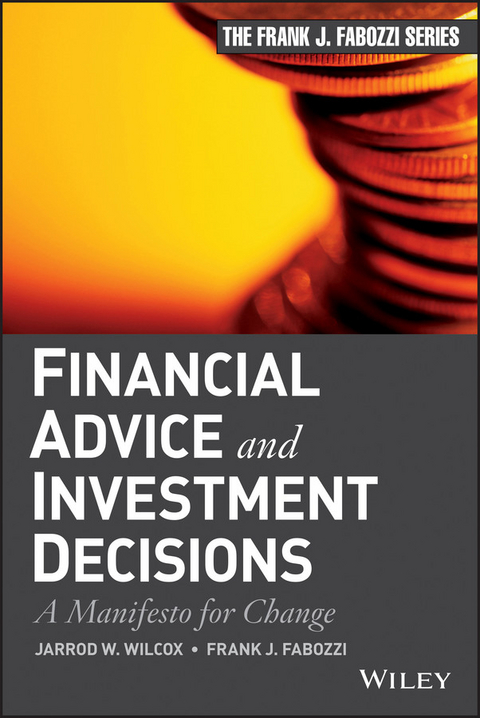
Financial Advice and Investment Decisions (eBook)
352 Seiten
Wiley (Verlag)
978-1-118-41532-0 (ISBN)
A practical guide to adapting financial advice and investing to a post crisis world
There's no room for 'business as usual' in today's investment management environment. Following the recent financial crisis, both retail and institutional investors are searching for new ways to oversee investment portfolios. How do you combine growth with a focus on wealth preservation? This book offers you a fresh perspective on the changes in tools and strategies needed to effectively achieve this goal.
Financial Advice and Investment Decisions provides today's investment professionals with the conceptual framework and practical tools they need to successfully invest in and manage an investment portfolio with wealth preservation as a key concern. While there are many qualitative discussions, the authors present strong quantitative theory and practice in the form of small conceptual models, simulation, and empirical research.
- A comprehensive guide to properly managing investments with a focus on matching security and growth goals with the needs of the investor
- Blends insights gleaned from portfolio management practices used prior to the market mayhem of 2007-2009 with cutting-edge academic and professional investment research
- Includes innovative and wide-ranging treatment of subjects such as augmented balance sheets, the efficiency of markets, saving, spending, and investing habits, and dealing with uncertainty
- Description of opportunities for improving the investing environment
The recent financial crisis has opened our eyes to the need for improving the way we invest. This book will put you in a better position to excel in this new economic environment.
A practical guide to adapting financial advice and investing to a post crisis world There's no room for "e;business as usual"e; in today's investment management environment. Following the recent financial crisis, both retail and institutional investors are searching for new ways to oversee investment portfolios. How do you combine growth with a focus on wealth preservation? This book offers you a fresh perspective on the changes in tools and strategies needed to effectively achieve this goal. Financial Advice and Investment Decisions provides today's investment professionals with the conceptual framework and practical tools they need to successfully invest in and manage an investment portfolio with wealth preservation as a key concern. While there are many qualitative discussions, the authors present strong quantitative theory and practice in the form of small conceptual models, simulation, and empirical research. A comprehensive guide to properly managing investments with a focus on matching security and growth goals with the needs of the investor Blends insights gleaned from portfolio management practices used prior to the market mayhem of 2007-2009 with cutting-edge academic and professional investment research Includes innovative and wide-ranging treatment of subjects such as augmented balance sheets, the efficiency of markets, saving, spending, and investing habits, and dealing with uncertainty Description of opportunities for improving the investing environment The recent financial crisis has opened our eyes to the need for improving the way we invest. This book will put you in a better position to excel in this new economic environment.
CHAPTER 2
The Evidence Is Compelling
We want you to be convinced of the need for improved financial advice. You need not take our word for it. This chapter supports our view with the research findings of others. We also take some potshots at famous theories that seem not to have gotten very far in helping most people save and invest.
FINANCIAL PLANNING
Aesop’s fable of the grasshopper and the ants reminds us that financial planning in some form has been around for more than two thousand years. More recent academic advice is strongly influenced by the work of Franco Modigliani in the 1950s. The “life-cycle hypothesis” for which, in part, he received the 1985 Nobel Prize in Economic Science, essentially states that individuals act to smooth the utility of their consumption over time. The life-cycle model does not in itself suggest specific assisting mechanisms in an imperfect world. To the extent that the model is operational, it reflects the common sense that we should save enough to support ourselves in our old age.
In contrast, substantial proportions of the United States population experience severe declines in economic well-being during retirement.1 In a test situation with an objective determination of time preference, Ameriks et al. (2004) found that even among a group of highly educated and relatively affluent subjects there were subpopulations with exaggerated preference for current rewards over future rewards, and that these subjects possessed less monetary wealth on average.
Thaler and Shefrin (1981) gave us a better understanding of under-savers by postulating spending and saving decisions as the outcome of the interaction of two sets of utilities operating within the individual: the “doer” who cares only about the next time period and the “planner” who cares about the longer term. Research by McClure et al. (2004) supports that view; impulses to satisfy current desires and to provide for future satisfaction appear to arise in different parts of the brain. The Thaler-Shefrin model suggests improved prescriptions for higher saving for undersavers, such as precommitment to save at a higher rate contingent on future bonuses and increases in incomes. Though promising, these prescriptions have been slow to gain practical implementation.
The life-cycle model deals with time smoothing expected financial resources rather than with growing opportunities in an uncertain world. What happens if you unexpectedly gain enough wealth to meet your previously planned future needs? Should you stop saving? Or should you provide more opportunity for your wealth to grow further so that you may raise your aspirations? Difficulty in dealing with such questions suggests the need for further thinking about the nature of good financial planning.
In the United States, as in many other developed economies, the failure of most people to personally save enough to provide for their old age is materially offset by government-mediated transfer payments. It is easy to see the benefits of social insurance as risk pooling. It is also easy to appreciate the need to provide some compensation for the increased income inequality that appears to have accompanied globalization and ever more complex technology. However, the unintended consequence of the U.S. transfer payment approach is the shifting of the problem of undersaving from the individual to government, with problematic results for society as a whole. The political process is made less functional through greater polarization; those with more financial resources understandably resist efforts to transfer them to those with less. At the same time, a lower savings rate means that needed investments in education, research, capital equipment, and environmental protection may be foregone.
YOUR MOST IMPORTANT INVESTMENT DECISION
How much should you invest in relatively safe cash and bonds and how much in riskier common stocks? How much to other types of investments such as real estate? The exposure to risky investments determines not only how much your savings will be worth on average in a few decades but also how big is the probability of doing very badly, especially if you need the funds to be available in the interim.
All too common is the advice to invest for the average return necessary to meet your future spending goals. This advice generally does not pay enough attention to the possibility of disappointing investment performance or to the possibility of adverse changes in your financial situation. Beyond that, it plays into the hands of those who exploit the common misperception that a riskier investment necessarily carries an expectation of higher returns, as early noted by Dusak (1973) in her study of investing in commodity futures.
Investor questionnaires to determine suitability of investments for the particular investor may be less helpful than they appear. For example, Grable and Lytton (1999) developed questionnaire items that appear somewhat reliable as predictive descriptions of risk-taking behavior. So we know, for example, that the typical male is more risk prone than the typical female. But this fact does not seem to be strongly connected to future financial needs, but instead connected with comfort and personality. That is, it may be good description, but it is not good normative advice. A more elaborate method asks the investor to respond to a simulation of long-term results under different allocations of wealth between stocks and bonds. Again, however, the investor is likely to have a poor idea of how he or she will feel in the future as the consequences are played out.
The most frequently taught approach to quantitative investing, based on the mean-variance optimization method formulated by Harry Markowitz (1959), tells you quite a lot about good diversification given investment characteristics. However, it tells you nothing about how much to invest in stocks versus cash and bonds unless you happen to know your best risk tolerance to achieve your objectives. That is, it begins by assuming you know what you probably don’t know.
In a revealing experiment with university employees asked to allocate retirement funds, Benartzi and Thaler (2007) found that the stock–bond split was very strongly influenced by whether the participants were presented with more bond fund alternatives or more stock fund alternatives. Description of behavior, again, can be a very poor guide to good advice.
Are you persuaded yet of the need for better guidance for risk taking? It gets worse as we move from individuals to institutions, where risk taking is further stimulated by asymmetric rewards. That is, the mortgage broker, the hedge fund manager, the trader, and the corporate executive all take larger risks with someone else’s money because if they win they get rewards much bigger than their loss if they lose. Existing measures supposed to prevent excessive risk, such as the Value-at-Risk (VaR) model enshrined in international banking convention, may instead have promoted it by displacing better measures. It could even be argued that VaR is used more as an excuse for risk taking than as a limitation on it. Some financial executives apparently think it to be a measure of the most you could lose rather than as a measure of the least you could lose with a given probability.
In the absence of strong conceptual frameworks, widely shared, that could be more effectively employed as a check on financial risk taking, the ultimate check against too much risk is the bursting of financial bubbles. The global financial crisis beginning in 2007 and still continuing in 2012 appears rooted in excessive risk taking. The result is not a lack of saving, but rather negative saving in the form of too much borrowing. Reinhart and Rogoff (2009) give us a compelling account of how this most recent example fits into the context of centuries of similar bubbles and their collapses.
If the primary safeguard against excessive risk taking were to continue to be the memory of past traumatic crises, then as memories fade, we would be doomed to repeat the bubble cycles described by Hyman Minsky (1986) again, and yet again.
Diversification, the Only Free Lunch in Investing
Although the popularity of mutual funds and exchange-traded funds (ETF’s) has improved the situation, investors as a whole appear to be substantially under-diversified. Studies by Goetzmann and Kumar (2001, 2007) have found that the average investor in individual common stocks holds only about four different stocks, and that efforts to diversify are typically based more on the number of stocks than on any attempt to look for stocks that have less correlated returns with other stocks. Their research indicated that under-diversification is positively related to the following attributes: youth, lower income, less education, overconfidence, trend following, local bias, and risk tolerance as indicated for preferences for volatility and skewness. A study by Dorn and Haberman (2005) of German discount broker customers found similar factors associated with under-diversification, including self-reported risk tolerance, less experience, less knowledge about financial securities, youth, and being male.
There is some evidence that in the case of bias toward geographically local stocks, and also for a subset of more wealthy, experienced and knowledgeable investors, lack of diversification is associated with higher returns, possibly reflecting better information or investment skill.2 However, for the bulk of investors, under-diversification is associated with lower returns.
Perhaps the most surprising under-diversification occurs in context of failing to diversify one’s employment or...
| Erscheint lt. Verlag | 20.11.2013 |
|---|---|
| Sprache | englisch |
| Themenwelt | Recht / Steuern ► Wirtschaftsrecht |
| Wirtschaft ► Betriebswirtschaft / Management ► Finanzierung | |
| ISBN-10 | 1-118-41532-9 / 1118415329 |
| ISBN-13 | 978-1-118-41532-0 / 9781118415320 |
| Informationen gemäß Produktsicherheitsverordnung (GPSR) | |
| Haben Sie eine Frage zum Produkt? |
 EPUB (Adobe DRM)
Kopierschutz: Adobe-DRM
Adobe-DRM ist ein Kopierschutz, der das eBook vor Mißbrauch schützen soll. Dabei wird das eBook bereits beim Download auf Ihre persönliche Adobe-ID autorisiert. Lesen können Sie das eBook dann nur auf den Geräten, welche ebenfalls auf Ihre Adobe-ID registriert sind.
Details zum Adobe-DRM
Dateiformat: EPUB (Electronic Publication)
EPUB ist ein offener Standard für eBooks und eignet sich besonders zur Darstellung von Belletristik und Sachbüchern. Der Fließtext wird dynamisch an die Display- und Schriftgröße angepasst. Auch für mobile Lesegeräte ist EPUB daher gut geeignet.
Systemvoraussetzungen:
PC/Mac: Mit einem PC oder Mac können Sie dieses eBook lesen. Sie benötigen eine
eReader: Dieses eBook kann mit (fast) allen eBook-Readern gelesen werden. Mit dem amazon-Kindle ist es aber nicht kompatibel.
Smartphone/Tablet: Egal ob Apple oder Android, dieses eBook können Sie lesen. Sie benötigen eine
Geräteliste und zusätzliche Hinweise
Buying eBooks from abroad
For tax law reasons we can sell eBooks just within Germany and Switzerland. Regrettably we cannot fulfill eBook-orders from other countries.
aus dem Bereich