Twitter (eBook)
John Wiley & Sons (Verlag)
978-0-7456-6510-8 (ISBN)
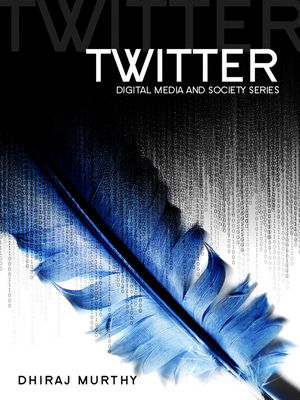
Twitter has become a household name, discussed both for its role in prominent national elections, natural disasters, and political movements, as well as for what some malign as narcissistic 'chatter.' This book takes a critical step back from popular discourse and media coverage of Twitter, to present the first balanced, scholarly engagement of this popular medium.
In this timely and comprehensive introduction, Murthy not only discusses Twitter's role in our political, economic, and social lives, but also draws a historical line between the telegraph and Twitter to reflect on changes in social communication over time. The book thoughtfully examines Twitter as an emergent global communications medium and provides a theoretical framework for students, scholars, and tweeters to reflect critically on the impact of Twitter and the contemporary media environment. The book uses case studies including citizen journalism, health, and national disasters to provide empirically rich insights and to help decipher some of the ways in which Twitter and social media more broadly may be shaping contemporary life.
Dhiraj Murthy is Assistant Professor of Sociology at Bowdoin College.
Twitter has become a household name, discussed both for its role in prominent national elections, natural disasters, and political movements, as well as for what some malign as narcissistic chatter. This book takes a critical step back from popular discourse and media coverage of Twitter, to present the first balanced, scholarly engagement of this popular medium. In this timely and comprehensive introduction, Murthy not only discusses Twitter s role in our political, economic, and social lives, but also draws a historical line between the telegraph and Twitter to reflect on changes in social communication over time. The book thoughtfully examines Twitter as an emergent global communications medium and provides a theoretical framework for students, scholars, and tweeters to reflect critically on the impact of Twitter and the contemporary media environment. The book uses case studies including citizen journalism, health, and national disasters to provide empirically rich insights and to help decipher some of the ways in which Twitter and social media more broadly may be shaping contemporary life.
Dhiraj Murthy is Assistant Professor of Sociology at Bowdoin College.
Figures and Tables viii
Preface and Acknowledgments ix
1 What is Twitter? 1
2 Contextualizing Twitter 14
3 Theorizing Twitter 24
4 Twitter and Journalism 51
5 Twitter and Disasters 70
6 Twitter and Activism 92
7 Twitter and Health 115
8 Conclusion 144
Notes 154
Glossary 159
References 162
Index 184
Winner of the Choice award for Outstanding Academic Title
"The 200,000 million tweets sent each day have been deserving of serious scholarly attention. Murthy addresses this gap in a pioneering book."
The Global Journal
"A tantalizing, insightful and balanced account of the existing scholarship about the question how Twitter changes our communication practices."
Koen van Turnhout Macro Blog
"For those seeking an introductory approach and who are interested in empirical findings on the four main topics addressed by Murthy, the book offers a start in what will surely become a growing area of investigation for those interested in the sociology of social media."
Information, Communication and Society
"Dhiraj Murthy's Twitter is an excellent overview of the endless spirals of meaning and insignificance that characterize the micro-blogging phenomenon."
Hal Niedzviecki, author of The Peep Diaries: How We're Learning to Love Watching Ourselves and Our Neighbours
"Dhiraj Murthy's Twitter is a rich and informed consideration of one of the most commonly used sites in the US today. Drawing from multiple perspectives and incorporating literature from sociology, communication, political science, and media studies, Murthy's book includes chapters on the role Twitter plays in reshaping journalism, activism practices, disaster coordination, and the sharing of social support and medical information. Notably, the book pays special attention to historical context, drawing out connections between Twitter and earlier technologies, and using these comparisons to illustrate what is new and what is not so new about this fascinating communication platform. Murthy engages with sophisticated analytical frameworks but does so using accessible language and concrete examples, which will make this volume especially useful in the classroom."
Nicole Ellison, Michigan State University
Preface and Acknowledgments
“What Hath God Wrought” – Samuel Morse’s first message, on May 24, 1844, on the newly completed telegraph wire linking Baltimore and Washington – was a mere 21 characters long. Alexander Graham Bell’s first message on the telephone to his lab assistant on March 10, 1876, “Mr. Watson – come here – I want to see you,” was more liberal: 42 characters long. And 95 years later, Ray Tomlinson sent the first email, with the message “QWERTYUIOP,” from one computer in Cambridge, Massachusetts, to another computer sitting beside it. Tomlinson’s message: a spartan 10 characters.
In the past, technology determined the length and duration of the message. In the Internet age of today, our ability to communicate is seemingly limitless. But the computer has ushered in a new era of brevity. Twitter is a digital throwback to the analog succinctness of telegrams. Yet what is the significance of this electronically diminished turn to terseness? Does it signal the dumbing down of society, the victory of short attention spans, or the rise of new virtual “me” cultures? Are we saying more with less, or just saying less? Or perhaps we are saying more about less. This position is well illustrated by “status updates,” short one- or two-line messages on the popular social networking website Facebook. Though these short messages are often trivially banal (e.g., “mustard dripping out of my bagel sandwich”), they are elevated to “news,” which Facebook automatically distributes to your group of “friends,” selected individuals who have access to your Facebook “profile,” that is, your personalized web page on the site. Once the update percolates to your friends, they have the opportunity to comment on your update, generating a rash of discussion about dripping mustard, and so on.
This form of curt social exchange has become the norm with messages on Twitter, the popular social media website where individuals respond to the question “What’s happening?” with a maximum of 140 characters. These messages, known as “tweets,” can be sent through the Internet, mobile devices such as Internet-enabled phones and iPads, and text messages. But, unlike status updates, their strict limit of 140 characters produces at best eloquently terse responses and at worst heavily truncated speech. Tweets such as “gonna see flm tonite!” or “jimmy wil be fired 18r 2day” are reflective of the latter. The first tweet on the site, “just setting up my twttr” (24 characters), by Jack Dorsey, the creator of Twitter, on March 21, 2006, perhaps led by example. This book emphasizes that Dorsey’s message, like that of Morse, was brief and, like that of Bell, was unremarkable – setting up one’s Twitter and asking the recipient to return.
By drawing this line between the telegraph and telephone to Twitter, this book makes its central argument – that the rise of these messages does not signal the death of meaningful communication. Rather, Twitter has the potential to increase our awareness of others and to augment our spheres of knowledge, tapping us into a global network of individuals who are passionately giving us instant updates on topics and areas in which they are knowledgeable or participating in real-time. In doing so, however, the depth of our engagements with this global network of people and ideas can also, sometimes, become more superficial. Many of us would be worried if Twitter replaced “traditional” media or the longer-length media of blogs, message boards, and email lists. The likelihood of this is, of course, minimal and this book concludes with the suggestion that there is something profoundly remarkable in us being able to follow minute-by-minute commentary in the aftermath of an earthquake, or even the break-up of a celebrity couple. This book is distinctive in not only having Twitter as its main subject, but also its approach of theorizing the site as a collection of communities of knowledge, ad hoc groups where individual voices are aggregated into flows of dialog and information (whether it be Michael Jackson’s death or the release of the Lockerbie bomber). Ultimately, Twitter affords a unique opportunity to re-evaluate how communication and culture can be individualistic and communal simultaneously.
I also describe how these changes in communication are not restricted exclusively to the West, as any mobile phone, even the most basic model, is compatible with Twitter. Tweets can be quickly and easily sent, a fact that has led to the exponential growth of its base to over 140 million users worldwide (Wasserman 2012). This has been useful in communicating information about disasters (e.g., the 2011 Tōhoku earthquake in Japan) and social movements (e.g., the 2011 “Arab Spring” movements). At an individual level, tweets have reported everything from someone’s cancer diagnosis to unlawful arrests. For example, in April 2008, James Karl Buck, a graduate student at the University of California, Berkeley, was arrested photographing an anti-government labor protest in Mahalla, Egypt. He quickly sent a one-word tweet from his phone, “arrested,” which caught the attention of Buck’s Twitter “followers,” those who subscribe to his tweets. His one-word tweet led to Berkeley hiring a lawyer and Buck’s eventual release. There are, of course, many distinctions to be made between the tweets sent by Buck, or those sent during the Mumbai bomb blasts, and the more unremarkable, everyday tweets. Contrast the tweet Prasad Naik sent moments after the Mumbai bomb blasts, “Firing happening at the Oberoi hotel where my sister works. Faaak!” with Jack Dorsey’s third tweet, “wishing I had another sammich.” Though an intentionally striking and loaded comparison, it is just this absurdity that happens daily, hourly, and by the minute on Twitter. This combination of banal/profound, combined with the one-to-many – explicitly – public broadcasting of tweets, differentiates Twitter from Facebook and text messages.
Rather than selectively condemning Twitter as dumbed down or, on the other hand, praising its profundity, the book poses important questions to explore the possibilities and pitfalls of this new communications medium. Although I examine the practice of social media through specific Twitter-mediated events, this book’s emphasis is both explanatory and theoretical. Specifically, my prime aim is to better understand the meanings behind Twitter and similar social media through concise yet sophisticated interpretations of theories of media and communication, drawing upon a diverse array of scholars, from Marshall McLuhan to Erving Goffman and Gilles Deleuze to Martin Heidegger. Though this network of thinkers and scholars crosses several disciplines, their work sheds light on a problem of communication faced since the dawn of the modern age: unraveling the connections, to paraphrase McLuhan, between the medium and the message.
The chapters present analyses of the shifts in which we communicate by exploring the role of Twitter in discourses of new media forms, communication, social formations, and digitally mediated communities. Early chapters introduce Twitter, historically contextualize it, and present theoretical frames to analyze the medium. Comparisons between historical media forms are made to highlight the fact that new media forms are not all that “new” in many of the ways in which they organize our social lives. For example, when the telephone began to get a critical mass in U.S. households, there were similar feelings of anxiety that the “public” would erode the “private,” as anyone could call your house as you were having an intimate family dinner or in deep conversation with a visiting friend. The middle chapters include specific discussions of Twitter and its relationship to journalism, disasters, social activism, and health. The book then brings together theory and practice to make conclusions on the medium itself and its role in social communication within an “update culture,” a culture in which society has placed importance on updating friends, family, peers, colleagues, and the general public. The question of whether this pattern signifies “me-centric” rather than “society-centric” cultures is explored in the conclusion. Between chapters, I single out an individual tweet to frame the forthcoming chapter.
My work on this book has been shaped by generous input and encouragement from family, friends, colleagues, and scholars. I am very grateful for their involvement in the development of this book. Students in my “In the Facebook Age” and “Critical Theory and New Media” classes have been taught material from early versions of chapters, and offered engaging and highly useful feedback. I am also indebted to my students for providing me with a treasure trove of examples of interesting Twitter users and tweets. Thank you to my undergraduate research fellow, Macgill Eldredge, who imported the data sources in chapter 7 into a standardized format and produced the spike data histogram. The reference librarians at the British Library patiently helped me navigate archives regarding the telegraph, material which fundamentally shaped the historical context of the book. I have greatly benefited from input from my colleagues at Bowdoin College. I would like to...
| Erscheint lt. Verlag | 4.9.2013 |
|---|---|
| Reihe/Serie | Digital Media and Society | DMS - Digital Media and Society |
| Sprache | englisch |
| Themenwelt | Mathematik / Informatik ► Informatik ► Web / Internet |
| Naturwissenschaften | |
| Recht / Steuern ► Privatrecht / Bürgerliches Recht ► IT-Recht | |
| Sozialwissenschaften ► Kommunikation / Medien ► Allgemeines / Lexika | |
| Sozialwissenschaften ► Kommunikation / Medien ► Kommunikationswissenschaft | |
| Sozialwissenschaften ► Kommunikation / Medien ► Medienwissenschaft | |
| Sozialwissenschaften ► Politik / Verwaltung | |
| Technik ► Elektrotechnik / Energietechnik | |
| Schlagworte | Communication & Media Studies • Cultural Studies • Digital Culture & the Information Age • Digitale Kultur im Informationszeitalter • Internet, digital media, social media, celebrity • Kommunikation u. Medienforschung • Kulturwissenschaften • Medienforschung • Mediensoziologie • Social Media • Sociology • Sociology of the Media • Soziologie • Twitter |
| ISBN-10 | 0-7456-6510-1 / 0745665101 |
| ISBN-13 | 978-0-7456-6510-8 / 9780745665108 |
| Informationen gemäß Produktsicherheitsverordnung (GPSR) | |
| Haben Sie eine Frage zum Produkt? |
 EPUB (Adobe DRM)
Kopierschutz: Adobe-DRM
Adobe-DRM ist ein Kopierschutz, der das eBook vor Mißbrauch schützen soll. Dabei wird das eBook bereits beim Download auf Ihre persönliche Adobe-ID autorisiert. Lesen können Sie das eBook dann nur auf den Geräten, welche ebenfalls auf Ihre Adobe-ID registriert sind.
Details zum Adobe-DRM
Dateiformat: EPUB (Electronic Publication)
EPUB ist ein offener Standard für eBooks und eignet sich besonders zur Darstellung von Belletristik und Sachbüchern. Der Fließtext wird dynamisch an die Display- und Schriftgröße angepasst. Auch für mobile Lesegeräte ist EPUB daher gut geeignet.
Systemvoraussetzungen:
PC/Mac: Mit einem PC oder Mac können Sie dieses eBook lesen. Sie benötigen eine
eReader: Dieses eBook kann mit (fast) allen eBook-Readern gelesen werden. Mit dem amazon-Kindle ist es aber nicht kompatibel.
Smartphone/Tablet: Egal ob Apple oder Android, dieses eBook können Sie lesen. Sie benötigen eine
Geräteliste und zusätzliche Hinweise
Buying eBooks from abroad
For tax law reasons we can sell eBooks just within Germany and Switzerland. Regrettably we cannot fulfill eBook-orders from other countries.
aus dem Bereich