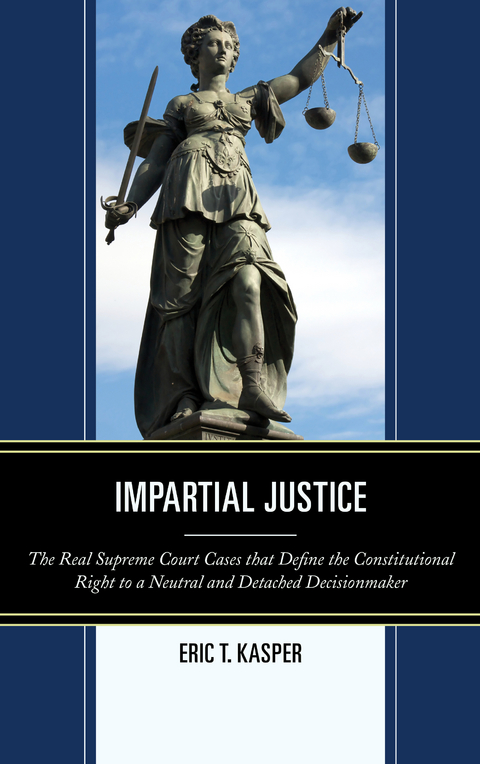
Impartial Justice (eBook)
232 Seiten
Lexington Books (Verlag)
978-0-7391-7722-8 (ISBN)

This book examines the right to a neutral and detached decisionmaker as interpreted by the U.S. Supreme Court. This right resides in the Constitution's Fifth Amendment and Fourteenth Amendment guarantees to procedural due process and in the Sixth Amendment's promise of an impartial jury. Supreme Court cases on these topics are the vehicles to understand how these constitutional rights have come alive. First, the book surveys the right to an impartial jury in criminal cases by telling the stories of defendants whose convictions were overturned after they were the victims of prejudicial pretrial publicity, mob justice, and discriminatory jury selection. Next, the book articulates how our modern notion of judicial impartiality was forged by the Court striking down cases where judges were bribed, where they had other direct financial stakes in the outcome of the case, and where a judge decided the case of a major campaign supporter. Finally, the book traces the development of the right to a neutral decisionmaker in quasi-judicial, non-court settings, including cases involving parole revocation, medical license review, mental health commitments, prison discipline, and enemy combatants. Each chapter begins with the typically shocking facts of these cases being retold, and each chapter ends with a critical examination of the Supreme Court's ultimate decisions in these cases.
Eric T. Kasper is an associate professor of political science for the University of Wisconsin Colleges and serves as the municipal judge in Rice Lake, Wisconsin, where he lives with his wife Julie and their two children, Madison and Jackson. This is his third book, having previously written Don’t Stop Thinking About the Music: The Politics of Songs and Musicians in Presidential Campaigns (with Benjamin Schoening) and To Secure the Liberty of the People: James Madison’s Bill of Rights and the Supreme Court’s Interpretation.
AcknowledgementsPrefaceIntroduction: A Short History of What It Means to Be a Neutral, Impartial, and Unbiased Decisionmaker Part One: An Impartial Jury Trial in Criminal Cases1. Prejudicial Pretrial Publicity: Sheppard v. Maxwell (1966)2. Avoiding Mob Justice: Frank v. Mangum (1915) and Moore v. Dempsey (1923)3. Racial Discrimination in Jury Selection: Batson v. Kentucky (1986) and Miller-El v. Dretke (2005)4. Sex Discrimination in Jury Selection: Hoyt v. Florida (1961) and Taylor v. Louisiana (1975)5. Death-Qualified Juries: Witherspoon v. Illinois (1968) and Lockhart v. McCree (1986)Part Two: Due Process and the Right to an Impartial Judge6. Mayor-Judges with a Financial Stake in the Outcome: Tumey v. Ohio (1927) and Ward v. Village of Monroeville (1972)7. A Judge Hearing a Contempt Proceeding after Being Vilified by the Defendant: Mayberry v. Pennsylvania (1971)8. Non-Lawyer Judges: North v. Russell (1976)9. The Judge Who Was Bribed in Other Cases: Bracy v. Gramley (1997)10. A Judge Deciding a Case Involving a Major Campaign Supporter: Caperton v. A.T. Massey Coal Co. (2009)Part Three: Due Process and the Right to an ImpartialDecisionmaker in Quasi-Judicial, Non-Court Settings 11. Parole Revocation: Morrissey v. Brewer (1972)12. Medical License Review: Withrow v. Larkin (1975)13. Mental Health Commitments for Juveniles: Parham v. J.R. (1979)14. Prison Discipline: Edwards v. Balisok (1997)15. Enemy Combatant Cases: Hamdi v. Rumsfeld (2004)ConclusionsCatalog of CasesBibliographyIndex
| Erscheint lt. Verlag | 22.3.2013 |
|---|---|
| Sprache | englisch |
| Themenwelt | Recht / Steuern ► Allgemeines / Lexika |
| Recht / Steuern ► EU / Internationales Recht | |
| Recht / Steuern ► Öffentliches Recht | |
| Recht / Steuern ► Strafrecht ► Strafverfahrensrecht | |
| Sozialwissenschaften ► Politik / Verwaltung ► Politische Systeme | |
| Sozialwissenschaften ► Politik / Verwaltung ► Staat / Verwaltung | |
| Schlagworte | Constitution • Due Process • Fourteenth Amendment • Impartial Jury • Supreme Court |
| ISBN-10 | 0-7391-7722-2 / 0739177222 |
| ISBN-13 | 978-0-7391-7722-8 / 9780739177228 |
| Informationen gemäß Produktsicherheitsverordnung (GPSR) | |
| Haben Sie eine Frage zum Produkt? |
 EPUB (Adobe DRM)
Kopierschutz: Adobe-DRM
Adobe-DRM ist ein Kopierschutz, der das eBook vor Mißbrauch schützen soll. Dabei wird das eBook bereits beim Download auf Ihre persönliche Adobe-ID autorisiert. Lesen können Sie das eBook dann nur auf den Geräten, welche ebenfalls auf Ihre Adobe-ID registriert sind.
Details zum Adobe-DRM
Dateiformat: EPUB (Electronic Publication)
EPUB ist ein offener Standard für eBooks und eignet sich besonders zur Darstellung von Belletristik und Sachbüchern. Der Fließtext wird dynamisch an die Display- und Schriftgröße angepasst. Auch für mobile Lesegeräte ist EPUB daher gut geeignet.
Systemvoraussetzungen:
PC/Mac: Mit einem PC oder Mac können Sie dieses eBook lesen. Sie benötigen eine
eReader: Dieses eBook kann mit (fast) allen eBook-Readern gelesen werden. Mit dem amazon-Kindle ist es aber nicht kompatibel.
Smartphone/Tablet: Egal ob Apple oder Android, dieses eBook können Sie lesen. Sie benötigen eine
Geräteliste und zusätzliche Hinweise
Buying eBooks from abroad
For tax law reasons we can sell eBooks just within Germany and Switzerland. Regrettably we cannot fulfill eBook-orders from other countries.
aus dem Bereich