


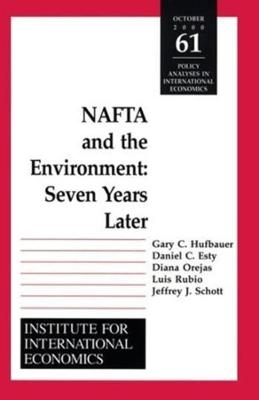
NAFTA and the Environnment – Seven Years Later
Seiten
2000
The Peterson Institute for International Economics (Verlag)
978-0-88132-299-6 (ISBN)
The Peterson Institute for International Economics (Verlag)
978-0-88132-299-6 (ISBN)
The North American Free Trade Agreement (NAFTA) was a proposal to advance regional integration of the United States, Canada and Mexico. This analysis reviews: the environmental provisions of the NAFTA; the NAAEC; the situation at the US-Mexican border; and the trends in US environmental policy.
Air and water pollution blighted northern Mexican cities long before the North American Free Trade Agreement (NAFTA) was a glimmer on the political horizon. Not surprisingly, when NAFTA became a political reality, environmentalists argued that commercial competition would weaken environmental standards in Canada and the United States and industrial growth in Mexico would further damage its weak environmental infrastructure. NAFTA's huge success in expanding free trade has concentrated population and environmental abuse at the US-Mexico border where it is most visible to Americans. Many environmental groups blame NAFTA and, drawing on its experience, now oppose new trade initiatives.Does the NAFTA record on the environment since 1994 justify its criticism? In this seven-year analysis, the authors review NAFTA's environmental provisions, including a side accord-the North American Agreement on Environmental Cooperation (NAAEC), the situation at the US-Mexican border, and the trends in North American environmental policy. They emphasize that the environmental problems of North America were not the result of NAFTA and the NAAEC was not devised to address all of them.
The authors recommend ways to better NAFTA's environmental dimension in all three countries, and improve living conditions where economic growth is greatest-at the US-Mexican border. It makes more sense to tackle the shortcomings than to lament NAFTA and the economic growth it promotes.
Air and water pollution blighted northern Mexican cities long before the North American Free Trade Agreement (NAFTA) was a glimmer on the political horizon. Not surprisingly, when NAFTA became a political reality, environmentalists argued that commercial competition would weaken environmental standards in Canada and the United States and industrial growth in Mexico would further damage its weak environmental infrastructure. NAFTA's huge success in expanding free trade has concentrated population and environmental abuse at the US-Mexico border where it is most visible to Americans. Many environmental groups blame NAFTA and, drawing on its experience, now oppose new trade initiatives.Does the NAFTA record on the environment since 1994 justify its criticism? In this seven-year analysis, the authors review NAFTA's environmental provisions, including a side accord-the North American Agreement on Environmental Cooperation (NAAEC), the situation at the US-Mexican border, and the trends in North American environmental policy. They emphasize that the environmental problems of North America were not the result of NAFTA and the NAAEC was not devised to address all of them.
The authors recommend ways to better NAFTA's environmental dimension in all three countries, and improve living conditions where economic growth is greatest-at the US-Mexican border. It makes more sense to tackle the shortcomings than to lament NAFTA and the economic growth it promotes.
Gary Clyde Hufbauer, Reginald Jones Senior Fellow since 1992, was formerly the Maurice Greenberg Chair and Director of Studies at the Council on Foreign Relations (1996-98), the Marcus Wallenberg Professor of International Finance Diplomacy at Georgetown University (1985-92), senior fellow at the Institute (1981-85), deputy director of the International Law Institute at Georgetown University (1979-81); deputy assistant secretary for international trade and investment policy of the US Treasury (1977-79); and director of the international tax staff at the Treasury (1974-76).
The NAFTA's Environmental Provisions; The North American Agreeement on Envionmental Co-operation; The US-Mexico Border; Environmental Policy Trends in North America.
| Erscheint lt. Verlag | 1.10.2000 |
|---|---|
| Zusatzinfo | tables, references, index |
| Verlagsort | Washington |
| Sprache | englisch |
| Maße | 159 x 231 mm |
| Gewicht | 356 g |
| Themenwelt | Recht / Steuern ► EU / Internationales Recht |
| Sozialwissenschaften ► Politik / Verwaltung ► Europäische / Internationale Politik | |
| Wirtschaft ► Volkswirtschaftslehre ► Finanzwissenschaft | |
| Wirtschaft ► Volkswirtschaftslehre ► Makroökonomie | |
| ISBN-10 | 0-88132-299-7 / 0881322997 |
| ISBN-13 | 978-0-88132-299-6 / 9780881322996 |
| Zustand | Neuware |
| Informationen gemäß Produktsicherheitsverordnung (GPSR) | |
| Haben Sie eine Frage zum Produkt? |
Mehr entdecken
aus dem Bereich



aus dem Bereich
kurze Geschichte einer langen Beziehung
Buch | Hardcover (2025)
Suhrkamp (Verlag)
CHF 36,40
Amerikas Strategie der Vorherrschaft und der Kampf um Eurasien
Buch | Softcover (2024)
NOMEN Verlag
CHF 27,95
erfolgreiche Interessenvertretung durch Prozesskompetenz im komplexen …
Buch | Hardcover (2023)
Wiley-VCH (Verlag)
CHF 58,75


