


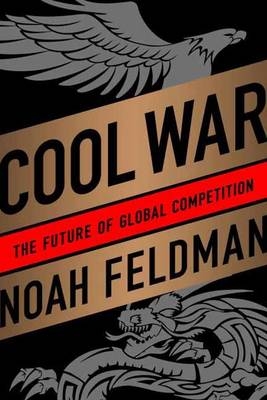
Cool War (eBook)
224 Seiten
Random House Publishing Group (Verlag)
978-0-679-64383-8 (ISBN)
A bold and thought-provoking look at the future of U.S.-China relations, and how their coming power struggle will reshape the competitive playing field for nations around the world
The Cold War seemingly ended in a decisive victory for the West. But now, Noah Feldman argues, we are entering an era of renewed global struggle: the era of Cool War. Just as the Cold War matched the planet's reigning superpowers in a contest for geopolitical supremacy, so this new age will pit the United States against a rising China in a contest for dominance, alliances, and resources. Already visible in Asia, the conflict will extend to the Middle East (U.S.-backed Israel versus Chinese-backed Iran), Africa, and beyond.
Yet this Cool War differs fundamentally from the zero-sum showdowns of the past: The world's major power and its leading challenger are economically interdependent to an unprecedented degree. Exports to the U.S. account for nearly a quarter of Chinese trade, while the Chinese government holds 8 percent of America's outstanding debt. This positive-sum interdependence has profound implications for nations, corporations, and international institutions. It makes what looked to be a classic contest between two great powers into something much more complex, contradictory, and badly in need of the shrewd and carefully reasoned analysis that Feldman provides.
To understand the looming competition with China, we must understand the incentives that drive Chinese policy. Feldman offers an arresting take on that country's secretive hierarchy, proposing that the hereditary 'princelings' who reap the benefits of the complicated Chinese political system are actually in partnership with the meritocrats who keep the system full of fresh talent and the reformers who are trying to root out corruption and foster government accountability. He provides a clear-eyed analysis of the years ahead, showing how China's rise presents opportunities as well as risks. Robust competition could make the U.S. leaner, smarter, and more pragmatic, and could drive China to greater respect for human rights. Alternatively, disputes over trade, territory, or human rights could jeopardize the global economic equilibrium--or provoke a catastrophic 'hot war' that neither country wants.
The U.S. and China may be divided by political culture and belief, but they are also bound together by mutual self-interest. Cool War makes the case for competitive cooperation as the only way forward that can preserve the peace and make winners out of both sides.
A bold and thought-provoking look at the future of U.S.-China relations, and how their coming power struggle will reshape the competitive playing field for nations around the world The Cold War seemingly ended in a decisive victory for the West. But now, Noah Feldman argues, we are entering an era of renewed global struggle: the era of Cool War. Just as the Cold War matched the planet’s reigning superpowers in a contest for geopolitical supremacy, so this new age will pit the United States against a rising China in a contest for dominance, alliances, and resources. Already visible in Asia, the conflict will extend to the Middle East (U.S.-backed Israel versus Chinese-backed Iran), Africa, and beyond. Yet this Cool War differs fundamentally from the zero-sum showdowns of the past: The world’s major power and its leading challenger are economically interdependent to an unprecedented degree. Exports to the U.S. account for nearly a quarter of Chinese trade, while the Chinese government holds 8 percent of America’s outstanding debt. This positive-sum interdependence has profound implications for nations, corporations, and international institutions. It makes what looked to be a classic contest between two great powers into something much more complex, contradictory, and badly in need of the shrewd and carefully reasoned analysis that Feldman provides. To understand the looming competition with China, we must understand the incentives that drive Chinese policy. Feldman offers an arresting take on that country’s secretive hierarchy, proposing that the hereditary “princelings” who reap the benefits of the complicated Chinese political system are actually in partnership with the meritocrats who keep the system full of fresh talent and the reformers who are trying to root out corruption and foster government accountability. He provides a clear-eyed analysis of the years ahead, showing how China’s rise presents opportunities as well as risks. Robust competition could make the U.S. leaner, smarter, and more pragmatic, and could drive China to greater respect for human rights. Alternatively, disputes over trade, territory, or human rights could jeopardize the global economic equilibrium—or provoke a catastrophic “hot war” that neither country wants. The U.S. and China may be divided by political culture and belief, but they are also bound together by mutual self-interest. Cool War makes the case for competitive cooperation as the only way forward that can preserve the peace and make winners out of both sides.Praise for Cool War “A timely book . . . sharp, logical and cool.”—The Economist “Noah Feldman’s dissection of the United States–China relationship is smart, balanced, and wise.”—Robert D. Kaplan, New York Times bestselling author of The Revenge of Geography “Compelling . . . Feldman’s book carries enough insight to warrant serious attention from anyone interested in what may well be the defining relationship in global affairs for decades to come.”—Kirkus Reviews “A worthwhile and intriguing read.”—The Washington Post “Masterfully elucidates China’s non-democratic/non-communist new form of government.”—Publishers Weekly
Bound Together
Who won the Cold War?
For twenty years now--almost half the length of the war itself--the Western democracies have assumed that they did. For the first decade after the collapse of the Soviet Union, the United States and Europe grew vastly in the absence of their greatest strategic challenger. The United States generated the information revolution. Europe increased mutual cooperation, united its currency, and incorporated the choicest bits of the former Soviet empire into the European Union. There was good historical precedent for both growth and unity: after the defeat of Napoleon at Waterloo, Britain, the main winner, initiated the industrial revolution, and the Concert of Europe represented the efforts of the European states to cooperate and manage their security affairs.1
But in the second decade after the Cold War, two surprising things happened. First, the United States, with European participation, invaded Afghanistan and Iraq and then spent trillions of dollars, enormous diplomatic capital, and thousands of its soldiers' lives in the effort to build functioning states in each. The results were a very partial success in one case and something very much like failure in the other. The economic downturn that began toward the end of the decade was not caused by these misadventures, but taken together they signaled the possibility of imperial decline.2
At the same time, China, which had been a secondary player in the Cold War, deepened the experiment it had already begun with state-managed market reform. The result was sustained economic growth of stunning proportions. China became the world's second-largest economy, outstripping Japan and all individual members of the European Union. The pace of its growth has declined from the consistent 10 percent or more of the post--Cold War era to something more like 7.5 percent in 2012, and further slowing remains possible.3 Yet China weathered the global financial crisis much better than the United States and Europe. Serious observers believe that the Chinese economy could become the biggest in the world in a decade--or even sooner.4
Suddenly, the assumption of Western, democratic victory in the Cold War has had to be reexamined. On the level of ideas, capitalism indeed won a significant victory. The communist ideal of a totally nonmarket economy no longer has many adherents outside North Korea and perhaps Cuba. The Communist Party of China has formally welcomed capitalists--defined to include owners of private businesses--into party membership. The Chinese state still owns huge enterprises and guides the economy by controlling banks and by regulating some industries, but the basic theory on which it acts is market capitalism, not communism or even socialism.5
Democracy, however, has not won in the way its promoters had hoped.6 China's ruling elite rejects both elections and individual rights, and it has been able to achieve fast growth and de facto legitimacy without either. After a largely unsuccessful experiment with democracy, Russia has reverted to the rule of a strongman. Much of its public seems to accept, even embrace, this result, notwithstanding some protest. The U.S. experiments with democratic nation building in Afghanistan and Iraq went poorly, not because of any inherent problem with Islam but because of the extreme difficulty of establishing democracy without a strong, functioning state to keep order. Mass demonstrations demanding the end of autocracy deposed dictators in Tunisia and Egypt, yet the Arab Spring has struggled.
Meanwhile, the position of the United States looks much weaker than it should if the Cold War was a definitive victory. The Pax...
| Erscheint lt. Verlag | 21.5.2013 |
|---|---|
| Sprache | englisch |
| Themenwelt | Recht / Steuern ► Allgemeines / Lexika |
| Sozialwissenschaften ► Politik / Verwaltung ► Europäische / Internationale Politik | |
| Sozialwissenschaften ► Politik / Verwaltung ► Staat / Verwaltung | |
| Wirtschaft ► Volkswirtschaftslehre ► Makroökonomie | |
| Wirtschaft ► Volkswirtschaftslehre ► Wirtschaftspolitik | |
| ISBN-10 | 0-679-64383-4 / 0679643834 |
| ISBN-13 | 978-0-679-64383-8 / 9780679643838 |
| Informationen gemäß Produktsicherheitsverordnung (GPSR) | |
| Haben Sie eine Frage zum Produkt? |
 EPUB (Adobe DRM)
Kopierschutz: Adobe-DRM
Adobe-DRM ist ein Kopierschutz, der das eBook vor Mißbrauch schützen soll. Dabei wird das eBook bereits beim Download auf Ihre persönliche Adobe-ID autorisiert. Lesen können Sie das eBook dann nur auf den Geräten, welche ebenfalls auf Ihre Adobe-ID registriert sind.
Details zum Adobe-DRM
Dateiformat: EPUB (Electronic Publication)
EPUB ist ein offener Standard für eBooks und eignet sich besonders zur Darstellung von Belletristik und Sachbüchern. Der Fließtext wird dynamisch an die Display- und Schriftgröße angepasst. Auch für mobile Lesegeräte ist EPUB daher gut geeignet.
Systemvoraussetzungen:
PC/Mac: Mit einem PC oder Mac können Sie dieses eBook lesen. Sie benötigen eine
eReader: Dieses eBook kann mit (fast) allen eBook-Readern gelesen werden. Mit dem amazon-Kindle ist es aber nicht kompatibel.
Smartphone/Tablet: Egal ob Apple oder Android, dieses eBook können Sie lesen. Sie benötigen eine
Geräteliste und zusätzliche Hinweise
Buying eBooks from abroad
For tax law reasons we can sell eBooks just within Germany and Switzerland. Regrettably we cannot fulfill eBook-orders from other countries.


