


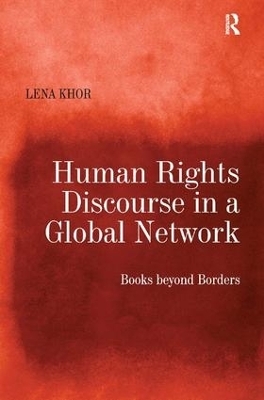
Human Rights Discourse in a Global Network
Books beyond Borders
Seiten
2013
Routledge (Verlag)
978-1-4094-3117-6 (ISBN)
Routledge (Verlag)
978-1-4094-3117-6 (ISBN)
Rather than viewing human rights as an immutable and ill-defined entity, Khor argues for the recognition of human rights as a social construct comprised of language and language use. Her case studies of Doctors Without Borders, Paul Rusesabagina and Hotel Rwanda.
In her innovative study of human rights discourse, Lena Khor takes up the prevailing concern by scholars who charge that the globalization of human rights discourse is becoming yet another form of cultural, legal, and political imperialism imposed from above by an international human rights regime based in the Global North. To counter these charges, she argues for a paradigmatic shift away from human rights as a hegemonic, immutable, and ill-defined entity toward one that recognizes human rights as a social construct comprised of language and of language use. She proposes a new theoretical framework based on a global discourse network of human rights, supporting her model with case studies that examine the words and actions of witnesses to genocide (Paul Rusesabagina) and humanitarian organizations (Doctors Without Borders). She also analyzes the language of texts such as Michael Ondaatje's Anil's Ghost. Khor's idea of a globally networked structure of human rights discourse enables actors (textual and human) who tap into or are linked into this rapidly globalizing system of networks to increase their power as speaking subjects and, in so doing, to influence the range of acceptable meanings and practices of human rights in the cultural sphere. Khor’s book is a unique and important contribution to the study of human rights in the humanities that revitalizes viable notions of agency and liberatory network power in fields that have been dominated by negative visions of human capacity and moral action.
In her innovative study of human rights discourse, Lena Khor takes up the prevailing concern by scholars who charge that the globalization of human rights discourse is becoming yet another form of cultural, legal, and political imperialism imposed from above by an international human rights regime based in the Global North. To counter these charges, she argues for a paradigmatic shift away from human rights as a hegemonic, immutable, and ill-defined entity toward one that recognizes human rights as a social construct comprised of language and of language use. She proposes a new theoretical framework based on a global discourse network of human rights, supporting her model with case studies that examine the words and actions of witnesses to genocide (Paul Rusesabagina) and humanitarian organizations (Doctors Without Borders). She also analyzes the language of texts such as Michael Ondaatje's Anil's Ghost. Khor's idea of a globally networked structure of human rights discourse enables actors (textual and human) who tap into or are linked into this rapidly globalizing system of networks to increase their power as speaking subjects and, in so doing, to influence the range of acceptable meanings and practices of human rights in the cultural sphere. Khor’s book is a unique and important contribution to the study of human rights in the humanities that revitalizes viable notions of agency and liberatory network power in fields that have been dominated by negative visions of human capacity and moral action.
Lena Khor is Assistant Professor of English at Lawrence University in Appleton, Wisconsin, USA, where she teaches courses on postcolonial studies, globalization, and human rights. Her research interests include human rights and humanitarian discourses, globalization processes, and contemporary World Anglophone literature.
Introduction; Chapter 1 Human Rights Discourse and its Global Network; Chapter 2 Human Rights Survivors as Multitude; Chapter 3 Human Rights Heroes/Humanitarian Saviors as Empire and Counter-Empire; Chapter 4 Literal and Literary Bystanders as Multitude and the Common; Chapter 101 Conclusion The Global-National and Human-Personal Paradoxes of Human Rights Discourse;
| Verlagsort | London |
|---|---|
| Sprache | englisch |
| Maße | 156 x 234 mm |
| Gewicht | 680 g |
| Themenwelt | Geisteswissenschaften ► Geschichte |
| Geisteswissenschaften ► Sprach- / Literaturwissenschaft ► Anglistik / Amerikanistik | |
| Geisteswissenschaften ► Sprach- / Literaturwissenschaft ► Literaturwissenschaft | |
| Recht / Steuern ► Allgemeines / Lexika | |
| Recht / Steuern ► EU / Internationales Recht | |
| Recht / Steuern ► Öffentliches Recht ► Völkerrecht | |
| Sozialwissenschaften ► Politik / Verwaltung | |
| ISBN-10 | 1-4094-3117-7 / 1409431177 |
| ISBN-13 | 978-1-4094-3117-6 / 9781409431176 |
| Zustand | Neuware |
| Informationen gemäß Produktsicherheitsverordnung (GPSR) | |
| Haben Sie eine Frage zum Produkt? |
Mehr entdecken
aus dem Bereich


aus dem Bereich
Poetik eines sozialen Urteils
Buch | Hardcover (2023)
De Gruyter (Verlag)
CHF 83,90


