


David Orrell is an applied mathematician and author of popular science books. He studied mathematics at the University of Alberta, and obtained his doctorate from Oxford University on the prediction of nonlinear systems. His work in applied mathematics and complex systems research has since led him to diverse areas such as weather forecasting, economics, and cancer biology. His work has been featured in the New Scientist, the Financial Times and on BBC Radio.
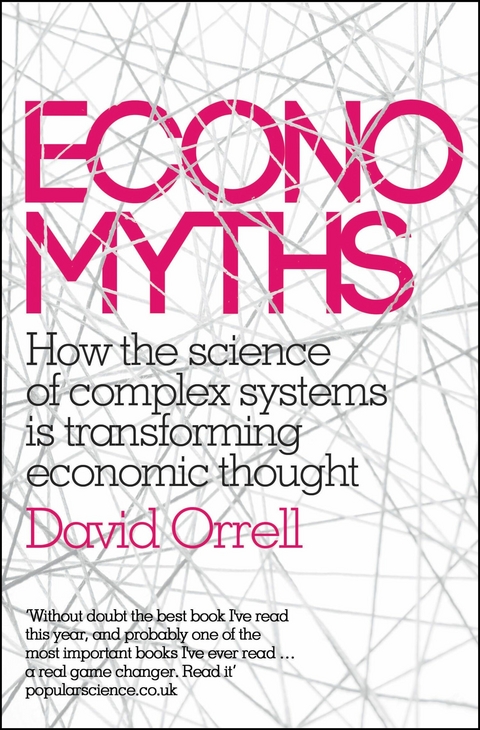
From the inability of wealth to make us happier, to our catastrophic blindness to the credit crunch, "e;Economyths"e; reveals ten ways in which economics has failed us all. Forecasters predicted a prosperous year in 2008 for financial markets - in one influential survey the average prediction was for an eleven per cent gain. But by the end of the year, the Standard and Poor's 500 index - a key economic barometer - was down 38 per cent, and major economies were plunging into recession. Even the Queen asked - Why did no one see it coming? An even bigger casualty was the credibility of economics, which for decades has claimed that the economy is a rational, stable, efficient machine, governed by well-understood laws. Mathematician David Orrell traces the history of this idea from its roots in ancient Greece to the financial centres of London and New York, shows how it is mistaken, and proposes new alternatives. "e;Economyths"e; explains how the economy is the result of complex and unpredictable processes; how risk models go astray; why the economy is not rational or fair; why no woman (until 2009) had ever won the Nobel Prize for economics; why financial crashes are less Black Swans than part of the landscape; and, finally, how new ideas in mathematics, psychology, and environmentalism are helping to reinvent economics.
David Orrell is an applied mathematician and author of popular science books. He studied mathematics at the University of Alberta, and obtained his doctorate from Oxford University on the prediction of nonlinear systems. His work in applied mathematics and complex systems research has since led him to diverse areas such as weather forecasting, economics, and cancer biology. His work has been featured in the New Scientist, the Financial Times and on BBC Radio.
| Erscheint lt. Verlag | 6.5.2010 |
|---|---|
| Verlagsort | London |
| Sprache | englisch |
| Themenwelt | Recht / Steuern ► EU / Internationales Recht |
| Recht / Steuern ► Wirtschaftsrecht ► Bank- und Kapitalmarktrecht | |
| Sozialwissenschaften ► Politik / Verwaltung ► Europäische / Internationale Politik | |
| Sozialwissenschaften ► Politik / Verwaltung ► Vergleichende Politikwissenschaften | |
| Wirtschaft ► Volkswirtschaftslehre ► Finanzwissenschaft | |
| Wirtschaft ► Volkswirtschaftslehre ► Makroökonomie | |
| Schlagworte | economic failure • Economics • Financial Crisis |
| ISBN-10 | 1-84831-199-0 / 1848311990 |
| ISBN-13 | 978-1-84831-199-2 / 9781848311992 |
| Informationen gemäß Produktsicherheitsverordnung (GPSR) | |
| Haben Sie eine Frage zum Produkt? |
 EPUB (Adobe DRM)
Kopierschutz: Adobe-DRM
Adobe-DRM ist ein Kopierschutz, der das eBook vor Mißbrauch schützen soll. Dabei wird das eBook bereits beim Download auf Ihre persönliche Adobe-ID autorisiert. Lesen können Sie das eBook dann nur auf den Geräten, welche ebenfalls auf Ihre Adobe-ID registriert sind.
Details zum Adobe-DRM
Dateiformat: EPUB (Electronic Publication)
EPUB ist ein offener Standard für eBooks und eignet sich besonders zur Darstellung von Belletristik und Sachbüchern. Der Fließtext wird dynamisch an die Display- und Schriftgröße angepasst. Auch für mobile Lesegeräte ist EPUB daher gut geeignet.
Systemvoraussetzungen:
PC/Mac: Mit einem PC oder Mac können Sie dieses eBook lesen. Sie benötigen eine
eReader: Dieses eBook kann mit (fast) allen eBook-Readern gelesen werden. Mit dem amazon-Kindle ist es aber nicht kompatibel.
Smartphone/Tablet: Egal ob Apple oder Android, dieses eBook können Sie lesen. Sie benötigen eine
Geräteliste und zusätzliche Hinweise
Buying eBooks from abroad
For tax law reasons we can sell eBooks just within Germany and Switzerland. Regrettably we cannot fulfill eBook-orders from other countries.


