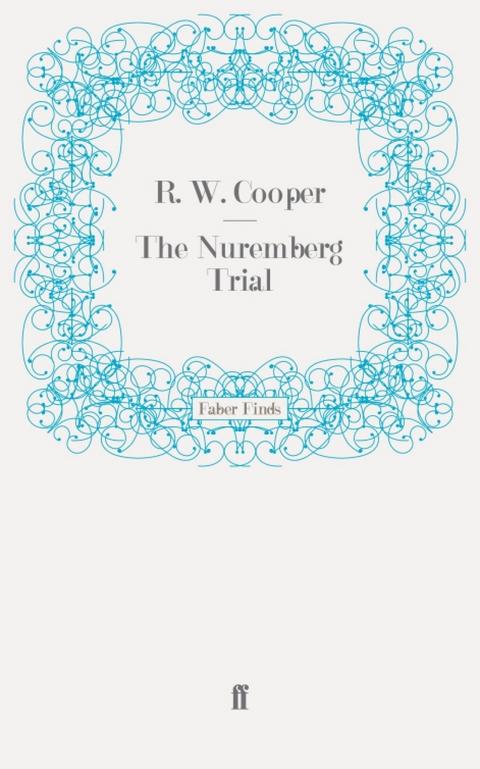
Nuremberg Trial (eBook)
200 Seiten
Faber & Faber (Verlag)
978-0-571-28759-8 (ISBN)
R. W. Cooper joined The Times in 1924 and remained with the paper for forty-five years before his retirement in 1969. As a war correspondent he reported from France leaving Paris as the Germans marched in. For several years he reported 'the forgotten war' in Burma and India before returning to Europe. As foreign correspondent after the war, he was first in Germany then the United States to cover the formation of the United Nations, and later became chief correspondent in Washington. His last posting was in Paris. As The Daily Telegraph wrote in its obituary on Cooper's death in April 1992, 'Bob Cooper, who has died aged eighty-seven, covered the world with great distinction but scant recognition (because) The Times was the last of the British nationals to give its writers bylines. There is no doubt that Cooper's reporting would have won him fame if he had worked for a more modern newspaper.' The Nuremberg Trial, reissued in Faber Finds, was the first book on the subject. Robert Cooper was the only British journalist to cover the trial for its duration, producing daily articles ranging from 350 to 6000 words, and it was these articles that formed the basis of the book.
'They were hanged at dead of night on October 16 - hanged, that is with the exception of Goring. He, mocking to the end, took cyanide of potassium in his cell as the hour approached and was dead by the time the doctors were called. The finding of the board of inquiry that he had it all the time fit in well enough with the little ironical smile that we saw in the dock. For a day he made sport of Nuremberg, above all of American security and its year of pin-pricks. But Goring is dead and the others with him. It could hardly have been more sordid - the grimy prison gymnasium in which soldiers played their ball games, with its row of blazing lights, its three scaffolds, the ugly scrawled inscription on one of the wall ''V. D. walks the streets.'' Hollywood to the end. And one after another the monstrous leaders of the Third Reich fell with the name of the Fatherland on their lips. Have we after all created a grotesque legend?'This is how Robert Cooper's book ends. The book itself has the distinction of being the very first to have been published about the Nuremberg Trial. Its business was finished in October 1946: this book was published in January 1947. Penguin was its publisher, and it is worth quoting from the original blurb, 'This popular but full account of the epoch-making trial of the War criminals at Nuremberg, specially written for Penguin Books by The Times special correspondent who covered the process, is intended as a permanent summary and record of the first attempt to bring to justice the authors and begetters of international crime against humanity.'The author admits to there being 'many gaps and other deficiencies in this necessarily hurried summary of the Nuremberg Trial' and pleads with History to bring about a perspective, but it is the very immediacy of the account that makes it so compelling and still worth reading.
THIRTY million people, at a reliable estimate, died during the Second World War—twelve millions of them far removed from the battlefields of Europe. The figures defy the imagination of mankind. Twelve million people done to death to satisfy the monstrous theories of Nazi geopolitics! Whole races torn out by the roots, so long as German “blood” could course more freely: a human life marked down at three cigarettes a time to the executioner.
Even the Dark Ages had not known crimes of such magnitude, and it was perhaps in an instinctive urge to retain its sanity and moral values that the civilized world, represented by the four victorious Powers, set out on November 20, 1945, on the great Nuremberg Trial—the first trial to call aggressive war mass murder. Months of academic argument, or blunted sensibility, or the dispassionate legal atmosphere of the court could not obscure the stark murder that flowed like a river of crimson through almost every phase of the inquiry. The strangely elusive Nazi language, whether in the mouths of the surviving leaders of the Third Reich and their counsel or in the thousands of captured documents put in as evidence, almost became the language of the Court: it is rich in such words as “exterminate,” “liquidate” or “special treatment,” which meant death.
It is not the purpose of this cursory digest of the Nuremberg Trial to dwell on such matters as its great length, or its legal aspects, or the view expressed by the average German, far more occupied with the business of living, that it was no more than the vengeance of the conquerors, who could equally have shot the prisoners out of hand. And for probably most Germans the Nazis’ greatest crime was, not to have begun the war, but to have lost it. I would only maintain that once the decision was taken to bring these men to justice there is every advantage to future historians, who alone can assess the lessons of Nuremberg in their true perspective, in letting every word be said. What are ten months in the light of the soaring hope the trial may leave to posterity in making wars of aggression a capital offence? The strongest argument advanced for the accused was that under international law as it existed no punishment was laid down for breaches of the peace; and that the Nazi statesmen, therefore, were unaware that their acts were criminal—this of deeds that violated the common law of every nation. Nor was murder by a cowardly duellist, the man who taunted an outmatched adversary into defending himself and thereupon ran him through, always a crime. Duelling was outlawed by an outraged society, just as war was outlawed by a civilized world that saw nothing but self-destruction in its perpetuation—and the first swordsman to be charged with murder was probably equally surprised. No, there have been no fanfares of the trumpets of victory at the Nuremberg Trial: rather the gropings of a still fearing world towards a future which, given the immensity of total war, does not contain its own death warrant. Let there be no vainglorious approach to Nuremberg. The evidence has suggested too vividly where Hitler’s insane plunge to war might have been stopped. It has also shown beyond all doubt that he and his régime alone willed war on Europe.
Götterdammerung—the Twilight of the Gods! The end was to have come up in the fastnesses of the Bavarian Alps, quickly known to the world as the “Redoubt,” where Hitler ruled from his eyrie. Here in prepared mountain strongholds the Nazi chieftains surrounded by fanatical S.S. troops were to have made their last stand as the Wagnerian shadows closed around them. But the plan went wrong: the Allied armies moved too fast: and it was Nuremberg, the symbolic setting of Nazi pomp and panoply, that was to see the final act of a tragedy which has steeped the world in blood. And Wagnerian symbols were not wanting in Nuremberg, which was chosen as the place of trial—less, however, for that reason than for convenience. Not far from the imposing Palace of Justice the old walled city of Nuremberg, perhaps the finest example of mediæval architecture in Europe, lies in sprawling ruins, a grim token of the catastrophe brought by the prisoners upon their own country. A commentary, too, upon the wantonness of modern bombing; for while nothing would seem to justify the destruction of this rare jewel in aged stone, the vulgar Nazi stadium with its pseudo-Roman columns built by Albert Speer, the scene each year of even more frenzied party rallies, has escaped untouched. Nuremberg, the home of Albrecht Dürer, stood in the Middle Ages at the cross-roads of European commerce. It stands now in its ashes at the cross-roads of humanity.
Certainly no other trial in history has known anything like the immense sweep of the Nuremberg canvas, and only history can stand back and see it. Its study in despotism in tracing the rise to power of Hitler showed the Court how Nazi methods operated in the Reich. We saw what ruthless men of blood these Nazis were even among their own people, and against the background of European diplomacy between the two wars we saw something of their foreign policy at work. Ribbentrop as Ambassador to the Court of St. James’s, while paying ardent lip-service to Anglo-German friendship, was quite ready to advise the Führer on the necessity of forming a coalition against Britain. The cultural activities of Germans living abroad, organized as Nazi cells with headquarters in Berlin, were a ready mask for a skilful espionage service.
The imagination boggles at Nuremberg’s disclosures of intrigue in high places—some of it in the best cloak-and-dagger style—in which most of the prisoners seem to have had a hand. It appeared that almost everybody of any standing in the country was plotting at some time or other, usually to kill Hitler; the wonder began to be, not that Germany failed to win the war, as so many people say, but that she waged it for so long. In their private lives the accused men emerged as plotters of almost Ruritanian stature, and from this aspect alone Nuremberg would provide a Phillips Oppenheim with enough material for a small library.
But the central motif of the Trial was always the tumult of war and all the appalling crimes that came in its wake. Military strategy as seen in the war rooms or in history can exert a strong fascination of its own, and those of us who saw something of the inner scenes at Allied headquarters during the conflict had a peculiar interest in seeing the enemy’s plans revealed, in hearing his appreciation of the war situation at a given period.
Yet how little could a dilettante interest in the military scene as traced on paper compare with the bloody misery, the tears and fears, of a whole Continent torn and eternally scarred by German war lords as true to type as the Teutonic knights! There is even a suggestion of barbarous chivalry about the Teutonic knights that has no place in the record of Nuremberg, for if ever the age of chivalry was dead it was in Nazi Germany. Aggressive war itself, which the trial seeks to establish as a crime against the civilized world, had been far outstripped by the geopolitical disciples of Karl Haushofer in their deliberate, inhumanly intellectual studies in genocide, the new crime of the Nuremberg indictment. For your genocidal maniac victory in the military sense means nothing; once victory is achieved it becomes a matter of racial or national extermination, either by wholesale murder and resettlement or by sowing the swift-devouring weeds of self-strangulation, the seeds of corruption, by which a nation is calculated to kill itself and thus make way for the stream of virile new blood, the blood of the “master race.” As we shall see, there was nothing far-fetched in Nazi dreams about their “Garden of Eden,” in which all but the racially pure had perished. The burning ghats of the concentration camps, the gas-vans and the special extermination squads of the S.S. were the most obvious means, the black markets of the occupied capitals perhaps the most subtle, and even a traditional soldier like Keitel was not above signing a decree holding out allurements to Norwegian women bearing the children of German occupation troops.
Who will say, examining a record of premeditated crime unequalled in the story of mankind, that the Nazi leaders were not given a fair hearing? By the legal conceptions of justice inherent in the Tribunal, Nuremberg for a period of nearly six months became a ready platform from which the defence could deliver the political apologia of National Socialism addressed to future generations of Germans in terms that would never have been allowed outside the Court within less than a year of the surrender. There was plenty of recrimination, above all at the expense of dead men, but seldom an expression of contrition. Defending counsel, among them some of the most undismayed Nazis who ever breathed, shrouded themselves in the metaphysical mists of nearly every philosopher, preferably German, known to learning, in an insidious effort to justify the war, or to place it at the door of Britain’s “interference,” and to draw a sycophantic picture of a devastated Reich at the mercy of its conquerors.
Did they not hear what Albert Speer, the accused Minister of War Production, said in the box about their Führer’s plans for a race that they had been weak enough to lose? What arrogance for German lawyers, who rarely had a hearing under the Nazi régime, to suggest that whatever international law was in existence had been made obsolete by German unilateral denunciations! Yet...
| Erscheint lt. Verlag | 15.3.2012 |
|---|---|
| Verlagsort | London |
| Sprache | englisch |
| Themenwelt | Geschichte ► Teilgebiete der Geschichte ► Militärgeschichte |
| Recht / Steuern ► EU / Internationales Recht | |
| Recht / Steuern ► Rechtsgeschichte | |
| Sozialwissenschaften ► Politik / Verwaltung | |
| Schlagworte | Faber Finds • Genocide • Nazi Germany • WWII |
| ISBN-10 | 0-571-28759-X / 057128759X |
| ISBN-13 | 978-0-571-28759-8 / 9780571287598 |
| Informationen gemäß Produktsicherheitsverordnung (GPSR) | |
| Haben Sie eine Frage zum Produkt? |
 EPUB (Adobe DRM)
Kopierschutz: Adobe-DRM
Adobe-DRM ist ein Kopierschutz, der das eBook vor Mißbrauch schützen soll. Dabei wird das eBook bereits beim Download auf Ihre persönliche Adobe-ID autorisiert. Lesen können Sie das eBook dann nur auf den Geräten, welche ebenfalls auf Ihre Adobe-ID registriert sind.
Details zum Adobe-DRM
Dateiformat: EPUB (Electronic Publication)
EPUB ist ein offener Standard für eBooks und eignet sich besonders zur Darstellung von Belletristik und Sachbüchern. Der Fließtext wird dynamisch an die Display- und Schriftgröße angepasst. Auch für mobile Lesegeräte ist EPUB daher gut geeignet.
Systemvoraussetzungen:
PC/Mac: Mit einem PC oder Mac können Sie dieses eBook lesen. Sie benötigen eine
eReader: Dieses eBook kann mit (fast) allen eBook-Readern gelesen werden. Mit dem amazon-Kindle ist es aber nicht kompatibel.
Smartphone/Tablet: Egal ob Apple oder Android, dieses eBook können Sie lesen. Sie benötigen eine
Geräteliste und zusätzliche Hinweise
Buying eBooks from abroad
For tax law reasons we can sell eBooks just within Germany and Switzerland. Regrettably we cannot fulfill eBook-orders from other countries.
aus dem Bereich