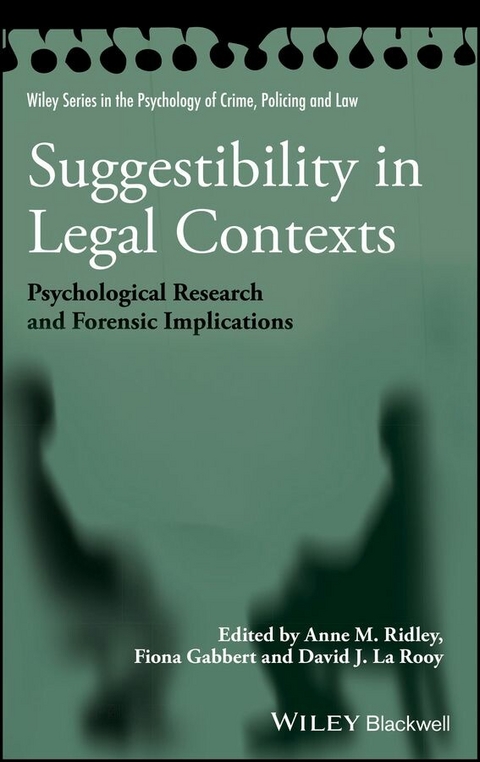
Suggestibility in Legal Contexts (eBook)
A comprehensive survey of the theory, research and forensic implications related to suggestibility in legal contexts that includes the latest research.
- Provides a useful digest for academics and a trusted text for students of forensic and applied psychology
- A vital resource for legal practitioners who need to familiarize themselves with the subject
- Includes practical suggestions for minimizing witness suggestibility in interviews
- Features topics that focus on suggestibility at each stage - from witnessing a crime through to trial
Anne Ridley is Principal Lecturer in Psychology at London South Bank University, UK, with particular interest in individual differences in witness suggestibility as well as strategies for supporting vulnerable witnesses in the legal system. In 2008 she was awarded a National Teaching Fellowship by the Higher Education Academy.
Fiona Gabbert is a Reader in Psychology at the University of Abertay Dundee, UK. She is an expert in the area of social influences on memory, and has published widely on this topic, including a chapter on 'memory conformity' in the current book. Another of Fiona's interests is developing methods to obtain reliable evidence from eyewitnesses. She received an Academic Excellence Award for 'Outstanding Achievements in the Area of Investigative Interviewing' in 2011.
David La Rooy is a Reader in Psychology at the University of Abertay Dundee, UK. He is also a Scottish Institute for Policing Research Lecturer and his research focuses on issues surrounding the forensic interviewing of children. He teaches evidence-based investigative-interviewing and oversees the university's degree course in Forensic Psychobiology.
A comprehensive survey of the theory, research and forensic implications related to suggestibility in legal contexts that includes the latest research. Provides a useful digest for academics and a trusted text for students of forensic and applied psychology A vital resource for legal practitioners who need to familiarize themselves with the subject Includes practical suggestions for minimizing witness suggestibility in interviews Features topics that focus on suggestibility at each stage - from witnessing a crime through to trial
Anne Ridley is Principal Lecturer in Psychology at London South Bank University, UK, with particular interest in individual differences in witness suggestibility as well as strategies for supporting vulnerable witnesses in the legal system. In 2008 she was awarded a National Teaching Fellowship by the Higher Education Academy. Fiona Gabbert is a Reader in Psychology at the University of Abertay Dundee, UK. She is an expert in the area of social influences on memory, and has published widely on this topic, including a chapter on 'memory conformity' in the current book. Another of Fiona's interests is developing methods to obtain reliable evidence from eyewitnesses. She received an Academic Excellence Award for 'Outstanding Achievements in the Area of Investigative Interviewing' in 2011. David La Rooy is a Reader in Psychology at the University of Abertay Dundee, UK. He is also a Scottish Institute for Policing Research Lecturer and his research focuses on issues surrounding the forensic interviewing of children. He teaches evidence-based investigative-interviewing and oversees the university's degree course in Forensic Psychobiology.
Contributors ix
Series Preface xi
Preface xiii
Acknowledgements xv
1 Suggestibility: A History and Introduction 1
Anne M. Ridley
2 The Misinformation Effect: Past Research and Recent Advances 21
Quin M. Chrobak and Maria S. Zaragoza
3 Interrogative Suggestibility and Compliance 45
Gisli H. Gudjonsson
4 Suggestibility and Memory Conformity 63
Fiona Gabbert and Lorraine Hope
5 Suggestibility and Individual Differences: Psychosocial and Memory Measures 85
Anne M. Ridley and Gisli H. Gudjonsson
6 Recovered Memories and Suggestibility for Entire Events 107
James Ost
7 Suggestibility and Individual Differences in Typically Developing and Intellectually Disabled Children 129
Kamala London, Lucy A. Henry, Travis Conradt and Ryan Corser
8 Suggestibility in Vulnerable Groups: Witnesses with Intellectual Disability, Autism Spectrum Disorder, and Older People 149
Katie L. Maras and Rachel Wilcock
9 Acute Suggestibility in Police Interrogation: Self-regulation Failure as a Primary Mechanism of Vulnerability 171
Deborah Davis and Richard A. Leo
10 Suggestibility and Witness Interviewing using the Cognitive Interview and NICHD Protocol 197
David J. La Rooy, Deirdre Brown and Michael E. Lamb
11 Suggestibility in Legal Contexts: What Do We Know? 217
Anne M. Ridley, Fiona Gabbert and David J. La Rooy
Index 229
Suggestibility is one of the most important psychological
concepts to capture the imagination of scientists, both past and
present. The internationally known contributors to this volume
tackle this concept with scientific astuteness and balance, and
with an eye towards its importance for the legal field. It is
a must read for researchers and practitioners
alike.--Elizabeth F. Loftus, PhD, Distinguished
Professor, University of California, Irvine
| Erscheint lt. Verlag | 11.10.2012 |
|---|---|
| Reihe/Serie | Wiley Series in Psychology of Crime, Policing and Law | Wiley Series in The Psychology of Crime, Policing and Law |
| Sprache | englisch |
| Themenwelt | Geisteswissenschaften ► Psychologie |
| Recht / Steuern ► EU / Internationales Recht | |
| Recht / Steuern ► Strafrecht ► Kriminologie | |
| Schlagworte | Forensic Psychology • Forensic psychology, investigative, court, witness, crime, Gisli Gudjonsson, Elizabeth Loftus, police interviews, memory conformity • Forensische Psychologie • Gedächtnis • Gedächtnis • Memory • Psychologie • Psychology • Psychology of Law • Rechtspsychologie |
| ISBN-13 | 9781118432815 / 9781118432815 |
| Informationen gemäß Produktsicherheitsverordnung (GPSR) | |
| Haben Sie eine Frage zum Produkt? |
 PDF (Adobe DRM)
Kopierschutz: Adobe-DRM
Adobe-DRM ist ein Kopierschutz, der das eBook vor Mißbrauch schützen soll. Dabei wird das eBook bereits beim Download auf Ihre persönliche Adobe-ID autorisiert. Lesen können Sie das eBook dann nur auf den Geräten, welche ebenfalls auf Ihre Adobe-ID registriert sind.
Details zum Adobe-DRM
Dateiformat: PDF (Portable Document Format)
Mit einem festen Seitenlayout eignet sich die PDF besonders für Fachbücher mit Spalten, Tabellen und Abbildungen. Eine PDF kann auf fast allen Geräten angezeigt werden, ist aber für kleine Displays (Smartphone, eReader) nur eingeschränkt geeignet.
Systemvoraussetzungen:
PC/Mac: Mit einem PC oder Mac können Sie dieses eBook lesen. Sie benötigen eine
eReader: Dieses eBook kann mit (fast) allen eBook-Readern gelesen werden. Mit dem amazon-Kindle ist es aber nicht kompatibel.
Smartphone/Tablet: Egal ob Apple oder Android, dieses eBook können Sie lesen. Sie benötigen eine
Geräteliste und zusätzliche Hinweise
Buying eBooks from abroad
For tax law reasons we can sell eBooks just within Germany and Switzerland. Regrettably we cannot fulfill eBook-orders from other countries.
aus dem Bereich