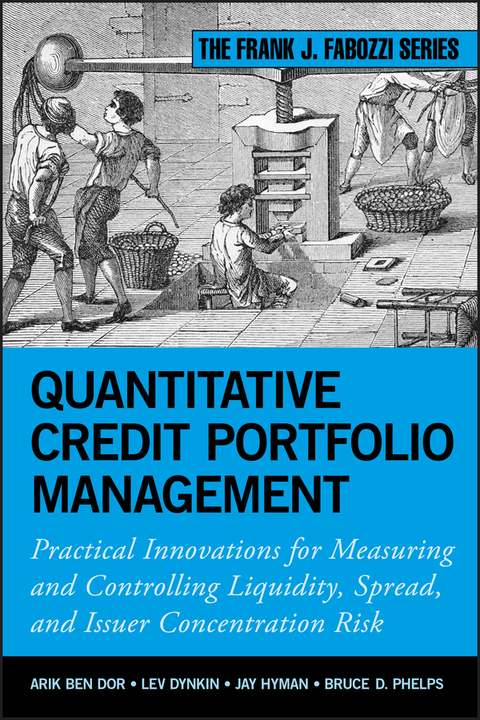
Quantitative Credit Portfolio Management (eBook)
416 Seiten
John Wiley & Sons (Verlag)
978-1-118-16742-7 (ISBN)
management
Credit portfolio managers traditionally rely on fundamental
research for decisions on issuer selection and sector rotation.
Quantitative researchers tend to use more mathematical techniques
for pricing models and to quantify credit risk and relative value.
The information found here bridges these two approaches. In an
intuitive and readable style, this book illustrates how
quantitative techniques can help address specific questions facing
today's credit managers and risk analysts.
A targeted volume in the area of credit, this reliable resource
contains some of the most recent and original research in this
field, which addresses among other things important questions
raised by the credit crisis of 2008-2009. Divided into two
comprehensive parts, Quantitative Credit Portfolio
Management offers essential insights into understanding the
risks of corporate bonds--spread, liquidity, and Treasury
yield curve risk--as well as managing corporate bond
portfolios.
* Presents comprehensive coverage of everything from duration
time spread and liquidity cost scores to capturing the credit
spread premium
* Written by the number one ranked quantitative research group
for four consecutive years by Institutional Investor
* Provides practical answers to difficult question, including:
What diversification guidelines should you adopt to protect
portfolios from issuer-specific risk? Are you well-advised to sell
securities downgraded below investment grade?
Credit portfolio management continues to evolve, but with this
book as your guide, you can gain a solid understanding of how to
manage complex portfolios under dynamic events.
ARIK BEN DOR, PHD, is a Director and Senior Analyst in the Quantitative Portfolio Strategy (QPS) Group at Barclays Capital Research. He joined the group in 2004 after completing a PhD in finance from the Kellogg School of Management. Ben Dor has published extensively in the Journal of Portfolio Management, Journal of Fixed Income, and Journal of Alternative Investments. LEV DYNKIN, PHD, is the founder and Global Head of the Quantitative Portfolio Strategy Group at Barclays Capital Research. Dynkin and the QPS group joined Barclays Capital in 2008 from Lehman Brothers where the group was a part of fixed income research since 1987--one of the longest tenures for an investor-focused research group on Wall Street. JAY HYMAN, PHD, is a Managing Director in the Quantitative Portfolio Strategy Group at Barclays Capital Research. He joined the group in 1991 and has since worked on issues of risk budgeting, cost of investment constraints, improved measures of risk sensitivities, and optimal risk diversification for portfolios spanning all fixed income asset classes. Hyman helped develop a number of innovative measures that have been broadly adopted by portfolio managers and that have changed standard industry practice. BRUCE D. PHELPS, PHD, is a Managing Director in the Quantitative Portfolio Strategy Group at Barclays Capital Research, which he joined in 2000. Prior to that, he was an institutional portfolio manager and head of fixed income at Ark Asset Management. Phelps was also senior economist at the Chicago Board of Trade, where he designed derivative contracts and electronic trading systems, and an international credit officer and foreign exchange trader at Wells Fargo Bank. Phelps is a member of the editorial board of the Financial Analysts Journal.
Foreword xvii
Introduction xix
Notes on Terminology xxvii
PART ONE Measuring the Market Risks of CorporateBonds
CHAPTER 1 Measuring Spread Sensitivity of Corporate Bonds3
Analysis of Corporate Bond Spread Behavior 5
A New Measure of Excess Return Volatility 20
Refinements and Further Tests 25
Summary and Implications for Portfolio Managers 30
Appendix: Data Description 34
CHAPTER 2 DTS for Credit Default Swaps 39
Estimation Methodology 40
Empirical Analysis of CDS Spreads 41
Appendix: Quasi-Maximum Likelihood Approach 51
CHAPTER 3 DTS for Sovereign Bonds 55
Spread Dynamics of Emerging Markets Debt 55
DTS for Developed Markets Sovereigns: The Case of EuroTreasuries 59
Managing Sovereign Risk Using DTS 66
CHAPTER 4 A Theoretical Basis for DTS 73
The Merton Model: A Zero-Coupon Bond 74
Dependence of Slope on Maturity 77
CHAPTER 5 Quantifying the Liquidity of Corporate Bonds81
Liquidity Cost Scores (LCS) for U.S. Credit Bonds 82
Liquidity Cost Scores: Methodology 88
LCS for Trader-Quoted Bonds 92
LCS for Non-Quoted Bonds: The LCS Model 96
Testing the LCS Model: Out-of-Sample Tests 102
LCS for Pan-European Credit Bonds 113
Using LCS in Portfolio Construction 123
Trade Efficiency Scores (TES) 129
CHAPTER 6 Joint Dynamics of Default and Liquidity Risk133
Spread Decomposition Methodology 138
What Drives OAS Differences across Bonds? 139
How Has the Composition of OAS Changed? 141
Spread Decomposition Using an Alternative Measure of ExpectedDefault Losses 145
High-Yield Spread Decomposition 147
Applications of Spread Decomposition 147
Alternative Spread Decomposition Models 150
Appendix 152
CHAPTER 7 Empirical versus Nominal Durations of CorporateBonds 157
Empirical Duration: Theory and Evidence 159
Segmentation in Credit Markets 173
Potential Stale Pricing and Its Effect on Hedge Ratios 173
Hedge Ratios Following Rating Changes: An Event Study Approach179
Using Empirical Duration in Portfolio Management Applications186
PART TWO Managing Corporate Bond Portfolios
CHAPTER 8 Hedging the Market Risk in Pairs Trades 197
Data and Hedging Simulation Methodology 199
Analysis of Hedging Results 200
Appendix: Hedging Pair-Wise Trades with Skill 208
CHAPTER 9 Positioning along the Credit Curve 213
Data and Methodology 214
Empirical Analysis 217
CHAPTER 10 The 2007-2009 Credit Crisis 229
Spread Behavior during the Credit Crisis 229
Applications of DTS 234
Advantages of DTS in Risk Model Construction 244
CHAPTER 11 A Framework for Diversification of Issuer Risk249
Downgrade Risk before and after the Credit Crisis 250
Using DTS to Set Position-Size Ratios 257
Comparing and Combining the Two Approaches to Issuer Limits260
CHAPTER 12 How Best to Capture the Spread Premium ofCorporate Bonds? 265
The Credit Spread Premium 266
Measuring the Credit Spread Premium for the IG Corporate Index266
Alternative Corporate Indexes 279
Capturing Spread Premium: Adopting an Alternative CorporateBenchmark 288
CHAPTER 13 Risk and Performance of Fallen Angels 295
Data and Methodology 298
Performance Dynamics around Rating Events 303
Fallen Angels as an Asset Class 319
CHAPTER 14 Obtaining Credit Exposure Using Cash and SyntheticReplication 337
Cash Credit Replication (TCX) 338
Synthetic Replication of Cash Indexes 351
Credit RBIs 358
References 367
Index 371
| Erscheint lt. Verlag | 8.11.2011 |
|---|---|
| Reihe/Serie | Frank J. Fabozzi Series | Frank J. Fabozzi Series |
| Sprache | englisch |
| Themenwelt | Recht / Steuern ► Wirtschaftsrecht |
| Wirtschaft ► Betriebswirtschaft / Management ► Finanzierung | |
| Betriebswirtschaft / Management ► Spezielle Betriebswirtschaftslehre ► Bankbetriebslehre | |
| Schlagworte | Finance & Investments • Finanz- u. Anlagewesen • Investments & Securities • Kapitalanlage • Kapitalanlagen u. Wertpapiere |
| ISBN-10 | 1-118-16742-2 / 1118167422 |
| ISBN-13 | 978-1-118-16742-7 / 9781118167427 |
| Informationen gemäß Produktsicherheitsverordnung (GPSR) | |
| Haben Sie eine Frage zum Produkt? |
 EPUB (Adobe DRM)
Kopierschutz: Adobe-DRM
Adobe-DRM ist ein Kopierschutz, der das eBook vor Mißbrauch schützen soll. Dabei wird das eBook bereits beim Download auf Ihre persönliche Adobe-ID autorisiert. Lesen können Sie das eBook dann nur auf den Geräten, welche ebenfalls auf Ihre Adobe-ID registriert sind.
Details zum Adobe-DRM
Dateiformat: EPUB (Electronic Publication)
EPUB ist ein offener Standard für eBooks und eignet sich besonders zur Darstellung von Belletristik und Sachbüchern. Der Fließtext wird dynamisch an die Display- und Schriftgröße angepasst. Auch für mobile Lesegeräte ist EPUB daher gut geeignet.
Systemvoraussetzungen:
PC/Mac: Mit einem PC oder Mac können Sie dieses eBook lesen. Sie benötigen eine
eReader: Dieses eBook kann mit (fast) allen eBook-Readern gelesen werden. Mit dem amazon-Kindle ist es aber nicht kompatibel.
Smartphone/Tablet: Egal ob Apple oder Android, dieses eBook können Sie lesen. Sie benötigen eine
Geräteliste und zusätzliche Hinweise
Buying eBooks from abroad
For tax law reasons we can sell eBooks just within Germany and Switzerland. Regrettably we cannot fulfill eBook-orders from other countries.
aus dem Bereich