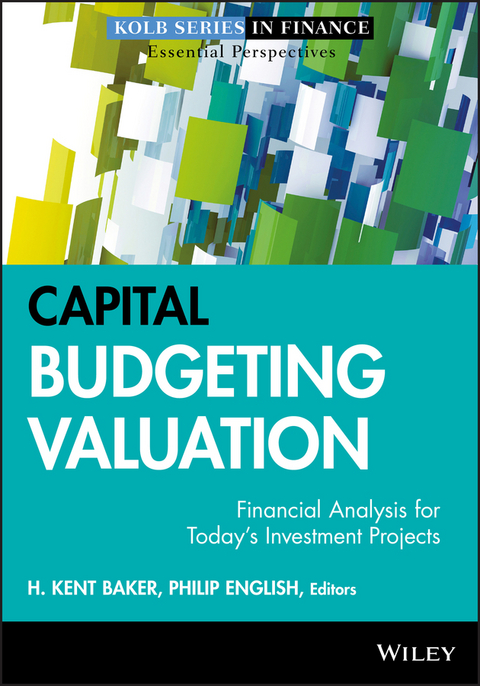
Capital Budgeting Valuation (eBook)
528 Seiten
John Wiley & Sons (Verlag)
978-1-118-04454-4 (ISBN)
analysis
With the collapse of the economy and financial systems, many
institutions are reevaluating what they are willing to spend money
on. Project valuation is key to both cost effectiveness measures
and shareholder value.
The purpose of this book is to provide a comprehensive
examination of critical capital budgeting topics. Coverage extends
from discussing basic concepts, principles, and techniques to their
application to increasingly complex, real-world situations.
Throughout, the book emphasizes how financially sound capital
budgeting facilitates the process of value creation and discusses
why various theories make sense and how firms can use them to solve
problems and create wealth.
* Offers a strategic focus on the application of various
techniques and approaches related to a firm's overall strategy
* Provides coverage of international topics based on the premise
that managers should view business from a global perspective
* Emphasizes the importance of using real options
Comprised of contributed chapters from both experienced
professionals and academics, Capital Budgeting Valuation
offers a variety of perspectives and a rich interplay of ideas
related to this important financial discipline.
DAVID L. H. KENT BAKER, PHD, CFA, CMA, is University Professor of Finance and Kogod Research Professor at the Kogod School of Business at American University, Washington, D.C. He has published extensively in leading academic and professional finance journals including the Journal of Finance, Journal of Financial and Quantitative Analysis, Financial Management, Financial Analysts Journal, and Journal of Portfolio Management. Recognized as one of the most prolific authors in finance during the past fifty years, Professor Baker has consulting and training experience with more than 100 organizations and has been listed in fifteen biographies. PHILIP ENGLISH is an Assistant Professor of Finance and Real Estate at the Kogod School of Business, American University. He currently serves as Director of the Master of Science in Finance and Master of Science in Real Estate programs. Before pursuing a doctorate, English worked as the primary financial officer and director of product development for Campbell Classics, a Virginia-based manufacturing firm. Professor English's research interests focus on the role of the legal environment in emerging markets, corporate governance, and mutual fund regulation. He has published in the Journal of Financial Research, Journal of Corporate Finance, Journal of Law and Economics, and Emerging Markets Review.
Acknowledgments ix
1 Capital Budgeting: An Overview 1
H. Kent Baker and Philip English
Part I Foundation and Key Concepts 17
2 Corporate Strategy and Investment Decisions 19
Daniel Ferreira
3 Corporate Governance and Investment Decisions 37
Fodil Adjaoud, Dorra Charfi, and Lamia Chourou
Part II Capital Investment Choice 57
4 Measuring Investment Value: Free Cash Flow, Net Present Value, and Economic Value Added 59
Tom Arnold and Terry Nixon
5 Alternative Methods of Evaluating Capital Investments 79
Tom Arnold and Terry Nixon
6 Capital Rationing for Capital Budgeting 95
Alexander Brüggen
7 Analyzing Foreign Investments 111
Wim Westerman and John Henry Hall
8 Postcompletion Auditing of Capital Investments 131
Jari Huikku
9 Capital Budgeting Techniques in Practice: U.S. Survey Evidence 151
Tarun K. Mukherjee and Naseem M. Al Rahahleh
Part III Project Cash Flows and Inflation 173
10 Estimating Project Cash Flows 175
Kyle Meyer and Halil Kiymaz
11 Capital Budgeting and Inflation 197
Ignacio Vélez-Pareja and Joseph Tham
Part IV Risk and Investment Choice 215
12 Basic Risk Adjustment Techniques in Capital Budgeting 217
John H. Hall and Wim Westerman
13 Capital Budgeting with Political/Country Risk 241
Yacine Belghitar and Ephraim Clark
14 Risk Management in Project Finance 259
Stefano Gatti and Stefano Caselli
15 Risk Simulation Concepts and Methods 279
Tom Arnold and David North
Part V Real Options and Project Analysis 299
16 Real Options Analysis: An Introduction 301
Tom Arnold and Bonnie Buchanan
17 Applications of Real Options Analysis 321
Tom Arnold and Bonnie Buchanan
Part VI Estimating the Project Cost of Capital 337
18 Cost of Capital: An Introduction 339
Octavian Ionici, Kenneth Small, and Frank D'Souza
19 Using the Capital Asset Pricing Model and Arbitrage Pricing Theory in Capital Budgeting 363
S. David Young and Samir Saadi
20 Financing Mix and Project Valuation: Alternative Methods and Possible Adjustments 381
Alex Pierru and Denis Babusiaux
Part VII Special Topics 403
21 Capital Budgeting for Government Entities 405
Davina F. Jacobs
22 Decision Making Using Behavioral Finance for Capital Budgeting 421
Yuri Biondi and Giuseppe Marzo
23 Merger and Acquisition Pricing: The Valuation of Synergy 445
Rainer Lenz
24 Multicriteria Analysis for Capital Budgeting 463
Fernando R. Fernholz
Answers to Discussion Questions 483
Index 507
| Erscheint lt. Verlag | 4.5.2011 |
|---|---|
| Reihe/Serie | Robert W. Kolb Series | Robert W. Kolb Series |
| Sprache | englisch |
| Themenwelt | Recht / Steuern ► Wirtschaftsrecht |
| Wirtschaft ► Betriebswirtschaft / Management ► Finanzierung | |
| Schlagworte | Finance & Investments • Finanz- u. Anlagewesen • Institutional & Corporate Finance • Institutionelle Finanzplanung |
| ISBN-10 | 1-118-04454-1 / 1118044541 |
| ISBN-13 | 978-1-118-04454-4 / 9781118044544 |
| Informationen gemäß Produktsicherheitsverordnung (GPSR) | |
| Haben Sie eine Frage zum Produkt? |
 PDF (Adobe DRM)
Kopierschutz: Adobe-DRM
Adobe-DRM ist ein Kopierschutz, der das eBook vor Mißbrauch schützen soll. Dabei wird das eBook bereits beim Download auf Ihre persönliche Adobe-ID autorisiert. Lesen können Sie das eBook dann nur auf den Geräten, welche ebenfalls auf Ihre Adobe-ID registriert sind.
Details zum Adobe-DRM
Dateiformat: PDF (Portable Document Format)
Mit einem festen Seitenlayout eignet sich die PDF besonders für Fachbücher mit Spalten, Tabellen und Abbildungen. Eine PDF kann auf fast allen Geräten angezeigt werden, ist aber für kleine Displays (Smartphone, eReader) nur eingeschränkt geeignet.
Systemvoraussetzungen:
PC/Mac: Mit einem PC oder Mac können Sie dieses eBook lesen. Sie benötigen eine
eReader: Dieses eBook kann mit (fast) allen eBook-Readern gelesen werden. Mit dem amazon-Kindle ist es aber nicht kompatibel.
Smartphone/Tablet: Egal ob Apple oder Android, dieses eBook können Sie lesen. Sie benötigen eine
Geräteliste und zusätzliche Hinweise
Buying eBooks from abroad
For tax law reasons we can sell eBooks just within Germany and Switzerland. Regrettably we cannot fulfill eBook-orders from other countries.
aus dem Bereich