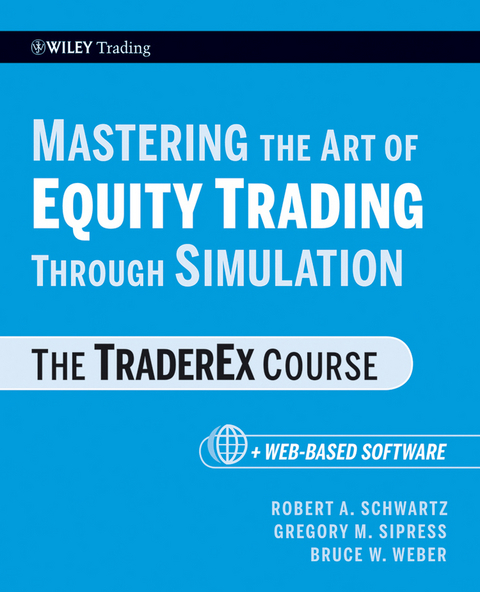
Mastering the Art of Equity Trading Through Simulation (eBook)
288 Seiten
John Wiley & Sons (Verlag)
978-0-470-64249-8 (ISBN)
markets
Mastering the Art of Equity Trading Through Simulation is
a guidebook to interactive computer trading simulation designed to
provide participants with hands-on experience in making tactical
decisions and implementing them in different market
environments-from continuous order drive markets to call auction
markets, and from dealer markets to dark liquidity pools.
By showing traders how to operate in these different markets,
this reliable resource quickly reveals a good deal about what
trading involves and how market design impacts trading
decisions.
* Provides a virtual platform that gives users hands-on
experience in making tactical trading decisions
* Shows exactly how prices are established in the
marketplace
* Teaches how the structure of a marketplace influences
participant decisions
Learning to trade through study is like learning about a roller
coaster ride verbally. You may get the idea of going up and down
and around curves, but will lack the actual experience.
Mastering the Art of Equity Trading Through Simulation will
get you as close as possible to the markets-without actually going
in them-and prepare you to profit once you're really there.
Robert A. Schwartz is Marvin M. Speiser Professor of Finance and University Distinguished Professor in the Zicklin School of Business, Baruch College, CUNY. He is the developer, with Bruce Weber and Gregory Sipress, of the trading and market structure simulation, TraderEx. Gregory M. Sipress is the head of software development at TraderEx, LLC. Bruce W. Weber is a Professor of Information Management at the London Business School.
Foreword (Professor Dr. Reto Francioni).
Preface.
How TraderEx Works.
Who This Book is For.
Overview of the Book.
Downloading the TraderEx Software.
How TraderEx Works with Micro Markets.
Acknowledgements.
Part One: An Overview of Equity Market Trading.
Chapter 1: Equity Market Trading.
The Costs of Trading.
Liquidity.
Market Structure.
Informational Efficiency (or the Lack Thereof).
Expectations.
The Players.
Summary.
Chapter 2: Simulation as a Learning Tool.
Canned versus Computer Generated Prices and Quotes.
Appendix: Intertemporal Returns Correlation.
Summary.
Chapter 3: How to Use TraderEx.
An Overview of the TraderEx Environment.
The Continuous Order Book Market.
The Dealer Market.
Call Auctions.
Block Trading Facility.
Crossing Network.
Hybrid Markets.
Summary.
Chapter 4: Introduction to the Trading Exercises.
The Buy-Side Perspective.
The Sell-Side Intermediary Perspective.
TraderEx Performance Measures.
Summary.
Part Two: TraderEx Exercises.
Chapter 5: Microeconomics Goes to Market.
Exercise 5.1: The Look of a Financial Market.
Exercise 5.2: What Are Your Attitudes Toward Risk?
Exercise 5.3: Call Market Trading.
Exercise 5.4: Trading Costs in Action.
Exercise 5.5: Dealer Costs and Inventory Control.
Exercise 5.6: Inter-Market Competition for a Stock Exchange.
Exercise 5.7: Finding an Equilibrium Value.
Exercise 5.8: Economic Effects of an Order Protection Rule.
Conclusion.
Chapter 6: The Order Book Market Structure.
Exercise 6.1: Entering Limit Orders.
Exercise 6.2: Entering Market Orders.
Exercise 6.3: Adjusting Limit Orders.
Exercise 6.4: Sizing your Orders - Markets and Limits.
Exercise 6.5: Post-Trade Analysis.
Exercise 6.6: A Really Big Order.
Exercise 6.8: Illiquidity.
Exercise 6.9: Heightened Volatility.
Exercise 6.10: News and Changing Expectations.
Exercise 6.11: Endogenous Expectations.
Exercise 6.12: A One-Year Holding Period.
Exercise 6.13: Crossing Networks.
Exercise 6.14: A Networked Simulation.
Conclusion.
Chapter 7: The Call Auction Market Structure.
The Price Setting Mechanism in TraderEx Call Auctions.
Exercise 7.1: Mechanics of the Opening Call Auction.
Exercise 7.2: Your TraderEx Call Auction Orders.
Exercise 7.3: Your Influence on TraderEx Call Auction Prices.
Exercise 7.4: Participating in the Opening Call Auction.
Exercise 7.5: Working a Large Order with Call Auctions.
Exercise 7.6: Proprietary Trading with Call Auction, and News Releases.
Exercise 7.7: Emphasizing Different Dimensions of Trading Performance.
Exercise 7.8: A Partially Disclosed Call Auction.
Conclusion.
Chapter 8: Dealer Markets: What Do the Trading Intermediaries Do?
Operations of Quote Driven Markets.
Exercise 8.1: Changing Quotes to Control Your Inventory.
Exercise 8.2: Market Maker Performance.
Exercise 8.3: Market Maker Risk Performance.
Exercise 8.4: Preferencing in Market Maker Systems.
Exercise 8.5: Volatility and Market Making.
Exercise 8.6: Low Liquidity and Market Making.
Exercise 8.7: Alternative Trading Systems and Market Making.
Conclusion.
Chapter 9: Dark Pools: How Undisclosed Liquidity Works.
Exercise 9.1: Mechanics of the Dark Pool.
Exercise 9.2: Seeking Advantages from Dark Pool Pricing.
Exercise 9.3: Working a Large Order with a Dark Pool.
Exercise 9.4: Proprietary Trading with Call Auction, and News Releases.
Exercise 9.5: Emphasizing Different Dimensions of Trading Performance.
Exercise 9.6: Dark Pools and Trade-Through Rules.
Conclusion.
About the Authors.
Index.
| Erscheint lt. Verlag | 24.6.2010 |
|---|---|
| Reihe/Serie | Wiley Trading Series | Wiley Trading Series |
| Sprache | englisch |
| Themenwelt | Recht / Steuern ► Wirtschaftsrecht |
| Wirtschaft ► Betriebswirtschaft / Management ► Finanzierung | |
| Schlagworte | Börsenhandel • Börsenhandel • Finance & Investments • Finanz- u. Anlagewesen • Trading |
| ISBN-10 | 0-470-64249-1 / 0470642491 |
| ISBN-13 | 978-0-470-64249-8 / 9780470642498 |
| Informationen gemäß Produktsicherheitsverordnung (GPSR) | |
| Haben Sie eine Frage zum Produkt? |
 PDF (Adobe DRM)
Größe: 8,2 MB
Kopierschutz: Adobe-DRM
Adobe-DRM ist ein Kopierschutz, der das eBook vor Mißbrauch schützen soll. Dabei wird das eBook bereits beim Download auf Ihre persönliche Adobe-ID autorisiert. Lesen können Sie das eBook dann nur auf den Geräten, welche ebenfalls auf Ihre Adobe-ID registriert sind.
Details zum Adobe-DRM
Dateiformat: PDF (Portable Document Format)
Mit einem festen Seitenlayout eignet sich die PDF besonders für Fachbücher mit Spalten, Tabellen und Abbildungen. Eine PDF kann auf fast allen Geräten angezeigt werden, ist aber für kleine Displays (Smartphone, eReader) nur eingeschränkt geeignet.
Systemvoraussetzungen:
PC/Mac: Mit einem PC oder Mac können Sie dieses eBook lesen. Sie benötigen eine
eReader: Dieses eBook kann mit (fast) allen eBook-Readern gelesen werden. Mit dem amazon-Kindle ist es aber nicht kompatibel.
Smartphone/Tablet: Egal ob Apple oder Android, dieses eBook können Sie lesen. Sie benötigen eine
Geräteliste und zusätzliche Hinweise
Buying eBooks from abroad
For tax law reasons we can sell eBooks just within Germany and Switzerland. Regrettably we cannot fulfill eBook-orders from other countries.
 EPUB (Adobe DRM)
Kopierschutz: Adobe-DRM
Adobe-DRM ist ein Kopierschutz, der das eBook vor Mißbrauch schützen soll. Dabei wird das eBook bereits beim Download auf Ihre persönliche Adobe-ID autorisiert. Lesen können Sie das eBook dann nur auf den Geräten, welche ebenfalls auf Ihre Adobe-ID registriert sind.
Details zum Adobe-DRM
Dateiformat: EPUB (Electronic Publication)
EPUB ist ein offener Standard für eBooks und eignet sich besonders zur Darstellung von Belletristik und Sachbüchern. Der Fließtext wird dynamisch an die Display- und Schriftgröße angepasst. Auch für mobile Lesegeräte ist EPUB daher gut geeignet.
Systemvoraussetzungen:
PC/Mac: Mit einem PC oder Mac können Sie dieses eBook lesen. Sie benötigen eine
eReader: Dieses eBook kann mit (fast) allen eBook-Readern gelesen werden. Mit dem amazon-Kindle ist es aber nicht kompatibel.
Smartphone/Tablet: Egal ob Apple oder Android, dieses eBook können Sie lesen. Sie benötigen eine
Geräteliste und zusätzliche Hinweise
Buying eBooks from abroad
For tax law reasons we can sell eBooks just within Germany and Switzerland. Regrettably we cannot fulfill eBook-orders from other countries.
aus dem Bereich