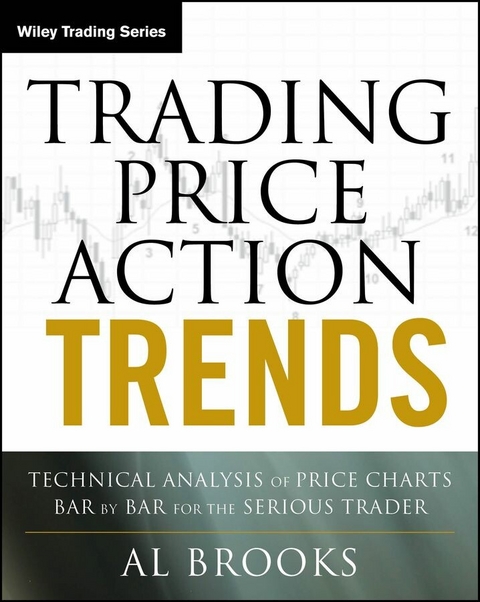
Trading Price Action Trends (eBook)
John Wiley & Sons (Verlag)
978-1-118-16625-3 (ISBN)
The key to being a successful trader is finding a system that works and sticking with it. Author Al Brooks has done just that. By simplifying his trading system and trading only 5-minute price charts he's found a way to capture profits regardless of market direction or economic climate. His first book, Reading Price Charts Bar by Bar, offered an informative examination of his system, but it didn't allow him to get into the real nuts and bolts of the approach. Now, with this new series of books, Brooks takes you step by step through the entire process.
By breaking down his trading system into its simplest pieces: institutional piggybacking or trend trading (the topic of this particular book in the series), trading ranges, and transitions or reversals, this three book series offers access to Brooks' successful methodology. Price Action Trends Bar by Bar describes in detail what individual bars and combinations of bars can tell a trader about what institutions are doing. This is critical because the key to making money in trading is to piggyback institutions and you cannot do that unless you understand what the charts are telling you about their behavior. This book will allow you to see what type of trend is unfolding, so can use techniques that are specific to that type of trend to place the right trades.
- Discusses how to profit from institutional trading trends using technical analysis
- Outlines a detailed and original trading approach developed over the author's successful career as an independent trader
- Other books in the series include Price Action Trading Ranges Bar by Bar and Price Action Reversals Bar by Bar
If you're looking to make the most of your time in today's markets the trading insights found in Price Action Trends Bar by Bar will help you achieve this goal.
AL BROOKS is a technical analysis contributor for Futures magazine and an independent day trader. His approach to reading price charts was developed over two decades in which he changed careers from ophthalmology to trading. Brooks graduated from The University of Chicago Pritzker School of Medicine in 1978 and received a BS in mathematics with honors from Trinity College in 1974. His website, brookspriceaction.com, outlines his trading approach and views as well as hosts a subscription-based daily trading chat room in which Brooks talks with other traders about the market.
AL BROOKS is a technical analysis contributor for Futures magazine and an independent day trader. His approach to reading price charts was developed over two decades in which he changed careers from ophthalmology to trading. Brooks graduated from The University of Chicago Pritzker School of Medicine in 1978 and received a BS in mathematics with honors from Trinity College in 1974. His website, brookspriceaction.com, outlines his trading approach and views as well as hosts a subscription-based daily trading chat room in which Brooks talks with other traders about the market.
Acknowledgments xi
List of Terms Used in This Book xiii
Introduction 1
PART I Price Action 35
CHAPTER 1 The Spectrum of Price Action: Extreme Trends to
Extreme Trading Ranges 55
CHAPTER 2 Trend Bars, Doji Bars, and Climaxes 59
CHAPTER 3 Breakouts, Trading Ranges, Tests, and Reversals 77
CHAPTER 4 Bar Basics: Signal Bars, Entry Bars, Setups, and
Candle Patterns 83
CHAPTER 5 Signal Bars: Reversal Bars 89
CHAPTER 6 Signal Bars: Other Types 101
CHAPTER 7 Outside Bars 155
CHAPTER 8 The Importance of the Close of the Bar 169
CHAPTER 9 Exchange-Traded Funds and Inverse Charts 173
CHAPTER 10 Second Entries 177
CHAPTER 11 Late and Missed Entries 181
CHAPTER 12 Pattern Evolution 185
PART II Trend Lines and Channels 191
CHAPTER 13 Trend Lines 195
CHAPTER 14 Trend Channel Lines 209
CHAPTER 15 Channels 219
CHAPTER 16 Micro Channels 249
CHAPTER 17 Horizontal Lines: Swing Points and Other Key Price
Levels 269
PART III Trends 275
CHAPTER 18 Example of How to Trade a Trend 289
CHAPTER 19 Signs of Strength in a Trend 307
CHAPTER 20 Two Legs 319
PART IV Common Trend Patterns 323
CHAPTER 21 Spike and Channel Trend 325
CHAPTER 22 Trending Trading Range Days 359
CHAPTER 23 Trend from the Open and Small Pullback Trends 383
CHAPTER 24 Reversal Day 415
CHAPTER 25 Trend Resumption Day 423
CHAPTER 26 Stairs: Broad Channel Trend 431
About the Author 437
About the Website 439
Index 441
List of Terms Used in This Book
All of these terms are defined in a practical way to be helpful to traders and not necessarily in the theoretical way often described by technicians.
always in If you have to be in the market at all times, either long or short, this is whatever your current position is (always in long or always in short). If at any time you are forced to decide between initiating a long or a short trade and are confident in your choice, then the market is in always-in mode at that moment. Almost all of these trades require a spike in the direction of the trend before traders will have confidence.
barbwire A trading range of three or more bars that largely overlap and one or more is a doji. It is a type of tight trading range with prominent tails and often relatively large bars.
bar pullback In an upswing, a bar pullback is a bar with a low below the low of the prior bar. In a downswing, it is a bar with a high above that of the prior bar.
bear reversal A change in trend from up to down (a bear trend).
blown account An account that your losses have reduced below the minimum margin requirements set by your broker, and you will not be allowed to place a trade unless you deposit more money.
breakout The high or low of the current bar extends beyond some prior price of significance such as a swing high or low, the high or low of any prior bar, a trend line, or a trend channel.
breakout bar (or bar breakout) A bar that creates a breakout. It is usually a strong trend bar.
breakout mode A setup where a breakout in either direction should have follow-through.
breakout pullback A small pullback of one to about five bars that occurs within a few bars after a breakout. Since you see it as a pullback, you are expecting the breakout to resume and the pullback is a setup for that resumption. If instead you thought that the breakout would fail, you would not use the term pullback and instead would see the pullback as a failed breakout. For example, if there was a five-bar breakout above a bear trend line but you believed that the bear trend would continue, you would be considering shorting this bear flag and not looking to buy a pullback immediately after it broke out to the downside.
breakout test A breakout pullback that comes close to the original entry price to test a breakeven stop. It may overshoot it or undershoot it by a few ticks. It can occur within a bar or two of entry or after an extended move or even 20 or more bars later.
bull reversal A change in trend from a downtrend to an uptrend (a bull trend).
buying pressure Strong bulls are asserting themselves and their buying is creating bull trend bars, bars with tails at the bottoms, and two-bar bull reversals. The effect is cumulative and usually is eventually followed by higher prices.
candle A chart representation of price action in which the body is the area between the open and the close. If the close is above the open, it is a bull candle and is shown as white. If it is below, it is a bear candle and is black. The lines above and below are called tails (some technicians call them wicks or shadows).
chart type A line, bar, candle, volume, tick, or other type of chart.
climax A move that has gone too far too fast and has now reversed direction to either a trading range or an opposite trend. Most climaxes end with trend channel overshoots and reversals, but most of those reversals result in trading ranges and not an opposite trend.
countertrend A trade or setup that is in the opposite direction from the current trend (the current always-in direction). This is a losing strategy for most traders since the risk is usually at least as large as the reward and the probability is rarely high enough to make the trader's equation favorable.
countertrend scalp A trade taken in the belief that there is more to go in the trend but that a small pullback is due; you enter countertrend to capture a small profit as that small pullback is forming. This is usually a mistake and should be avoided.
day trade A trade where the intent is to exit on the day of entry.
directional probability The probability that the market will move either up or down any number of ticks before it reaches a certain number of ticks in the opposite direction. If you are looking at an equidistant move up and down, it hovers around 50 percent most of the time, which means that there is a 50–50 chance that the market will move up by X ticks before it moves down X ticks, and a 50–50 chance that it will move down X ticks before it moves up X ticks.
doji A candle with a small body or no body at all. On a 5 minute chart, the body would be only one or two ticks; but on a daily chart, the body might be 10 or more ticks and still appear almost nonexistent. Neither the bulls nor the bears control the bar. All bars are either trend bars or nontrend bars, and those nontrend bars are called dojis.
double bottom A chart formation in which the low of the current bar is about the same as the low of a prior swing low. That prior low can be just one bar earlier or 20 or more bars earlier. It does not have to be at the low of the day, and it commonly forms in bull flags (a double bottom bull flag).
double bottom bull flag A pause or bull flag in a bull trend that has two spikes down to around the same price and then reverses back into a bull trend.
double bottom pullback A buy setup composed of a double bottom followed by a deep pullback that forms a higher low.
double top A chart formation in which the high of the current bar is about the same as the high of a prior swing high. That prior high can be just one bar earlier or 20 or more bars earlier. It does not have to be at the high of the day, and it commonly forms in bear flags (a double top bear flag).
double top bear flag A pause or bear flag in a bear trend that has two spikes up to around the same price and then reverses back into a bear trend.
double top pullback A sell setup composed of a double top followed by a deep pullback that forms a lower high.
early longs Traders who buy as a bull signal bar is forming rather than waiting for it to close and then entering on a buy stop at one tick above its high.
early shorts Traders who sell as a bear signal bar is forming rather than waiting for it to close and then entering on a sell stop at one tick below its low.
edge A setup with a positive trader's equation. The trader has a mathematical advantage if he trades the setup. Edges are always small and fleeting because they need someone on the other side, and the market is filled with smart traders who won't allow an edge to be big and persistent.
EMA See exponential moving average (EMA).
entry bar The bar during which a trade is entered.
exponential moving average (EMA) The charts in these books use a 20-bar exponential moving average, but any moving average can be useful.
fade To place a trade in the opposite direction of the trend (for example, selling a bull breakout that you expect to fail and reverse downward).
failed failure A failure that fails, resuming in the direction of the original breakout, and therefore a breakout pullback. Since it is a second signal, it is more reliable. For example, if there is a breakout above a trading range and the bar after the breakout is a bear reversal bar, if the market trades below that bar, the breakout has failed. If the market then trades above the high of a prior bar within the next few bars, the failed breakout has failed and now the breakout is resuming. This means that the failed breakout became a small bull flag and just a pullback from the breakout.
failure (a failed move) A move where the protective stop is hit before a scalper's profit is secured or before the trader's objective is reached, usually leading to a move in the opposite direction as trapped traders are forced to exit at a loss. Currently, a scalper's target in the Emini of four ticks usually requires a six-tick move, and a target in the QQQQ of 10 ticks usually requires a move of 12 cents.
false Failed, failure.
five-tick failure A trade in the Emini that reaches five ticks beyond the signal bar and then reverses. For example, a breakout of a bull flag runs five ticks, and once the bar closes, the next bar has a low that is lower. Most limit orders to take a one-point profit would fail to get filled since a move usually has to go one tick beyond the order before it is filled. It is often a setup for a trade in the opposite direction.
flat Refers to a trader who is not currently holding any positions.
follow-through After the initial move, like a breakout, it is one or more bars that extend the move. Traders like to see follow-through on the next bar and on the several bars after that, hoping for a trend where they stand to make more profit.
follow-through bar A bar that creates follow-through after the entry bar; it is usually the next bar but sometimes forms a couple of bars later.
fractal Every pattern is a fractal of a pattern on a higher time frame chart. This means that every pattern is a micro pattern on a higher time frame and every micro pattern is a standard pattern on a smaller time...
| Erscheint lt. Verlag | 9.11.2011 |
|---|---|
| Reihe/Serie | Wiley Trading |
| Wiley Trading Series | Wiley Trading Series |
| Sprache | englisch |
| Themenwelt | Recht / Steuern ► Wirtschaftsrecht |
| Wirtschaft ► Betriebswirtschaft / Management ► Finanzierung | |
| Schlagworte | Al Brooks, price action trends bar by bar, price action trends, trading price action trends, analyzing price action trends, technical analysis of price action, brookspriceaction.com, spotting institutional trading trends, profiting from institutional trading trends, piggyback financial institutions, institutional piggybacking, trend trading, technical analysis of price charts, price action trading ranges bar by bar, price action reversals bar by bar • Börsenhandel • Börsenhandel • Finance & Investments • Finanz- u. Anlagewesen • Trading |
| ISBN-10 | 1-118-16625-6 / 1118166256 |
| ISBN-13 | 978-1-118-16625-3 / 9781118166253 |
| Informationen gemäß Produktsicherheitsverordnung (GPSR) | |
| Haben Sie eine Frage zum Produkt? |
 EPUB (Adobe DRM)
Kopierschutz: Adobe-DRM
Adobe-DRM ist ein Kopierschutz, der das eBook vor Mißbrauch schützen soll. Dabei wird das eBook bereits beim Download auf Ihre persönliche Adobe-ID autorisiert. Lesen können Sie das eBook dann nur auf den Geräten, welche ebenfalls auf Ihre Adobe-ID registriert sind.
Details zum Adobe-DRM
Dateiformat: EPUB (Electronic Publication)
EPUB ist ein offener Standard für eBooks und eignet sich besonders zur Darstellung von Belletristik und Sachbüchern. Der Fließtext wird dynamisch an die Display- und Schriftgröße angepasst. Auch für mobile Lesegeräte ist EPUB daher gut geeignet.
Systemvoraussetzungen:
PC/Mac: Mit einem PC oder Mac können Sie dieses eBook lesen. Sie benötigen eine
eReader: Dieses eBook kann mit (fast) allen eBook-Readern gelesen werden. Mit dem amazon-Kindle ist es aber nicht kompatibel.
Smartphone/Tablet: Egal ob Apple oder Android, dieses eBook können Sie lesen. Sie benötigen eine
Geräteliste und zusätzliche Hinweise
Buying eBooks from abroad
For tax law reasons we can sell eBooks just within Germany and Switzerland. Regrettably we cannot fulfill eBook-orders from other countries.
aus dem Bereich