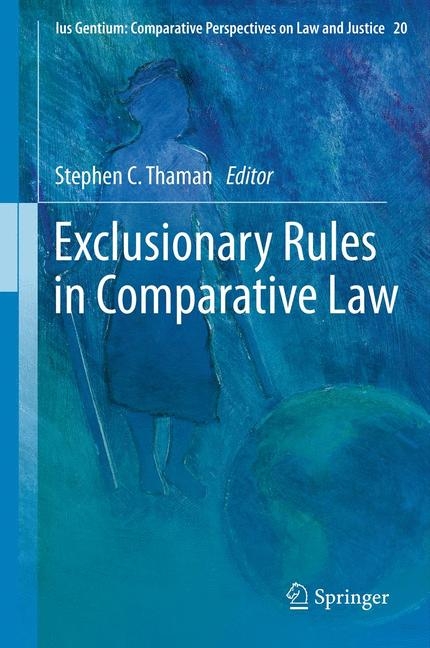
Exclusionary Rules in Comparative Law (eBook)
XVI, 456 Seiten
Springer Netherland (Verlag)
978-94-007-5348-8 (ISBN)
This book is a comparative study of the exclusion of illegally gathered evidence in the criminal trial , which includes 15 country studies, a chapter on the European Court of Human Rights, and a comparative synthetic conclusion. No other book has undertaken such a broad comparative study of exclusionary rules, which have now become a world-wide phenomenon. The topic is one of the most controversial in criminal procedure law, because it reveals a constant tension between the criminal court's duty to ascertain the truth, on the one hand, and its duty to uphold important constitutional rights on the other, most importantly, the privilege against self-incrimination and the right to privacy in one's home and one's private communications.
The chapters were contributed by noted world experts on the subject for the XVIII Congress of the International Academy of Comparative Law in Washington in July 2010.
This book is a comparative study of the exclusion of illegally gathered evidence in the criminal trial , which includes 15 country studies, a chapter on the European Court of Human Rights, and a comparative synthetic conclusion. No other book has undertaken such a broad comparative study of exclusionary rules, which have now become a world-wide phenomenon. The topic is one of the most controversial in criminal procedure law, because it reveals a constant tension between the criminal court's duty to ascertain the truth, on the one hand, and its duty to uphold important constitutional rights on the other, most importantly, the privilege against self-incrimination and the right to privacy in one's home and one's private communications. The chapters were contributed by noted world experts on the subject for the XVIII Congress of the International Academy of Comparative Law in Washington in July 2010.
Introduction; Stephen C. Thaman.- Part One: The Vicissitudes of Court-Made Exclusionary Tests: Section One: Common Law Jurisdictions.- Chapter 1: The United States: The Rise and Fall of the Constitutional Exclusionary Rule; Mark E. Cammack.- Chapter 2: Ireland: A Move to Categorical Exclusion?; Arnaud Cras and Yvonne Daly.- Chapter 3: Scotland: A Plea for Consistency; Fiona Leverick and Findlay Stark.- Chapter 4: Israel: The Supreme Court’s New, Cautious Exclusionary Rule; Yuval Merin and Rinat Kitai-Sangero.- Part One: The Vicissitudes of Court-Made Exclusionary Tests:Section Two: Civil Law Balancing.- Chapter 5: Germany: Balancing Truth against Protected Constitutional Interests; Sabine Gless.- Part Two: From Nullities to Statutory Exclusionary Rules in Continental Europe: Section One: The Traditional Approach Based on Statutory Nullities.- Chapter 6: France: Procedural Nullities and Exclusion; Jean Pradel.- Part Two: From Nullities to Statutory Exclusionary Rules in Continental Europe: Section Two: From Nullities to Balancing.- Chapter 7: Belgium: From Categorical Nullities to a Judicially Created Balancing Test; Marie-Aude Beernaert and Philip Traest.- Chapter 8: The Netherlands: Statutory Balancing and a Choice of Remedies: Matthias Borgers and Lonneke Stevens.- Part Two: From Nullities to Statutory Exclusionary Rules in Continental Europe: Section Three: From Nullities to Statutory Exclusionary Rules.- Chapter 9: Spain: The Constitutional Court’s Move From Categorical Exclusion to Limited Balancing; Lorena Bachmaier Winter.- Chapter 10: Italy: Statutory Nullities and Non-Usability; Giulio Illuminati.- Chapter 11: Greece: From Nullities to Categorical Statutory and Constitutional Exclusionary Rules; George Triantafyllou.- Chapter 12: Turkey: The Move to Categorical Exclusion of Illegally Gathered Evidence; Adem Sözüer.- Chapter 13: Serbia: Courts Struggle With a New Categorical Statutory Exclusionary Rule; Snežana Brkić.- Part Three: The Fair Trial Test for Exclusion.- Chapter 14: England and Wales: Fair Trial Analysis and the Presumed Admissibility of Physical Evidence; Andrew L-T Choo.- Chapter 15: Taiwan: The Codification of a Judicially-Made Discretionary Exclusionary Rule; Jaw-perng Wang.- Chapter 16: The European Court of Human Rights: The Fair Trial Analysis under Article 6 of the European Convention of Human Rights; Pinar Ölcer.- Part Four: A Comparison of Exclusionary Jurisprudence.- Chapter 17: Balancing Truth Against Human Rights: A Comparative Analysis of the Use of Illegally Gathered Evidence in the Criminal Trial; Stephen C. Thaman.-About the contributors.- index.
| Erscheint lt. Verlag | 31.12.2012 |
|---|---|
| Reihe/Serie | Ius Gentium: Comparative Perspectives on Law and Justice | Ius Gentium: Comparative Perspectives on Law and Justice |
| Zusatzinfo | XVI, 456 p. |
| Verlagsort | Dordrecht |
| Sprache | englisch |
| Themenwelt | Recht / Steuern ► Allgemeines / Lexika |
| Recht / Steuern ► EU / Internationales Recht | |
| Recht / Steuern ► Strafrecht ► Strafverfahrensrecht | |
| Schlagworte | admissibility • Balancing • Categorial Nullities • Categorical Exclusion • Cautious Exclusion • comparative law • Cost-Benefit-Balancing • criminal justice • Criminal Procedure Law • Criminal Trial • European Court of Human Rights • exclusionary rule • Exclusionary Tests • fair trial • Human Rights • IACL • Illegally Gathered Evidence • Inconsistent Case Law • International Academy of Comparative Law • Non-Usability • Nullities • Physical Evidence • Privilege Against Self-Incrimination • Probative Evidence • Procedural Nullities • Protected Constitutional Interests • Relevant Evidence • remedies • Right to Privacy • Statutory Nullities • Violoation of Constitutional Rights |
| ISBN-10 | 94-007-5348-9 / 9400753489 |
| ISBN-13 | 978-94-007-5348-8 / 9789400753488 |
| Informationen gemäß Produktsicherheitsverordnung (GPSR) | |
| Haben Sie eine Frage zum Produkt? |
 PDF (Wasserzeichen)
DRM: Digitales Wasserzeichen
Dieses eBook enthält ein digitales Wasserzeichen und ist damit für Sie personalisiert. Bei einer missbräuchlichen Weitergabe des eBooks an Dritte ist eine Rückverfolgung an die Quelle möglich.
Dateiformat: PDF (Portable Document Format)
Mit einem festen Seitenlayout eignet sich die PDF besonders für Fachbücher mit Spalten, Tabellen und Abbildungen. Eine PDF kann auf fast allen Geräten angezeigt werden, ist aber für kleine Displays (Smartphone, eReader) nur eingeschränkt geeignet.
Systemvoraussetzungen:
PC/Mac: Mit einem PC oder Mac können Sie dieses eBook lesen. Sie benötigen dafür einen PDF-Viewer - z.B. den Adobe Reader oder Adobe Digital Editions.
eReader: Dieses eBook kann mit (fast) allen eBook-Readern gelesen werden. Mit dem amazon-Kindle ist es aber nicht kompatibel.
Smartphone/Tablet: Egal ob Apple oder Android, dieses eBook können Sie lesen. Sie benötigen dafür einen PDF-Viewer - z.B. die kostenlose Adobe Digital Editions-App.
Buying eBooks from abroad
For tax law reasons we can sell eBooks just within Germany and Switzerland. Regrettably we cannot fulfill eBook-orders from other countries.
aus dem Bereich