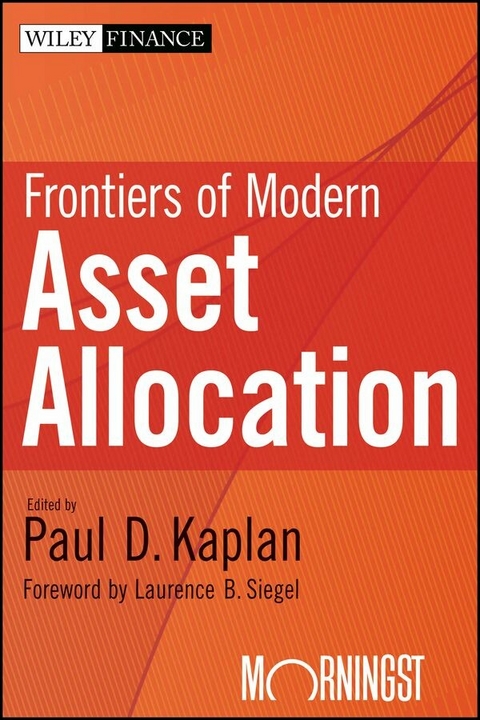
Frontiers of Modern Asset Allocation (eBook)
416 Seiten
John Wiley & Sons (Verlag)
978-1-118-17301-5 (ISBN)
practice
Building on more than 15 years of asset-allocation research,
Paul D. Kaplan, who led the development of the methodologies behind
the Morningstar Rating(TM) and the Morningstar Style Box(TM),
tackles key challenges investor professionals face when putting
asset-allocation theory into practice. This book addresses common
issues such as:
* How should asset classes be defined?
* Should equities be divided into asset classes based on
investment style, geography, or other factors?
* Should asset classes be represented by market-cap-weighted
indexes or should other principles, such as fundamental weights, be
used?
* How do actively managed funds fit into asset-class mixes?
Kaplan also interviews industry luminaries who have greatly
influenced the evolution of asset allocation, including Harry
Markowitz, Roger Ibbotson, and the late Benoit Mandelbrot.
Throughout the book, Kaplan explains allocation theory, creates new
strategies, and corrects common misconceptions, offering original
insights and analysis. He includes three appendices that put theory
into action with technical details for new asset-allocation
frameworks, including the next generation of portfolio construction
tools, which Kaplan dubs "Markowitz 2.0."
PAUL D. KAPLAN is quantitative research director at Morningstar Europe and is responsible for the quantitative methodologies behind Morningstar's fund analysis, indexes, advisor tools, and other services. Dr. Kaplan conducts research on investment style analysis, performance and risk measurement, asset allocation, retirement-income planning, portfolio construction, index methodologies, and alternative investments. He led the development of quantitative methodologies behind the Morningstar Rating for funds (Morningstar's star rating), the Morningstar Style Box, and the Morningstar family of indexes. Many of Dr. Kaplan's research papers have been published in professional books and publications such as the Financial Analysts Journal, the Journal of Portfolio Management, the Journal of Wealth Management, the Journal of Investing, the Journal of Performance Measurement, the Journal of Indexes, and the Handbook of Equity Style Management. He received the 2008 Graham and Dodd Award and won a Graham and Dodd Award of Excellence in 2000.
Foreword xi
Introduction xxiii
A Note on Expected Return and Geometric Mean xxv
Acknowledgments xxxi
PART ONE Equities
CHAPTER 1 Purity of Purpose: How Style-Pure Indexes Provide
Useful Insights 7
CHAPTER 2 Investing in Europe with Style: Why Investors in
Europe Would Benefit From Constructing Portfolios Through the Prism
of Style 15
CHAPTER 3 Why Fundamental Indexation Might--or Might
Not--Work 21
CHAPTER 4 The Fundamental Debate: Two Experts Square Off on the
Big Issues Surrounding Fundamentally Weighted Indexes 39
CHAPTER 5 Collared Weighting: A Hybrid Approach to Indexing
51
CHAPTER 6 Yield to Investors? A Practical Approach to Building
Dividend Indexes 63
CHAPTER 7 Holdings-Based and Returns-Based Style Models 71
CHAPTER 8 Estimates of Small Stock Betas Are Much Too Low
103
CHAPTER 9 A Macroeconomic Model of the Equity Risk Premium
117
PART TWO Fixed Income, Real Estate, and
Alternatives
CHAPTER 10 Good and Bad Monetary Economics, and Why Investors
Need to Know the Difference 133
CHAPTER 11 Inflation, Gilt Yields, and Economic Policy 143
CHAPTER 12 Reverse Mean-Variance Optimization for Real Estate
Asset-Allocation Parameters 147
CHAPTER 13 The Long and Short of Commodity Indexes 157
CHAPTER 14 Less Alpha and More Beta Than Meets the Eye 175
CHAPTER 15 Venture Capital and its Role in Strategic Asset
Allocation 179
PART THREE Crashes and Fat Tails
CHAPTER 16 One-and-a-Quarter Centuries of Stock Market Drawdowns
193
CHAPTER 17 Stock Market Bubbles and Crashes: A Global Historical
and Economic Perspective 199
CHAPTER 18 De´ ja` Vu All Over Again 211
CHAPTER 19 De´ ja` Vu Around the World 223
CHAPTER 20 Getting a Read on Risk: A Discussion with Roger
Ibbotson, George Cooper, and Beno^it Mandelbrot on the
Crisis and Risk Models 239
PART FOUR Doing Asset Allocation
CHAPTER 21 Does Asset-Allocation Policy Explain 40 Percent, 90
Percent, or 100 Percent of Performance? 253
CHAPTER 22 Asset-Allocation Models Using the Markowitz Approach
267
CHAPTER 23 Asset Allocation with Annuities for Retirement Income
Management 275
CHAPTER 24 MPT Put Through the Wringer: A Debate Between Steven
Fox and Michael Falk 303
CHAPTER 25 Updating Monte Carlo Simulation for the Twenty-First
Century 311
CHAPTER 26 Markowitz 2.0 325
CHAPTER 27 What Does Harry Markowitz Think? A Discussion with
Harry Markowitz and Sam Savage 351
Afterword 367
About the Author 375
Index 377
| Erscheint lt. Verlag | 29.11.2011 |
|---|---|
| Reihe/Serie | Wiley Finance Editions | Wiley Finance Editions |
| Vorwort | Laurence B. Siegel |
| Sprache | englisch |
| Themenwelt | Recht / Steuern ► Wirtschaftsrecht |
| Wirtschaft ► Betriebswirtschaft / Management ► Finanzierung | |
| Schlagworte | Finance & Investments • Finanz- u. Anlagewesen • Institutional & Corporate Finance • Institutionelle Finanzplanung |
| ISBN-10 | 1-118-17301-5 / 1118173015 |
| ISBN-13 | 978-1-118-17301-5 / 9781118173015 |
| Informationen gemäß Produktsicherheitsverordnung (GPSR) | |
| Haben Sie eine Frage zum Produkt? |
 PDF (Adobe DRM)
Kopierschutz: Adobe-DRM
Adobe-DRM ist ein Kopierschutz, der das eBook vor Mißbrauch schützen soll. Dabei wird das eBook bereits beim Download auf Ihre persönliche Adobe-ID autorisiert. Lesen können Sie das eBook dann nur auf den Geräten, welche ebenfalls auf Ihre Adobe-ID registriert sind.
Details zum Adobe-DRM
Dateiformat: PDF (Portable Document Format)
Mit einem festen Seitenlayout eignet sich die PDF besonders für Fachbücher mit Spalten, Tabellen und Abbildungen. Eine PDF kann auf fast allen Geräten angezeigt werden, ist aber für kleine Displays (Smartphone, eReader) nur eingeschränkt geeignet.
Systemvoraussetzungen:
PC/Mac: Mit einem PC oder Mac können Sie dieses eBook lesen. Sie benötigen eine
eReader: Dieses eBook kann mit (fast) allen eBook-Readern gelesen werden. Mit dem amazon-Kindle ist es aber nicht kompatibel.
Smartphone/Tablet: Egal ob Apple oder Android, dieses eBook können Sie lesen. Sie benötigen eine
Geräteliste und zusätzliche Hinweise
Buying eBooks from abroad
For tax law reasons we can sell eBooks just within Germany and Switzerland. Regrettably we cannot fulfill eBook-orders from other countries.
aus dem Bereich