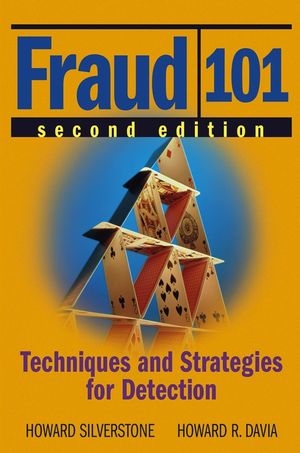
Fraud 101 (eBook)
288 Seiten
John Wiley & Sons (Verlag)
978-0-471-72713-2 (ISBN)
It's not enough to wait for a tip to expose corporate fraud. Fraud
101, Second Edition provides step-by-step guidance on how to
perform detection procedures for every major type of fraud. Its new
and detailed case studies reveal how easy it can be for a
perpetrator to commit a fraud and how difficult it can be to
prosecute. This new edition also offers expanded coverage of
financial statement fraud, fraud-specific internal control, and
Sarbanes-Oxley.
HOWARD M. SILVERSTONE, CPA, FCA, CFE, is founder and Director of Forensic Resolutions, Inc., a forensic accounting firm. He has concentrated on forensic and investigative accounting since 1985 and has been involved in all aspects of cases, including those involving fraud investigations, complex commercial litigation, insurance claims, and due diligence, both as a consulting and expert witness. He is also coauthor of Forensic Accounting and Fraud Investigation for Non-Experts (published by Wiley) and has contributed articles to The Legal Intelligencer, Security Management, and many other publications. He also contributed a chapter to The CPA's Handbook of Fraud and Commercial Crime Prevention, originally published in 2000 by the AICPA. He is a frequent speaker who has delivered presentations for professional organizations, law firms, and insurance companies. HOWARD R. DAVIA (deceased) was a certified public accountant with more than thirty years of experience in government, industry, and public accounting. As an audit executive with both the U.S. General Accounting Office and the General Services Administration, and subsequently as a chief executive operating officer with the General Services Administration, he gained vast experience in the opportunities for fraud, as well as for its detection and deterrence. He is the author of Fraud 101 and coauthor of Accountant's Guide to Fraud Detection and Control, Second Edition (published by Wiley).
Introduction.
1. The World of Fraud.
Who Commits Fraud and Why?
Fraud Prevention and Detection.
Notes.
2. Fraud Combatants.
Fraud Company Profile (1987-1997).
Auditor Responsibilities to Detect Fraud.
Financial Statement Audit versus Fraud Investigation.
Fraud Guidance.
Audit Deficiencies and Audit Failures.
The New World.
Recommended Reading.
Notes.
3. Sarbanes-Oxley and Its Influence on Fraud
Prevention.
Audit Committee.
Code of Ethics.
Internal Controls.
Internal Audit.
Common Problems.
Note.
4. Proactive Fraud Investigations: An
Introduction.
Fraud Investigations Defined.
Three Objectives of Fraud Investigations.
Proactive Fraud Investigations.
Advice for Inexperienced Fraud Investigators.
Notes.
5. Proactive Fraud Investigations: Conducting the
Investigation.
Art of Fishing.
How Proactive Fraud Investigators Think and Work.
Beginning the Investigation.
Selecting a Fraud Type.
Fraud Investigation Procedure.
Summary.
Notes.
6. Elementary Fraud Types.
Three Elementary Fraud Types: Definitions.
Duplicate Payment Fraud.
Multiple Payee Fraud.
Shell Fraud.
Notes.
7. Fraud Defectives.
Defective Delivery Fraud.
Defective Shipment Fraud.
Defective Pricing Fraud.
Summary.
Notes.
8. Contract Rigging Fraud.
Definition.
Obtaining the Contract.
Contract Change Orders.
Unbalanced Bidding.
Detection Recommendations.
Rotation Fraud.
Note.
9. Ethical Behavior.
Accounting Ethical Standards.
Consequences of Unethical Behavior.
Codes of Conduct.
Notes.
10. Evidence.
Indicative Evidence.
Validating Evidence.
Notes.
11. Symptomatic Fraud Investigation.
Symptoms of Fraud.
Variations in Actual versus Planned Cost.
"Should Cost" Approach.
Employee Lifestyle Changes.
Notes.
12. Fraud Investigation Alternatives.
Monitoring Known or Suspected Fraud.
Monitoring Operational Areas at Risk of Fraud.
Fraud Investigations and Internal Control.
Note.
APPENDIX A: Anatomy of a Corporate Fraud.
APPENDIX B: Symptomatic Fraud Investigation Case
Study.
APPENDIX C: Fraud-Specific Contract Review Case
Study.
APPENDIX D: World Top Corporation Case Study.
Glossary.
Index.
| Erscheint lt. Verlag | 15.4.2005 |
|---|---|
| Sprache | englisch |
| Themenwelt | Recht / Steuern ► Strafrecht ► Kriminologie |
| Sozialwissenschaften | |
| Wirtschaft ► Betriebswirtschaft / Management | |
| Schlagworte | Accounting • Accounting Special Topics • Auditing • Rechnungswesen • Revision • Revision (Wirtsch.) • Spezialthemen Rechnungswesen |
| ISBN-10 | 0-471-72713-X / 047172713X |
| ISBN-13 | 978-0-471-72713-2 / 9780471727132 |
| Informationen gemäß Produktsicherheitsverordnung (GPSR) | |
| Haben Sie eine Frage zum Produkt? |
 PDF (Adobe DRM)
Kopierschutz: Adobe-DRM
Adobe-DRM ist ein Kopierschutz, der das eBook vor Mißbrauch schützen soll. Dabei wird das eBook bereits beim Download auf Ihre persönliche Adobe-ID autorisiert. Lesen können Sie das eBook dann nur auf den Geräten, welche ebenfalls auf Ihre Adobe-ID registriert sind.
Details zum Adobe-DRM
Dateiformat: PDF (Portable Document Format)
Mit einem festen Seitenlayout eignet sich die PDF besonders für Fachbücher mit Spalten, Tabellen und Abbildungen. Eine PDF kann auf fast allen Geräten angezeigt werden, ist aber für kleine Displays (Smartphone, eReader) nur eingeschränkt geeignet.
Systemvoraussetzungen:
PC/Mac: Mit einem PC oder Mac können Sie dieses eBook lesen. Sie benötigen eine
eReader: Dieses eBook kann mit (fast) allen eBook-Readern gelesen werden. Mit dem amazon-Kindle ist es aber nicht kompatibel.
Smartphone/Tablet: Egal ob Apple oder Android, dieses eBook können Sie lesen. Sie benötigen eine
Geräteliste und zusätzliche Hinweise
Buying eBooks from abroad
For tax law reasons we can sell eBooks just within Germany and Switzerland. Regrettably we cannot fulfill eBook-orders from other countries.
aus dem Bereich