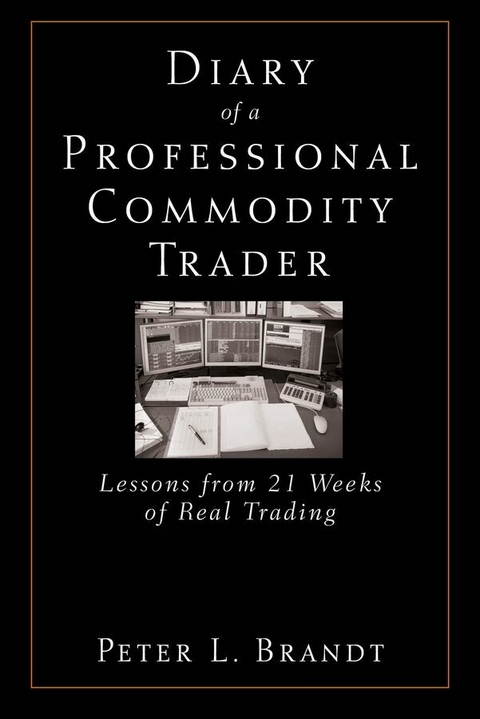
Diary of a Professional Commodity Trader (eBook)
John Wiley & Sons (Verlag)
978-0-470-94726-5 (ISBN)
PETER L. BRANDT has been a full time professional commodity and foreign exchange trader for over thirty years. He has worked as a broker to large industrial clients, traded for his own account, and was one of the early pioneers in the commodity hedge fund arena. Along the way, Brandt published a highly regarded newsletter called The Factor, and also collaborated with Bruce Babcock Jr. to publish the highly acclaimed book, Trading Commodity Futures with Classical Chart Patterns. Primarily devoted to trading proprietary capital in commodity and forex markets, Brandt has achieved a lofty average annual rate of return of 68 percent during his career. The author can be reached at plb.factor@gmail.com
Diary of a Professional Commodity Trader: Lessons from 21 Weeks of Real Trading Trading is generally far more difficult in practice than in theory. The reality is that no trade set up or individual trader or system can identify profitable trades in advance with complete certainty. In A Year of Trading, long-time trader Peter Brandt reveals the anxieties and uncertainties of trading in a diary of his 2009 trades. He explains his thought process as he searches for trading opportunities and executes them. Each trade includes charts, an analysis of the trade, and a play-by-play account of how the trade unfolds.
PETER L. BRANDT has been a full time professional commodity and foreign exchange trader for over thirty years. He has worked as a broker to large industrial clients, traded for his own account, and was one of the early pioneers in the commodity hedge fund arena. Along the way, Brandt published a highly regarded newsletter called The Factor, and also collaborated with Bruce Babcock Jr. to publish the highly acclaimed book, Trading Commodity Futures with Classical Chart Patterns. Primarily devoted to trading proprietary capital in commodity and forex markets, Brandt has achieved a lofty average annual rate of return of 68 percent during his career. The author can be reached at plb.factor@gmail.com
Introduction
One of the first things I check out in a new book is the number of pages prior to Chapter —long book introductions put me to sleep. I will assume that most of you are like me—you want to cut to the chase. The last thing I wanted to do was write a book with a lengthy introduction, but my opinion has changed now that I’m on the author’s side of the equation. It turns out introductions can be useful in providing necessary context and perspective for a book. And so, please forgive me for committing the sin I have always disliked—I think it will be worth it.
This is a book about me as a trader of commodity and forex markets and how I use price charts in my craft. I think of it as a mosaic: eventually the parts of this book will tie together in the same way that a good mosaic becomes visible only in its entirety. Piece by piece or section by section, a mosaic makes no sense. Only at a distance and in its fullness does a mosaic gain clarity and perspective. The concept of a mosaic describes how this book will unfold. First, a bit about how I got started in the business.
The Invention of a Commodity Trader
In 1972, shortly after graduating from the University of Minnesota with a degree in advertising, I moved to Chicago to work for one of the nation’s largest ad agencies. A neighbor was a trader at the Chicago Board of Trade (CBOT). Through our conversations and my visits to see him on the trading floor, I became captivated by the futures markets. In commodity trading I saw the opportunity to earn a good living, work for myself, and be challenged in a very exciting field. In short, I became hooked.
Everybody started in the commodity field at the bottom. Being hired at a sizable salary was not a reality of the business. I needed a plan B if I were to quit advertising and enter the commodity field. So, I asked the president of the advertising agency if he would hire me back at a 30 percent increase in salary if I quit, tried the commodity business for a year unsuccessfully, and reapplied for my old job. He agreed to the deal.
I entered the commodity business in 1976 when I was in my 20s with the singular goal of trading my own personal account. But I needed to learn the ropes first.
When I entered the business, most traders at the CBOT (as well as the Chicago Mercantile and the New York commodity exchanges) started at or near the bottom of the pecking order. The same thing exists to this day. An “MBA fast track” has never really existed in the trading pits. The learning curve is steep—the washout rate is high.
I learned the business by working for Continental Grain Company and Conti, its futures market brokerage operation. At the time Continental Grain was the second largest grain exporter in the world next to Cargill. Continental sold its grain merchandising business to Cargill in 1999.
During my time in the advertising field I had been working on the accounts of McDonald’s and Campbell’s Soup Company. It became a very fortunate coincidence that both companies were huge users of agricultural products.
Processors of agricultural commodities, such as Campbell’s Soup, had become accustomed to decades of oversupply conditions and stable commodity prices. But a number of events in the early 1970s, including global crop failures, led to massive bull markets in the price of agricultural products and nearly every raw material. In a matter of months the price of some commodity goods doubled. Figures I.1 and I.2 show gold and wheat prices as proxies for raw material prices.
FIGURE I.1 Spot Gold Prices, 1830–2009.
FIGURE I.2 Soft Wheat Prices, 1860–2009.
Food companies were not prepared for the price explosions taking place. Top management and purchasing executives of these companies were desperate for solutions. Few food processors had any experience with forward pricing in either the cash or futures markets.
This was the environment when I switched careers from advertising to commodities.
Immediately upon joining Conti, I approached the president of Campbell’s Soup Company with a proposal. I thought perhaps the futures markets could be a way for Campbell’s Soup to hedge its forward purchases.
I suggested that the company appoint a senior purchasing executive to relocate to Chicago for a time to determine if commodity contracts might be a beneficial management and purchasing tool. I further proposed that the designated purchasing executive and I would then submit a formal proposal to top management—and the proposal could just as likely nix as recommend the idea of futures contracts.
In the end, we recommended that the corporation could strategically use futures contracts in cocoa (Campbell’s Soup owned Godiva Chocolate at the time), corn and soybean meal (to grow chickens for its various frozen and canned products), soybean oil, iced broilers (then actively traded at the CBOT), live cattle and hogs (depending on the price relationship between the cuts of meats used by the company and the price of live animals on the hoof), and the three major wheat contracts traded in the U.S. (Campbell’s Soup made noodles by the ton and owned Oroweat and Pepperidge Farms bakeries).
Campbell’s Soup saw the wisdom in the use of commodity futures contracts. My consulting role with the company covered my business overhead and my family’s living expenses while I learned the futures business. Had I begun trading for myself immediately, I would have likely been forced rapidly back into advertising or another career path.
After learning the ropes for a couple of years, I began trading proprietary funds around 1980, starting with less than $10,000. Initially, my personal trading was not successful, although not disastrous. I tried just about every approach I heard or read about. The traders around me at the CBOT were making money, but I just couldn’t seem to find a niche that worked.
Then a friend introduced me to the book Technical Analysis of Stock Market Trends, written in the 1940s by John Magee and Robert Edwards. The book was—and still is—considered the bible of classical charting principles. I consumed the book in a weekend and have never looked back.
Chart trading offered me a unique combination of benefits not available with the other approaches I had attempted or considered, including:
- An indication of market direction
- A mechanism for timing
- A logical point of trade entry
- A means to determine risk
- A realistic target for taking profits
- The determination of a risk/reward relationship
I have been a chart trader ever since. More specifically, I trade breakouts of classical chart formations such as head and shoulders tops and bottoms, rectangles, channels, triangles, and the like. I focus on weekly and daily chart patterns that form over a period of four weeks to many months. Even though my focus on charts is longer term, my actual trading tends to be short term, with trades lasting anywhere from a day or two (in the case of losses) to a month or two.
Since 1981, my principle occupation has been trading proprietary funds, although off and on through the 1980s I sold trading research to other traders. In the late 1980s and early 1990s I traded some hedge funds for a couple of big money managers such as Commodities Corp. (since bought by Goldman Sachs). A number of the best hedge fund traders in the world have worked for Commodities Corp. (I do not pretend to be in their league.)
As a result of market burnout and an interest in nonmarket opportunities, in the early 1990s I began to distance myself from day-to-day contact with the markets and granted power of attorney over my own funds to another trader. It was not a successful experiment. From the mid-1990s through 2006 I pursued some personal non-profit interests (social causes) and did little or no trading at all. I started to employ my former trading plan again in January 2007.
In 1990, I cowrote a book with a since-deceased friend, Bruce Babcock, titled Trading Commodity Futures with Classical Chart Patterns, discussing in very general terms my approach to trading. That book sparked a desire to someday write a book providing much more detail on my trading operations. This book is the product of that desire.
My Proprietary Trading Record
For the active trading years of 1981–1995 (including four years when I granted power of attorney to another trader) and again starting in 2007, my average annual rate of return for proprietary funds has been 68.1 percent (annual Value Added Monthly Index [VAMI] method). I experienced one losing year during the time I was the sole trader for my proprietary funds (–4.7 percent in 1988). The numeric average of my worst annual month-ending drawdowns has been 15.4 percent. The performance capsule of my proprietary trading is shown in Figure I.3. Please read the disclaimers and discussion of my proprietary trading in the Author’s Note at the end of the book. Past performance is not necessarily indicative of future results.
FIGURE I.3 Factor LLC Proprietary Trading Record.
Why I Wrote This Book
In the business of commodity trading books, advisory services, seminars, and computerized trading programs, there is a lot of junk being peddled. There are numerous books written each year about speculating in stocks and commodities. Does the investment world really need another...
| Erscheint lt. Verlag | 14.1.2011 |
|---|---|
| Zusatzinfo | Charts: 223 B&W, 0 Color; Tables: 19 B&W, 0 Color |
| Sprache | englisch |
| Themenwelt | Recht / Steuern ► Wirtschaftsrecht |
| Wirtschaft ► Betriebswirtschaft / Management ► Finanzierung | |
| Schlagworte | Finance & Investments • Finance & Investments Special Topics • Finanz- u. Anlagewesen • Finanzwesen • Peter Brandt, Peter L. Brandt, 21 Weeks of trading, diary of a top trader, strategies of a top trader, strategy of a top trader, trading diary, real life trading stories, real world trading stories, real trading stories, real trading lessons, trading war stories, trading principles, the trading process, the process of trading, trading opportunities, trading methods, the life of a trader, trading risk, reality of trading • Spezialthemen Finanz- u. Anlagewesen |
| ISBN-10 | 0-470-94726-8 / 0470947268 |
| ISBN-13 | 978-0-470-94726-5 / 9780470947265 |
| Informationen gemäß Produktsicherheitsverordnung (GPSR) | |
| Haben Sie eine Frage zum Produkt? |
 PDF (Adobe DRM)
Größe: 6,0 MB
Kopierschutz: Adobe-DRM
Adobe-DRM ist ein Kopierschutz, der das eBook vor Mißbrauch schützen soll. Dabei wird das eBook bereits beim Download auf Ihre persönliche Adobe-ID autorisiert. Lesen können Sie das eBook dann nur auf den Geräten, welche ebenfalls auf Ihre Adobe-ID registriert sind.
Details zum Adobe-DRM
Dateiformat: PDF (Portable Document Format)
Mit einem festen Seitenlayout eignet sich die PDF besonders für Fachbücher mit Spalten, Tabellen und Abbildungen. Eine PDF kann auf fast allen Geräten angezeigt werden, ist aber für kleine Displays (Smartphone, eReader) nur eingeschränkt geeignet.
Systemvoraussetzungen:
PC/Mac: Mit einem PC oder Mac können Sie dieses eBook lesen. Sie benötigen eine
eReader: Dieses eBook kann mit (fast) allen eBook-Readern gelesen werden. Mit dem amazon-Kindle ist es aber nicht kompatibel.
Smartphone/Tablet: Egal ob Apple oder Android, dieses eBook können Sie lesen. Sie benötigen eine
Geräteliste und zusätzliche Hinweise
Buying eBooks from abroad
For tax law reasons we can sell eBooks just within Germany and Switzerland. Regrettably we cannot fulfill eBook-orders from other countries.
 EPUB (Adobe DRM)
Kopierschutz: Adobe-DRM
Adobe-DRM ist ein Kopierschutz, der das eBook vor Mißbrauch schützen soll. Dabei wird das eBook bereits beim Download auf Ihre persönliche Adobe-ID autorisiert. Lesen können Sie das eBook dann nur auf den Geräten, welche ebenfalls auf Ihre Adobe-ID registriert sind.
Details zum Adobe-DRM
Dateiformat: EPUB (Electronic Publication)
EPUB ist ein offener Standard für eBooks und eignet sich besonders zur Darstellung von Belletristik und Sachbüchern. Der Fließtext wird dynamisch an die Display- und Schriftgröße angepasst. Auch für mobile Lesegeräte ist EPUB daher gut geeignet.
Systemvoraussetzungen:
PC/Mac: Mit einem PC oder Mac können Sie dieses eBook lesen. Sie benötigen eine
eReader: Dieses eBook kann mit (fast) allen eBook-Readern gelesen werden. Mit dem amazon-Kindle ist es aber nicht kompatibel.
Smartphone/Tablet: Egal ob Apple oder Android, dieses eBook können Sie lesen. Sie benötigen eine
Geräteliste und zusätzliche Hinweise
Buying eBooks from abroad
For tax law reasons we can sell eBooks just within Germany and Switzerland. Regrettably we cannot fulfill eBook-orders from other countries.
aus dem Bereich