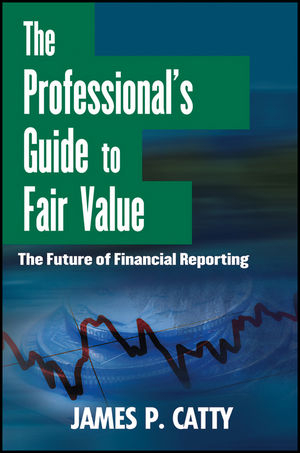
The Professional's Guide to Fair Value (eBook)
256 Seiten
John Wiley & Sons (Verlag)
978-1-118-18542-1 (ISBN)
value
With the important role fair value is playing in the creation of
a converged set of global accounting standards, demand for products
in this category is growing spectacularly. The elements and basics
of fair value are covered, including risk, dealing with the SEC,
and details on legal responsibility. In addition, sample financial
statements are included, along with tables, recommended applicable
techniques, and management checklists for those who are responsible
for preparing and approving of financial statements.
* Written by the Chairman and co-CEO of the International
Association of Consultants, Valuators and Analysts (IACVA)
* Includes sample financial statements of both U.S. and foreign
companies
Appropriate for anyone involved professionally with
finance--managers, accountants, investors, bankers,
instructors, and students--The Professional's Guide to Fair
Value is a reliable reference on the ins and outs of fair value
financial disclosure.
James P. Catty has been engaged in business valuations around the world for more than fifty years and has undertaken speaking engagements in China, Germany, Romania, Taiwan, Turkey, the U.K., and the U.S. He is Chairman of the International Association of Consultants, Valuators and Analysts (IACVA); President of Corporate Valuation Services Limited (CVS), Toronto; and of counsel to Hanlin Moss, PS in Seattle, Washington, and Xi'an, China. Catty is the author of the Wiley Guide to Fair Value under IFRS.
Preface xi
Acknowledgments xv
Chapter 1: Significance of Value 1
Business Uses for Valuation 2
Mergers and Acquisitions 2
Financial Reporting 3
Investment Bankers versus Valuators 8
Valuation Requirements 8
Litigation Risks 9
Ten Commandments of Valuation 10
Chapter 2: Fair Value Concept 13
Relevant Pronouncements 14
Definitions 14
Market Participants 15
Fair Value Accounting 16
Revaluation under IFRS 16
Other Types of Value 17
Valuation Principles 19
Reporting and Cash-Generating Units 20
Chapter 3: Fair Value Framework 21
Stage 1: Determine the Unit of Account 22
Stage 2: Evaluate the Premise of Value 24
Stage 3: Assess the Principal Market 29
Stage 4: Establish the Most Advantageous Market 30
Stage 5: Select Appropriate Valuation Methods 33
Stage 6: Estimate Fair Value Conclusions 37
Chapter 4: Taming the Future 41
Definitions 42
Effect of Market Participants' Assumptions 43
Scenario Analysis 45
Scenario Implications 49
Chapter 5: Projecting What Is to Come 53
Base the Future on the Past 54
The Truth Is in the Parts 56
Avoid Unnecessary Risks 59
Garbage In, Garbage Out 63
Believable and Likely Conclusions 66
Quality of Earnings 67
Conclusion 68
Chapter 6: The Market Approach to Fair Value 69
Nature of Markets 70
Classifying Assets 72
Comparable Transactions 74
Guideline Entities 76
Guideline Entities Example 79
Licensed Asset Example 82
Conclusion 84
Chapter 7: The Cost Approach to Fair Value 85
Current Replacement Cost 85
Deductions 87
Integrating the Factors 90
Residual Value 92
Useful Lives 92
Valuing Intangible Assets by the Cost Approach 97
Conclusion 103
Chapter 8: The Income Approach to Fair Value 105
Capitalization Methods 106
Income Approach--Discounting 110
Terminal Amounts 115
Application to Intangible Assets 116
Chapter 9: Sources of Value--Profits 121
Structure of Businesses 121
Innovation 122
DuPont Analyses 129
Chapter 10: Sources of Value--Risks 135
Reducing Risks 136
Continual Monitoring and Testing 136
Dealing with Biases 138
Risk Rate Component Model 139
Intellectual Capital Value Drivers 146
Conclusion 147
Chapter 11: Valuing Liabilities 149
Liabilities Transferred Rather Than Settled 150
Asset Retirement Obligations 157
Contingent Liabilities 158
Chapter 12: Business Combinations 161
Do Mergers Pay Off? 162
Why Merge? 163
Determination of Synergies 166
Intrinsic and Investment Values 167
Quantification 167
Chapter 13: Purchase Price Allocation 173
Stage 1: Determine the Acquirer 174
Stage 2: Establish the Consideration's Fair Value 176
Knowledge of the Industry 178
Stage 3: Identify All the Items Involved 180
Stage 4: Select Appropriate Valuation Techniques 188
Stage 5: Estimate Fair Values and Reconcile Rates of Return190
Conclusion 192
Chapter 14: Impairment 193
Reporting Units 194
Cash-Generating Units 196
Goodwill 197
Allocations 198
GAAP Long-Lived Assets Impairment Test 198
IFRS Impairment Test 200
GAAP Goodwill Impairment Test 202
Chapter 15: The Auditor's Blessing 207
Auditing Fair Values 208
Conclusion 220
About the Author 221
Index 223
| Erscheint lt. Verlag | 10.1.2012 |
|---|---|
| Reihe/Serie | Wiley Corporate F&A | Wiley Corporate F&A |
| Sprache | englisch |
| Themenwelt | Recht / Steuern ► Wirtschaftsrecht |
| Wirtschaft ► Betriebswirtschaft / Management ► Rechnungswesen / Bilanzen | |
| Schlagworte | Accounting • Bewertung • Rechnungswesen • Valuation |
| ISBN-10 | 1-118-18542-0 / 1118185420 |
| ISBN-13 | 978-1-118-18542-1 / 9781118185421 |
| Informationen gemäß Produktsicherheitsverordnung (GPSR) | |
| Haben Sie eine Frage zum Produkt? |
 EPUB (Adobe DRM)
Kopierschutz: Adobe-DRM
Adobe-DRM ist ein Kopierschutz, der das eBook vor Mißbrauch schützen soll. Dabei wird das eBook bereits beim Download auf Ihre persönliche Adobe-ID autorisiert. Lesen können Sie das eBook dann nur auf den Geräten, welche ebenfalls auf Ihre Adobe-ID registriert sind.
Details zum Adobe-DRM
Dateiformat: EPUB (Electronic Publication)
EPUB ist ein offener Standard für eBooks und eignet sich besonders zur Darstellung von Belletristik und Sachbüchern. Der Fließtext wird dynamisch an die Display- und Schriftgröße angepasst. Auch für mobile Lesegeräte ist EPUB daher gut geeignet.
Systemvoraussetzungen:
PC/Mac: Mit einem PC oder Mac können Sie dieses eBook lesen. Sie benötigen eine
eReader: Dieses eBook kann mit (fast) allen eBook-Readern gelesen werden. Mit dem amazon-Kindle ist es aber nicht kompatibel.
Smartphone/Tablet: Egal ob Apple oder Android, dieses eBook können Sie lesen. Sie benötigen eine
Geräteliste und zusätzliche Hinweise
Buying eBooks from abroad
For tax law reasons we can sell eBooks just within Germany and Switzerland. Regrettably we cannot fulfill eBook-orders from other countries.
aus dem Bereich