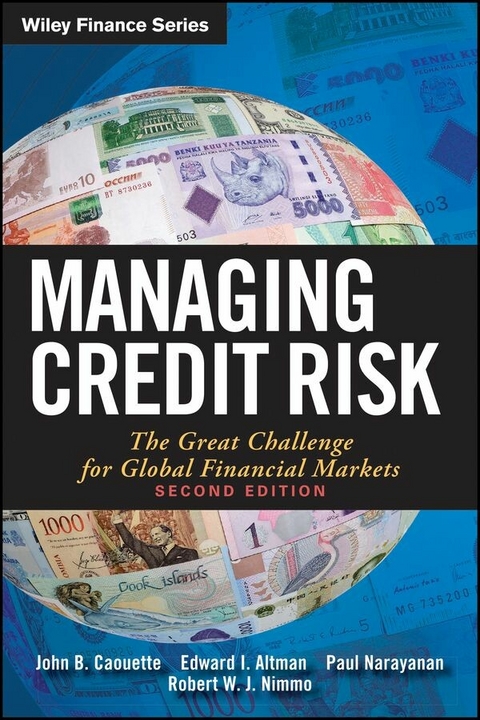
Managing Credit Risk (eBook)
John Wiley & Sons (Verlag)
978-1-118-16069-5 (ISBN)
JOHN B. CAOUETTE is the former vice chairman of MBIA Insurance Corporation and is currently Chairman of Channel Capital Group, a European-based credit derivative products company.
EDWARD I. ALTMAN, PHD, MBA, is the Max L. Heine Professor of Finance at the Stern School of Business, New York University. Previously, he chaired the Stern School's MBA Program for twelve years. He has been acclaimed as the world's leading academic on credit risk and distressed and high-yield debt for most of his forty-year career.
PAUL NARAYANAN is Director of Credit Portfolio Analytics at American International Group, Inc. He has been involved with credit risk management for more than two decades and in the development and deployment of analytical solutions for credit issues.
ROBERT W. J. NIMMO is the former group risk director of Barclays PLC, where he was responsible for all the risk management activities of the group covering credit, market, operational risk, and compliance. He was also the chief risk officer for Wachovia Corporation (2000-2001) and for Westpac Banking Corporation (1993-2000).
Managing Credit Risk, Second Edition opens with a detailed discussion of today s global credit markets touching on everything from the emergence of hedge funds as major players to the growing influence of rating agencies. After gaining a firm understanding of these issues, you ll be introduced to some of the most effective credit risk management tools, techniques, and vehicles currently available. If you need to keep up with the constant changes in the world of credit risk management, this book will show you how.
JOHN B. CAOUETTE is the former vice chairman of MBIA Insurance Corporation and is currently Chairman of Channel Capital Group, a European-based credit derivative products company. EDWARD I. ALTMAN, PHD, MBA, is the Max L. Heine Professor of Finance at the Stern School of Business, New York University. Previously, he chaired the Stern School's MBA Program for twelve years. He has been acclaimed as the world's leading academic on credit risk and distressed and high-yield debt for most of his forty-year career. PAUL NARAYANAN is Director of Credit Portfolio Analytics at American International Group, Inc. He has been involved with credit risk management for more than two decades and in the development and deployment of analytical solutions for credit issues. ROBERT W. J. NIMMO is the former group risk director of Barclays PLC, where he was responsible for all the risk management activities of the group covering credit, market, operational risk, and compliance. He was also the chief risk officer for Wachovia Corporation (2000-2001) and for Westpac Banking Corporation (1993-2000).
About the Authors xi
Introduction xv
Chapter 1 Credit Risk: The Great Challenge For The Global Economy 1
Chapter 2 Credit Culture 23
Chapter 3 Classic Industry Players: Banks, Savings Institutions, Insurance: Companies, Finance Companies, and Special Purpose Entities 41
Chapter 4 The Portfolio Managers: Investment Managers, Mutual Funds, Pension Funds, and Hedge Funds 59
Chapter 5 Structural Hubs: Clearinghouses, Derivative Product Companies, and Exchanges 69
Chapter 6 The Rating Agencies 81
Chapter 7 Classic Credit Analysis 103
Chapter 8 Asset-Based Lending and Lease Finance 117
Chapter 9 Introduction to Credit Risk Models 127
Chapter 10 Credit Risk Models Based upon Accounting Data and Market Values 139
Chapter 11 Corporate Credit Risk Models Based on Stock Price 181
Chapter 12 Consumer Finance Models 201
Chapter 13 Credit Models for Small Business, Real Estate, and Financial Institutions 223
Chapter 14 Testing and Implementation of Credit Risk Models 237
Chapter 15 About Corporate Default Rates 251
Chapter 16 Default Recovery Rates and LGD in Credit Risk Modeling and Practice 277
Chapter 17 Credit Risk Migration 311
Chapter 18 Introduction to Portfolio Approaches 325
Chapter 19 Economic Capital and Capital Allocation 349
Chapter 20 Application of Portfolio Approaches 367
Chapter 21 Credit Derivatives 411
Chapter 22 Counterparty Risk 437
Chapter 23 Country Risk Models 455
Chapter 24 Structured Finance 475
Chapter 25 New Markets, New Players, New Ways to Play 509
Chapter 26 Market Chaos and a Reversion to the Mean: The Rediscovery of Culture as a Critical Risk Management Tool 539
Notes 553
Appendix 569
Index 607
Introduction
Credit risk is the oldest form of risk in the financial markets. If credit can be defined as “nothing but the expectation of a sum of money within some limited time,” then credit risk is the chance that this expectation will not be met. Credit risk is as old as lending itself, which means that it dates back as far as 1800 BCE.1 It is essentially unchanged from ancient Egyptian times. Now as then, there is always an element of uncertainty as to whether a given borrower will repay a particular loan. This book is about how financial institutions are using new tools and techniques to reshape, price, and distribute this ancient form of financial risk.
Ever since banks as we know them were organized in Florence 700 years ago, they have been society’s primary lending institutions.2 Managing Credit Risk has formed the core of their expertise. Traditionally, bankers and other lenders have handled credit evaluation in much the same that tailors approach the creation of a custom-made suit—by carefully measuring the customer’s needs and capacities to make sure the financing is a good fit. When we originally wrote this book in the late 1990s, it was accurate to say that the approaches taken then did not differ fundamentally from the one used by the earliest banks. This is not necessarily the case today, although the changes we will comment on later in the book still vary from institution to institution, and certainly there are major differences between money center institutions, regional banks and banks in emerging markets. Meanwhile the first decade of the twenty-first century has seen the credit markets become the focus of a whole new category of lender including hedge funds, private equity firms, and other institutional players who are bypassing the traditional credit methodologies in favor of the new ways of credit risk management. Thanks to the creation of credit derivative products, market participants can take or shed credit risk on any entity anonymously, that is, without entering into any legal credit arrangement with that entity or lending to it. This is one of the reasons you find a bank in Germany taking credit risk on a subprime home mortgage in Kansas without ever seeing either the borrower or the property. This used to be the preserve of the local Kansas bank.
It is easier to design a suit for a customer you already know. Because of the very nature of this approach, banks historically have been drawn to relationship banking. This led to a pattern where they were more concerned about their relationship with a customer than they were about the profitability of a specific loan or about the effect a given transaction may have on their overall loan portfolio. As long as a borrower met the credit criteria, the bank did not pay much attention to concentrations that were building up. Citibank’s buildup of construction loans and the effect they had on the institution when these loans went sour in the late 1980s is a case in point. At the time of the publication of the first edition of Managing Credit Risk, the banking industry had begun to recover from a crisis that had emerged nearly a decade earlier. There was widespread recognition within the industry that the traditional approach to lending had led to unacceptable results and that banks had done a rather poor job of pricing and Managing Credit Risk.
In some ways the banking crisis of the day was just what you would expect from an industry that was adapting to a more limited role in the provision of credit. In other ways, it reflected an evaluation that the traditional banker/client roles needed some updating if not revolutionary change. Those who read our first edition would not have had to look hard to find a decidedly negative view of how banks were dealing with credit risk at the turn of the century. Less than a decade later, things look a lot different. Later in this introduction, we list the 10 major changes that are shaping the management of all risk, credit included. Those changes are significant and banks are at the cutting edge of the change. So we take a more generous view of the way banks are managing credit and portfolio risk and in many places you will see us holding many of them up as examples of excellence in the management of this risk. They are better, but as we can now see in the subprime mortgage crisis at the end of 2007, they are still capable of major missteps.
The first decade of the twenty-first century has seen the credit markets transformed by several institutional developments. First, the markets mirror their environment: They have become global, highly innovative, and of critical importance to the global economy. The top market players have developed into universal megabanks. There are a handful of such organizations, which were formed from the top ranks of what was once the top tier of commercial or investment banks. Now they do both investment and commercial banking as well as many other types of investment related services and lending. The names are familiar—-Citicorp, JPMorgan Chase, Goldman Sachs, Morgan Stanley, UBS, Merrill Lynch, Deutsche Bank, Credit Suisse, Bank of America, and so on. These organizations are on the cutting edge of credit risk management and are a proving ground for “best practices” within the industry. Secondly, real credit risk has been embraced by the capital markets and this has fueled the development of whole new categories of lenders including structured finance lenders, hedge funds, private equity firms, and others who, for the most part, are finding new ways to approach credit risk management. Thirdly, credit risk management has evolved into total enterprise risk management. Best practice for the major players is to include market, operational, and reputation risk alongside the management of credit. Finally, the shape and day-to-day operations of the credit risk markets in this new millennium are heavily influenced by regulators who are setting the rules (e.g., Basel II and Solvency II) for most of the players in a much more sophisticated way, and by the rating agencies whose rating practices have set the market standard of credit risk measurement—especially with respect to securitized products.
The counterpart to credit risk is market risk—the chance that an investment’s value will change in price as a result of marketplace forces such as interest rates, commodity prices, and currency levels. Market risk has affected financial institutions ever since markets were created. Techniques for managing market risk have undergone a radical change. Anyone who tours a large trading floor at a bank or an investment bank can see that the management of market risk has been the focus of tremendous technological development. Major breakthroughs have turned this aspect of risk management into something of a science—one that is applied to both equities and debt instruments. Market risk developments were an important precedent for our focus on credit risk management. Some have commented that the 1980s were a period when market participants focused on how to manage market risk. This led to the Basel Committee introduction in 1995 of a system that allowed banking institutions to set capital requirements based on market risk levels calculations using the models the banks had developed. This focus on models and other mathematical analysis by the Basel Committee continued as they turned to the management of credit risk in Basel I and II.
This is not to suggest that market risk has been eliminated. In the case of America’s savings and loan associations, for example, an entire industry quaked because of bad bets made on commercial real estate asset values during a period when deregulation was increasing the risks in the financial markets. Periodically, we learn of major losses experienced by trading firms that are the result of “rogue traders” who are identified—after the fact and accused of misappropriating the firm’s capital. Sometimes the problem is that a firm does not really understand what it is doing (despite a great pedigree such as with Long Term Capital Management) and bets the ranch on a losing idea.
Despite its shortcomings in anticipating systemic events and overcoming the actions of some individuals, the science of managing market risk does nevertheless reflect late twentieth-century knowledge and technology. For example, banks have adopted the concepts of gap management, duration, and even the theory of contingent claims. Major banks have created huge markets for interest rate and currency swaps.
By contrast, in 1998, when we first published Managing Credit Risk, the management of credit risk at banks was, to a substantial degree, a kind of cottage industry in which individual leading decisions were made to order. As befitted a cottage industry, there was, for the most part, no common credit language. Practitioners, academics, and regulators heatedly debated fundamental measurements such as default timing, default events, workout costs, and recoveries. There was a dearth of reliable quantitative data on financial and nonfinancial variables as well as on recovery rates following failure. There was, however, at the time, a considerable effort underway to improve the situation. Many studies were initiated by Edward Altman and the rating agencies on default levels and recovery rates, but they were all a work in progress and not yet internalized by many leading institutions. Ten years later things look a lot different. Credit risk is still a tougher risk to master than market risk. There are many more variables to consider. However, we now have many more tools, much more information and...
| Erscheint lt. Verlag | 12.7.2011 |
|---|---|
| Reihe/Serie | Wiley Finance |
| Wiley Finance Editions | Wiley Finance Editions |
| Sprache | englisch |
| Themenwelt | Recht / Steuern ► Wirtschaftsrecht |
| Wirtschaft ► Betriebswirtschaft / Management ► Finanzierung | |
| Betriebswirtschaft / Management ► Spezielle Betriebswirtschaftslehre ► Bankbetriebslehre | |
| Schlagworte | achievement • Analysis • Authors • backdrop • concise • credit • Derivat (Wertpapier) • dramatic • Finance & Investments • Financial Engineering • Finanzmanagement • Finanztechnik • Finanz- u. Anlagewesen • Industry evolution • Intellectual • investors • Kreditrisiko • Managing • managing credit • Markets • Officer • outstanding • Overview • Practical • radical • Risikomanagement • Risk • State • View • Wirtschaft / Management |
| ISBN-10 | 1-118-16069-X / 111816069X |
| ISBN-13 | 978-1-118-16069-5 / 9781118160695 |
| Informationen gemäß Produktsicherheitsverordnung (GPSR) | |
| Haben Sie eine Frage zum Produkt? |
 PDF (Adobe DRM)
Größe: 4,9 MB
Kopierschutz: Adobe-DRM
Adobe-DRM ist ein Kopierschutz, der das eBook vor Mißbrauch schützen soll. Dabei wird das eBook bereits beim Download auf Ihre persönliche Adobe-ID autorisiert. Lesen können Sie das eBook dann nur auf den Geräten, welche ebenfalls auf Ihre Adobe-ID registriert sind.
Details zum Adobe-DRM
Dateiformat: PDF (Portable Document Format)
Mit einem festen Seitenlayout eignet sich die PDF besonders für Fachbücher mit Spalten, Tabellen und Abbildungen. Eine PDF kann auf fast allen Geräten angezeigt werden, ist aber für kleine Displays (Smartphone, eReader) nur eingeschränkt geeignet.
Systemvoraussetzungen:
PC/Mac: Mit einem PC oder Mac können Sie dieses eBook lesen. Sie benötigen eine
eReader: Dieses eBook kann mit (fast) allen eBook-Readern gelesen werden. Mit dem amazon-Kindle ist es aber nicht kompatibel.
Smartphone/Tablet: Egal ob Apple oder Android, dieses eBook können Sie lesen. Sie benötigen eine
Geräteliste und zusätzliche Hinweise
Zusätzliches Feature: Online Lesen
Dieses eBook können Sie zusätzlich zum Download auch online im Webbrowser lesen.
Buying eBooks from abroad
For tax law reasons we can sell eBooks just within Germany and Switzerland. Regrettably we cannot fulfill eBook-orders from other countries.
 EPUB (Adobe DRM)
Kopierschutz: Adobe-DRM
Adobe-DRM ist ein Kopierschutz, der das eBook vor Mißbrauch schützen soll. Dabei wird das eBook bereits beim Download auf Ihre persönliche Adobe-ID autorisiert. Lesen können Sie das eBook dann nur auf den Geräten, welche ebenfalls auf Ihre Adobe-ID registriert sind.
Details zum Adobe-DRM
Dateiformat: EPUB (Electronic Publication)
EPUB ist ein offener Standard für eBooks und eignet sich besonders zur Darstellung von Belletristik und Sachbüchern. Der Fließtext wird dynamisch an die Display- und Schriftgröße angepasst. Auch für mobile Lesegeräte ist EPUB daher gut geeignet.
Systemvoraussetzungen:
PC/Mac: Mit einem PC oder Mac können Sie dieses eBook lesen. Sie benötigen eine
eReader: Dieses eBook kann mit (fast) allen eBook-Readern gelesen werden. Mit dem amazon-Kindle ist es aber nicht kompatibel.
Smartphone/Tablet: Egal ob Apple oder Android, dieses eBook können Sie lesen. Sie benötigen eine
Geräteliste und zusätzliche Hinweise
Buying eBooks from abroad
For tax law reasons we can sell eBooks just within Germany and Switzerland. Regrettably we cannot fulfill eBook-orders from other countries.
aus dem Bereich