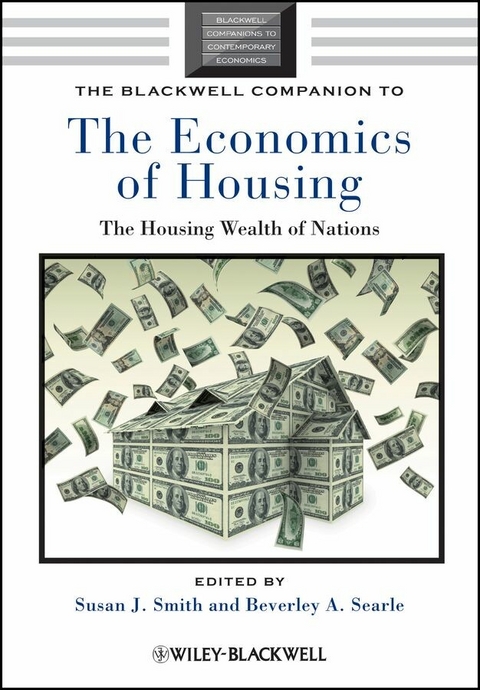
The Blackwell Companion to the Economics of Housing (eBook)
- Features 24 original essays, including an editorial introduction and three section overviews
- Includes 39 world-class authors from a mix of educational and financial organizations in the UK, Europe, Australia, and North America
- Broadly-based, scholarly, and accessible, serving students and professionals who wish to understand how today’s housing economy works
- Profiles the role and relevance of housing wealth; the mismanagement of mortgage debt; and the pitfalls and potential of hedging housing risk
- Key topics include: the housing price bubble and crash; the subprime mortgage crisis in the US and its aftermath; the links between housing wealth, the macroeconomy, and the welfare of home-occupiers; the mitigation of credit and housing investment risks
- Specific case studies help to illustrate concepts, along with new data sets and analyses to illustrate empirical points
Susan J. Smith is Mistress of Girton College Cambridge. She was previously Professor of Geography and a Director of the Institute of Advanced Study at Durham University. She is a graduate of Oxford University (MA, DPhil), a Fellow of the British Academy and of the Royal Society of Edinburgh, an Academician of the Academy of Social Sciences and a member of the Society of Authors. Professor Smith has published over 100 scholarly papers covering topics that range from residential segregation to health discrimination, from mortgage equity withdrawal to spread-betting on home price dynamics. Her books include Housing & Social Policy (1990), Housing for Health (2000), The Politics of Race and Residence (1989), and Children at Risk (1995). She is Editor-in-chief of the forthcoming International Encyclopedia of Housing and Home (2012) and has written a variety of press articles on home prices and housing markets.
Beverley A. Searle is a Lecturer in Human Geography at Durham University. She gained a PhD in 2005 from the University of York. Her research interest focuses on housing wealth and households' welfare and well-being. She is author of Well-being: In Search of a Good Life? (2008).
The Blackwell Companion to the Economics of Housing will help students and professionals alike to explore key elements of the housing economy: home prices, housing wealth, mortgage debt, and financial risk. Features 24 original essays, including an editorial introduction and three section overviews Includes 39 world-class authors from a mix of educational and financial organizations in the UK, Europe, Australia, and North America Broadly-based, scholarly, and accessible, serving students and professionals who wish to understand how today s housing economy works Profiles the role and relevance of housing wealth; the mismanagement of mortgage debt; and the pitfalls and potential of hedging housing risk Key topics include: the housing price bubble and crash; the subprime mortgage crisis in the US and its aftermath; the links between housing wealth, the macroeconomy, and the welfare of home-occupiers; the mitigation of credit and housing investment risks Specific case studies help to illustrate concepts, along with new data sets and analyses to illustrate empirical points
Susan J. Smith is Mistress of Girton College Cambridge. She was previously Professor of Geography and a Director of the Institute of Advanced Study at Durham University. She is a graduate of Oxford University (MA, DPhil), a Fellow of the British Academy and of the Royal Society of Edinburgh, an Academician of the Academy of Social Sciences and a member of the Society of Authors. Professor Smith has published over 100 scholarly papers covering topics that range from residential segregation to health discrimination, from mortgage equity withdrawal to spread-betting on home price dynamics. Her books include Housing & Social Policy (1990), Housing for Health (2000), The Politics of Race and Residence (1989), and Children at Risk (1995). She is Editor-in-chief of the forthcoming International Encyclopedia of Housing and Home (2012) and has written a variety of press articles on home prices and housing markets. Beverley A. Searle is a Lecturer in Human Geography at Durham University. She gained a PhD in 2005 from the University of York. Her research interest focuses on housing wealth and households' welfare and well-being. She is author of Well-being: In Search of a Good Life? (2008).
Chapter 1: Introduction (Susan J. Smith, Beverley A. Searle, and
Gareth D. Powells).
Part One: Banking on Housing.
Introduction (Editors).
Chapter 2: Housing and Mortgage markets: An OECD perspective
(Nathalie Girouard).
Chapter 3: Is Housing Wealth an 'ATM'?:
International Trends (Vladimir Kluyev and Paul Mills).
Chapter 4: Housing Wealth Effects and Course of the US
Economy: Theory, Evidence, and Policy Implications (Eric S.
Belsky).
Chapter 5: The rise in house prices and household debt in the
United Kingdom: potential causes and implications (Matt Waldron and
Fabrizio Zampolli).
Chapter 6: Housing Wealth and Mortgage Debt in Australia (Mike
Berry).
Chapter 7: A Survey of Housing Equity Withdrawal and Injection
in Australia (Carl Schwartz, Tim Hampton, Christine Lewis and David
Norman).
Chapter 8: What do we know about equity withdrawal by households
in New Zealand? (Mark Smith).
Chapter 9: What happened to the housing system? (Duncan
Maclennan).
Part Two: Housing Wealth as a Financial Buffer.
Introduction (Editors).
Chapter 10: Trading on housing wealth: political risk in an
ageing society (Mike Berry and Tony Dalton).
Chapter 11: Housing Equity Withdrawal and Retirement: Evidence
from the Household, Income and Labour Dynamics in Australia Survey
(HILDA) (Gavin Wood and Christian A. Nygaard).
Chapter 12: Housing Markets, Wealth and
'Self-Insurance' in Spain (Joan Costa-Font, Joan Gill
and Oscar Mascarilla).
Chapter 13: Housing wealth: a safety net of last resort?
Findings from a European study (Deborah Quilgars and Anwen
Jones).
Chapter 14: 'Pots of gold': Housing wealth and economic
wellbeing in Australia (Val Colic-Peisker, Guy Johnson and Susan J.
Smith).
Chapter 15: Housing Wealth as Insurance: Insights from the
UK (Beverley A Searle and Susan J Smith).
Chapter 16: Housing to manage debt and family care in the USA
(Helen Jarvis).
Chapter 17: The Subprime State of Race (Elvin K. Wyly).
Chapter 18: The Housing Finance Revolution (Richard Green and
Susan Wachter).
Part Three: Mitigating Housing Risk.
Introduction (Editors).
Chapter 19: How Housing Busts End: House Prices, User Cost and
Rigidities During Down Cycles (Karl E. Case and John M.
Quigley).
Chapter 20: Is there a Role for Shared Equity Products in
Twenty-First Century Housing? Experience in Australia and the UK
(Christine Whitehead, and Judith Yates).
Chapter 21: Trading on house price risk: Index derivatives
and home equity insurance (Peter Englund).
Chapter 22: Hedging Housing Risk: A Financial Markets
Perspective (Jonathan Reiss, John Blank, Peter Sceats, John Edwards
with Susan J Smith).
Creating housing futures: a view from the market (Jonathan
Reiss).
Residential property derivatives: exchange-traded futures and
options (John Blank).
Residential Property Derivatives: The role and relevance of
over-the-counter trading (Peter Sceats).
An interim Solution (John Edwards).
Chapter 23: Hedging Housing Risk: Is it Feasible? (Steve Swidler
and Harris Hollans).
Chapter 24: Housing Risk and Property Derivatives: the Role of
Financial Engineering (Juerg Syz).
Chapter 25: Housing Futures: A role for derivatives? (Susan J.
Smith).
"The book is a valuable contribution to a range of
significant ongoing debates about the role of homeownership and the
extent to which this can form the basis of assets-based welfare
regimes . . .The present work provides an important step towards
the exploration of these wider dimensions." (Urban
Studies, 1 May 2013)
"A valuable addition to the housing, economics, and public
policy literature. Highly recommended. Upper-division undergraduate
students through professionals." (Choice, 1 March 2011)
"Smith and Searle's book can help students easily comprehend the
importance of housing market performance in an economy. It should
be very useful to urban and real estate students in every level as
well as to a wider variety of readers."
--Yong Tu, National University of Singapore
"The Companion is a timely resource interlinking housing
studies and economics, and arguing convincingly that they belong at
the forefront of new thinking on public policy."
--Ian Skelton, University of Manitoba
| Erscheint lt. Verlag | 22.1.2010 |
|---|---|
| Reihe/Serie | Blackwell Companions to Contemporary Economics |
| Blackwell Companions to Contemporary Economics | Blackwell Companions to Contemporary Economics |
| Sprache | englisch |
| Themenwelt | Recht / Steuern ► Wirtschaftsrecht |
| Wirtschaft ► Betriebswirtschaft / Management | |
| Wirtschaft ► Volkswirtschaftslehre | |
| Schlagworte | Business & Management • Housing economics • Housing finance • Immobilien u. Grundbesitz • mortgage markets • Property & Real Estate • real estate economics • subprime mortgage • Volkswirtschaftslehre • Wirtschaft u. Management |
| ISBN-13 | 9781444317985 / 9781444317985 |
| Informationen gemäß Produktsicherheitsverordnung (GPSR) | |
| Haben Sie eine Frage zum Produkt? |
 PDF (Adobe DRM)
Kopierschutz: Adobe-DRM
Adobe-DRM ist ein Kopierschutz, der das eBook vor Mißbrauch schützen soll. Dabei wird das eBook bereits beim Download auf Ihre persönliche Adobe-ID autorisiert. Lesen können Sie das eBook dann nur auf den Geräten, welche ebenfalls auf Ihre Adobe-ID registriert sind.
Details zum Adobe-DRM
Dateiformat: PDF (Portable Document Format)
Mit einem festen Seitenlayout eignet sich die PDF besonders für Fachbücher mit Spalten, Tabellen und Abbildungen. Eine PDF kann auf fast allen Geräten angezeigt werden, ist aber für kleine Displays (Smartphone, eReader) nur eingeschränkt geeignet.
Systemvoraussetzungen:
PC/Mac: Mit einem PC oder Mac können Sie dieses eBook lesen. Sie benötigen eine
eReader: Dieses eBook kann mit (fast) allen eBook-Readern gelesen werden. Mit dem amazon-Kindle ist es aber nicht kompatibel.
Smartphone/Tablet: Egal ob Apple oder Android, dieses eBook können Sie lesen. Sie benötigen eine
Geräteliste und zusätzliche Hinweise
Buying eBooks from abroad
For tax law reasons we can sell eBooks just within Germany and Switzerland. Regrettably we cannot fulfill eBook-orders from other countries.
aus dem Bereich