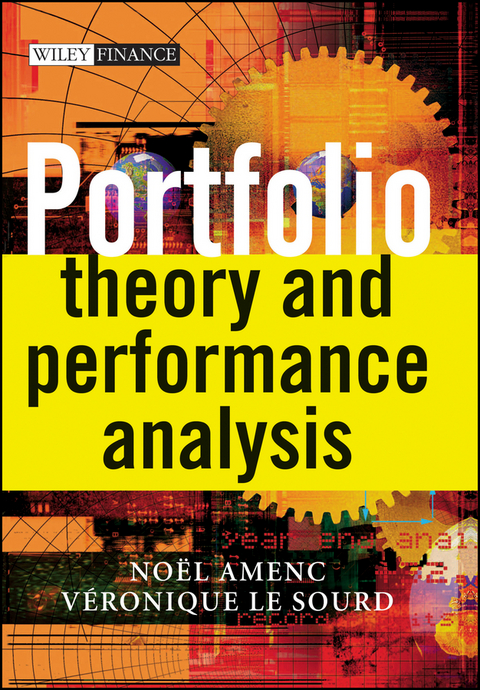
In these bear market times, performance evaluation of portfolio managers is of central focus. This book will be one of very few on the market and is by a respected member of the profession.
- Allows the professionals, whether managers or investors, to take a step back and clearly separate true innovations from mere improvements to well-known, existing techniques
- Puts into context the importance of innovations with regard to the fundamental portfolio management questions, which are the evolution of the investment management process, risk analysis and performance measurement
- Takes the explicit or implicit assumptions contained in the promoted tools into account and, by so doing, evaluate the inherent interpretative or practical limits
Noel Amenc is professor of finance at the Edhec Business School, where he is in charge of the Risk and Asset Management research centre. Noel is also associate editor of the Journal of Alternative Investments. He is the author of numerous publications in the domain of portfolio management, notably in the areas of asset allocation and performance measurement. He also holds significant positions within the asset management industry, including head of research with Misys Asset Management Systems.
Veronique Le Sourd holds an advanced graduate diploma in applied mathematics from the Université Pierre and Marie Curie (Paris VI) and has worked as a research assistant within the finance and economics departments of HEC Business School. She is currently a research engineer for Misys Asset Management Systems and associate researcher with the Edhec Risk and Asset Management Research Centre.
For many years asset management was considered to be a marginal activity, but today, it is central to the development of financial industry throughout the world. Asset management's transition from an "e;art and craft"e; to an industry has inevitably called integrated business models into question, favouring specialisation strategies based on cost optimisation and learning curve objectives. This book connects each of these major categories of techniques and practices to the unifying and seminal conceptual developments of modern portfolio theory. In these bear market times, performance evaluation of portfolio managers is of central focus. This book will be one of very few on the market and is by a respected member of the profession. Allows the professionals, whether managers or investors, to take a step back and clearly separate true innovations from mere improvements to well-known, existing techniques Puts into context the importance of innovations with regard to the fundamental portfolio management questions, which are the evolution of the investment management process, risk analysis and performance measurement Takes the explicit or implicit assumptions contained in the promoted tools into account and, by so doing, evaluate the inherent interpretative or practical limits
Noel Amenc is professor of finance at the Edhec Business School, where he is in charge of the Risk and Asset Management research centre. Noel is also associate editor of the Journal of Alternative Investments. He is the author of numerous publications in the domain of portfolio management, notably in the areas of asset allocation and performance measurement. He also holds significant positions within the asset management industry, including head of research with Misys Asset Management Systems. Veronique Le Sourd holds an advanced graduate diploma in applied mathematics from the Université Pierre and Marie Curie (Paris VI) and has worked as a research assistant within the finance and economics departments of HEC Business School. She is currently a research engineer for Misys Asset Management Systems and associate researcher with the Edhec Risk and Asset Management Research Centre.
Acknowledgements.
Biographies.
Introduction.
1. Presentation of the Portfolio Management Environment.
1.1 The different categories of assets.
1.2 Definition of portfolio management.
1.3 Organisation of portfolio management and description of the
investment management process.
1.4 Performance analysis and market efficiency.
1.5 Performance analysis and the AIMR standards.
1.6 International investment: additional elements to be taken
into account.
1.7 Conclusion.
2. The Basic Performance Analysis Concepts.
2.1 Return calculation.
2.2 Calculating relative return.
2.3 Definition of risk.
2.4 Estimation of parameters.
2.5 Conclusion.
id="_Toc454974460" name="_Toc454974460">3. The Basic Elements of
Modern Portfolio Theory.
3.1 Principles.
3.2 The Markowitz model.
3.3 Efficient frontier calculation algorithm.
3.4 Simplified portfolio modelling methods.
3.5 Conclusion .
4. The Capital Asset Pricing Model and its Application to
Performance Measurement.
4.1 The CAPM.
4.2 Applying the CAPM to performance measurement: single-index
performance measurement indicators.
4.3 Evaluating the management strategy with the help of models
derived from the CAPM: timing analysis.
4.4 Measuring the performance of internationally diversified
portfolios: extensions to the CAPM.
4.5 The limitations of the CAPM.
5. Developments in the Field of Performance Measurement.
5.1 Heteroskedastic models.
5.2 Performance measurement method using a conditional beta.
5.3 Performance analysis methods that are not dependent on the
market model .
5.4 Conclusion.
6. Multi-factor Models and their Application to Performance
Measurement.
6.1 Presentation of the multi-factor models.
6.2 Choosing the factors and estimating the model
parameters.
6.3 Extending the models to the international arena.
6.4 Applying multi-factor models.
6.5 Summary and conclusion.
7. Evaluating the Investment Management Process and Decomposing
Performance.
7.1 The steps in constructing a portfolio.
7.2 Performance decomposition and analysis.
8. Fixed Income Security Investment.
8.1 Modelling yield curves: the term structure of interest
rates.
8.2 Managing bond portfolio.
8.3 Performance analysis for fixed income security
investment.
Conclusion.
Index.
| Erscheint lt. Verlag | 21.1.2005 |
|---|---|
| Reihe/Serie | The Wiley Finance Series |
| Wiley Finance Series | Wiley Finance Series |
| Sprache | englisch |
| Themenwelt | Recht / Steuern ► Wirtschaftsrecht |
| Wirtschaft ► Betriebswirtschaft / Management ► Finanzierung | |
| Schlagworte | become • Business models • Central • Crossborder • Development • extremely • favouring • Finance & Investments • Financial Industry • Finanz- u. Anlagewesen • High • Industry • inevitably • Integrated • Investments & Securities • Kapitalanlage • Kapitalanlagen u. Wertpapiere • managements • Number • operations • optimisation • question • specialisation • States • United • valuations |
| ISBN-13 | 9780470858752 / 9780470858752 |
| Informationen gemäß Produktsicherheitsverordnung (GPSR) | |
| Haben Sie eine Frage zum Produkt? |
 PDF (Adobe DRM)
Kopierschutz: Adobe-DRM
Adobe-DRM ist ein Kopierschutz, der das eBook vor Mißbrauch schützen soll. Dabei wird das eBook bereits beim Download auf Ihre persönliche Adobe-ID autorisiert. Lesen können Sie das eBook dann nur auf den Geräten, welche ebenfalls auf Ihre Adobe-ID registriert sind.
Details zum Adobe-DRM
Dateiformat: PDF (Portable Document Format)
Mit einem festen Seitenlayout eignet sich die PDF besonders für Fachbücher mit Spalten, Tabellen und Abbildungen. Eine PDF kann auf fast allen Geräten angezeigt werden, ist aber für kleine Displays (Smartphone, eReader) nur eingeschränkt geeignet.
Systemvoraussetzungen:
PC/Mac: Mit einem PC oder Mac können Sie dieses eBook lesen. Sie benötigen eine
eReader: Dieses eBook kann mit (fast) allen eBook-Readern gelesen werden. Mit dem amazon-Kindle ist es aber nicht kompatibel.
Smartphone/Tablet: Egal ob Apple oder Android, dieses eBook können Sie lesen. Sie benötigen eine
Geräteliste und zusätzliche Hinweise
Buying eBooks from abroad
For tax law reasons we can sell eBooks just within Germany and Switzerland. Regrettably we cannot fulfill eBook-orders from other countries.
aus dem Bereich