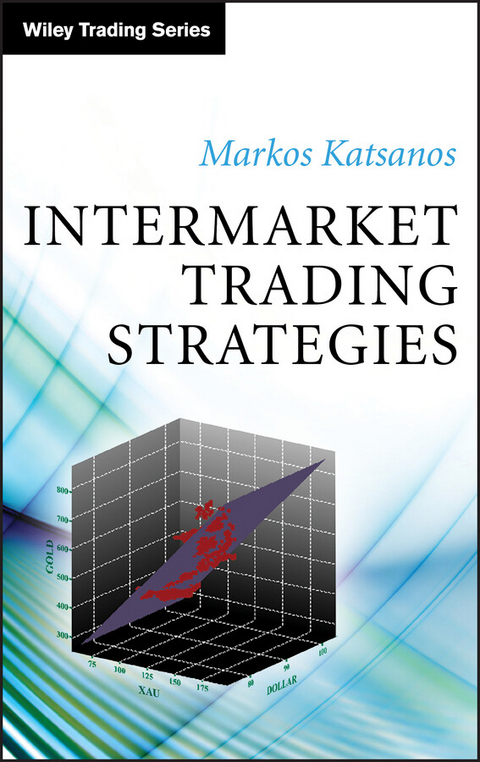
Intermarket Trading Strategies (eBook)
John Wiley & Sons (Verlag)
978-0-470-74146-7 (ISBN)
About the author
Markos Katsanos is an expert in technical analysis and trading systems and inventor of two new technical indicators. In showing the relationship of volume to price movement, his Finite Volume Element (FVE) and Volume Flow Indicators (VFI) have become popular tools used by traders and the code was incorporated in almost all Technical Analysis and trading software. He has a Bachelors degree in Civil Engineering and a Masters degree in Structural Engineering, and is a member of the Technical Securities Analysts Association of San Francisco (TSAASF). He has traded stocks and commodities since 1987, starting with fundamental analysis. With his engineering training he quickly gravitated to technical analysis of the market. With more than two decades of experience in computerized analysis of stocks and futures, he has spent years refining his methods to come up with some of the most profitable strategies for choosing trades. He specializes in mechanical systems and has constructed dozens of systems for his clients and his own use. Markos Katsanos has contributed several articles to Technical Analysis of Stocks & Commodities and other financial publications. He is currently in the process of setting up his own financial consulting company.
This book shows traders how to use Intermarket Analysis to forecast future equity, index and commodity price movements. It introduces custom indicators and Intermarket based systems using basic mathematical and statistical principles to help traders develop and design Intermarket trading systems appropriate for long term, intermediate, short term and day trading. The metastock code for all systems is included and the testing method is described thoroughly. All systems are back tested using at least 200 bars of historical data and compared using various profitability and drawdown metrics.
About the author Markos Katsanos is an expert in technical analysis and trading systems and inventor of two new technical indicators. In showing the relationship of volume to price movement, his Finite Volume Element (FVE) and Volume Flow Indicators (VFI) have become popular tools used by traders and the code was incorporated in almost all Technical Analysis and trading software. He has a Bachelors degree in Civil Engineering and a Masters degree in Structural Engineering, and is a member of the Technical Securities Analysts Association of San Francisco (TSAASF). He has traded stocks and commodities since 1987, starting with fundamental analysis. With his engineering training he quickly gravitated to technical analysis of the market. With more than two decades of experience in computerized analysis of stocks and futures, he has spent years refining his methods to come up with some of the most profitable strategies for choosing trades. He specializes in mechanical systems and has constructed dozens of systems for his clients and his own use. Markos Katsanos has contributed several articles to Technical Analysis of Stocks & Commodities and other financial publications. He is currently in the process of setting up his own financial consulting company.
Acknowledgments ix
Introduction xi
PART I 1
1 Intermarket Analysis 3
2 Correlation 17
3 Regression 33
4 International Indices and Commodities 41
5 The S&P 500 69
6 European Indices 85
7 Gold 93
8 Intraday Correlations 111
9 Intermarket Indicators 121
PART II 145
10 Trading System Design 147
11 A Comparison of Fourteen Technical Systems for Trading Gold 175
12 Trading the S&P 500 ETF and the e-mini 189
13 Trading DAX Futures 201
14 A Comparison of a Neural Network and a Conventional System for Trading FTSE Futures 215
15 The Use of Intermarket Systems in Trading Stocks 235
16 A Relative Strength Asset Allocation Trading System 247
17 Forex Trading Using Intermarket Analysis 261
18 Conclusion 293
Appendix A MetaStock Code and Test Specifications 297
Appendix B Neural Network Systems 357
Appendix C Rectangles 367
Glossary 371
Bibliography 385
Index 391
| Erscheint lt. Verlag | 15.1.2009 |
|---|---|
| Reihe/Serie | Wiley Trading | Wiley Trading Series |
| Sprache | englisch |
| Themenwelt | Recht / Steuern ► Wirtschaftsrecht |
| Wirtschaft ► Betriebswirtschaft / Management ► Finanzierung | |
| Schlagworte | Börsenhandel • Börsenhandel • Finance & Investments • Finanz- u. Anlagewesen • Intermarket trading, Intermarket analysis, trading strategies, forecast future equity, design Intermarket trading systems, Intermarket trading strategies, commodity price movements • Trading |
| ISBN-10 | 0-470-74146-5 / 0470741465 |
| ISBN-13 | 978-0-470-74146-7 / 9780470741467 |
| Informationen gemäß Produktsicherheitsverordnung (GPSR) | |
| Haben Sie eine Frage zum Produkt? |
 PDF (Adobe DRM)
Kopierschutz: Adobe-DRM
Adobe-DRM ist ein Kopierschutz, der das eBook vor Mißbrauch schützen soll. Dabei wird das eBook bereits beim Download auf Ihre persönliche Adobe-ID autorisiert. Lesen können Sie das eBook dann nur auf den Geräten, welche ebenfalls auf Ihre Adobe-ID registriert sind.
Details zum Adobe-DRM
Dateiformat: PDF (Portable Document Format)
Mit einem festen Seitenlayout eignet sich die PDF besonders für Fachbücher mit Spalten, Tabellen und Abbildungen. Eine PDF kann auf fast allen Geräten angezeigt werden, ist aber für kleine Displays (Smartphone, eReader) nur eingeschränkt geeignet.
Systemvoraussetzungen:
PC/Mac: Mit einem PC oder Mac können Sie dieses eBook lesen. Sie benötigen eine
eReader: Dieses eBook kann mit (fast) allen eBook-Readern gelesen werden. Mit dem amazon-Kindle ist es aber nicht kompatibel.
Smartphone/Tablet: Egal ob Apple oder Android, dieses eBook können Sie lesen. Sie benötigen eine
Geräteliste und zusätzliche Hinweise
Buying eBooks from abroad
For tax law reasons we can sell eBooks just within Germany and Switzerland. Regrettably we cannot fulfill eBook-orders from other countries.
aus dem Bereich