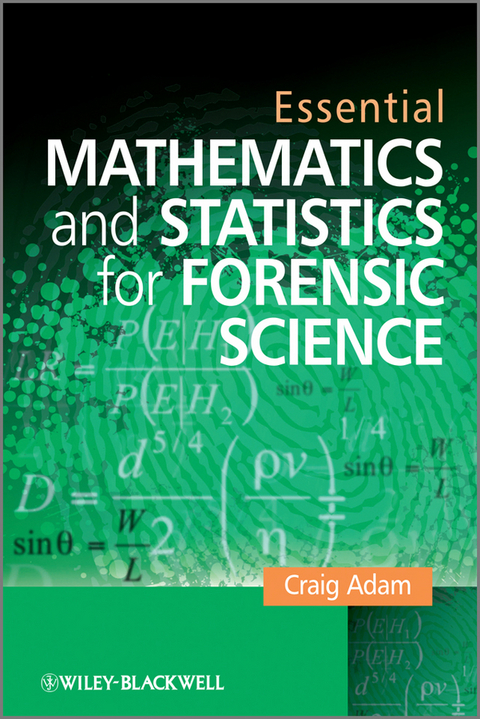
From a basis of high school mathematics, the book develops essential quantitative analysis techniques within the context of a broad range of forensic applications. This clearly structured text focuses on developing core mathematical skills together with an understanding of the calculations associated with the analysis of experimental work, including an emphasis on the use of graphs and the evaluation of uncertainties. Through a broad study of probability and statistics, the reader is led ultimately to the use of Bayesian approaches to the evaluation of evidence within the court. In every section, forensic applications such as ballistics trajectories, post-mortem cooling, aspects of forensic pharmacokinetics, the matching of glass evidence, the formation of bloodstains and the interpretation of DNA profiles are discussed and examples of calculations are worked through. In every chapter there are numerous self-assessment problems to aid student learning.
Its broad scope and forensically focused coverage make this book an essential text for students embarking on any degree course in forensic science or forensic analysis, as well as an invaluable reference for post-graduate students and forensic professionals.
Key features:
- Offers a unique mix of mathematics and statistics topics, specifically tailored to a forensic science undergraduate degree.
- All topics illustrated with examples from the forensic science discipline.
- Written in an accessible, student-friendly way to engage interest and enhance learning and confidence.
- Assumes only a basic high-school level prior mathematical knowledge.
Craig Adam has over twenty years experience in teaching mathematics within the context of science at degree level. Initially this was within the physics discipline, but more recently he has developed and taught courses in mathematics and statistics for students in forensic science. As head of natural sciences at Staffordshire University in 1998, he led the initial development of forensic science degrees at that institution. Once at Keele University he worked within physics before committing himself principally to forensic science from 2004. His current research interests are focused on the use of chemometrics in the interpretation and evaluation of data from the analysis of forensic materials, particularly those acquired from spectroscopy. His teaching expertise areas within forensic science, apart from mathematics and statistics, include blood dynamics and pattern analysis, enhancement of marks and impressions, all aspects of document analysis, trace evidence analysis and evidence evaluation.
This text is an accessible, student-friendly introduction to the wide range of mathematical and statistical tools needed by the forensic scientist in the analysis, interpretation and presentation of experimental measurements. From a basis of high school mathematics, the book develops essential quantitative analysis techniques within the context of a broad range of forensic applications. This clearly structured text focuses on developing core mathematical skills together with an understanding of the calculations associated with the analysis of experimental work, including an emphasis on the use of graphs and the evaluation of uncertainties. Through a broad study of probability and statistics, the reader is led ultimately to the use of Bayesian approaches to the evaluation of evidence within the court. In every section, forensic applications such as ballistics trajectories, post-mortem cooling, aspects of forensic pharmacokinetics, the matching of glass evidence, the formation of bloodstains and the interpretation of DNA profiles are discussed and examples of calculations are worked through. In every chapter there are numerous self-assessment problems to aid student learning. Its broad scope and forensically focused coverage make this book an essential text for students embarking on any degree course in forensic science or forensic analysis, as well as an invaluable reference for post-graduate students and forensic professionals. Key features: Offers a unique mix of mathematics and statistics topics, specifically tailored to a forensic science undergraduate degree. All topics illustrated with examples from the forensic science discipline. Written in an accessible, student-friendly way to engage interest and enhance learning and confidence. Assumes only a basic high-school level prior mathematical knowledge.
Craig Adam has over twenty years experience in teaching mathematics within the context of science at degree level. Initially this was within the physics discipline, but more recently he has developed and taught courses in mathematics and statistics for students in forensic science. As head of natural sciences at Staffordshire University in 1998, he led the initial development of forensic science degrees at that institution. Once at Keele University he worked within physics before committing himself principally to forensic science from 2004. His current research interests are focused on the use of chemometrics in the interpretation and evaluation of data from the analysis of forensic materials, particularly those acquired from spectroscopy. His teaching expertise areas within forensic science, apart from mathematics and statistics, include blood dynamics and pattern analysis, enhancement of marks and impressions, all aspects of document analysis, trace evidence analysis and evidence evaluation.
Essential Mathematics and Statistics for Forensic Science 5
Contents 7
Preface 13
1 Getting the basics right 15
Introduction: Why forensic science is a quantitative science 15
1.1 Numbers, their representation and meaning 16
Self-assessment exercises and problems 20
1.2 Units of measurement and their conversion 21
Self-assessment problems 28
1.3 Uncertainties in measurement and how to deal with them 29
1.4 Basic chemical calculations 34
Self-assessment exercises and problems 42
Chapter summary 43
2 Functions, formulae and equations 45
Introduction: Understanding and using functions, formulae and equations 45
2.1 Algebraic manipulation of equations 46
Self-assessment exercises 52
2.2 Applications involving the manipulation of formulae 53
Self-assessment exercises and problems 56
2.3 Polynomial functions 57
Self-assessment exercises and problems 63
2.4 The solution of linear simultaneous equations 64
Self-assessment exercises and problems 67
2.5 Quadratic functions 68
Self-assessment problems 75
2.6 Powers and indices 75
Self-assessment problems 81
Chapter summary 82
3 The exponential and logarithmic functions and their applications 83
Introduction: Two special functions in forensic science 83
3.1 Origin and definition of the exponential function 83
Self-assessment exercises 85
3.2 Origin and definition of the logarithmic function 86
Self-assessment exercises and problems 88
Self-assessment exercises 90
3.3 Application: the pH scale 90
Self-assessment exercises 92
3.4 The “decaying” exponential 92
Self-assessment problems 96
3.5 Application: post-mortem body cooling 97
Self-assessment problems 100
3.6 Application: forensic pharmacokinetics 100
Self-assessment problems 104
Chapter summary 104
4 Trigonometric methods in forensic science 107
Introduction: Why trigonometry is needed in forensic science 107
4.1 Pythagoras’s theorem 107
Self-assessment exercises and problems 111
4.2 The trigonometric functions 112
Self-assessment exercises and problems 118
4.3 Trigonometric rules 119
Self-assessment exercises 122
4.4 Application: heights and distances 123
Self-assessment problems 124
4.5 Application: ricochet analysis 125
Self-assessment problems 125
4.6 Application: aspects of ballistics 125
Self-assessment problems 129
4.7 Suicide, accident or murder? 130
Self-assessment problems 131
4.8 Application: bloodstain shape 132
Self-assessment problems 134
4.9 Bloodstain pattern analysis 134
Self-assessment problems 137
Chapter summary 137
5 Graphs – their construction and interpretation 139
Introduction: Why graphs are important in forensic science 139
5.1 Representing data using graphs 139
5.2 Linearizing equations 143
Self-assessment exercises 146
5.3 Linear regression 147
Self-assessment exercises 150
5.4 Application: shotgun pellet patterns in firearms incidents 151
Self-assessment problem 152
5.5 Application: bloodstain formation 153
Self-assessment problem 154
5.6 Application: the persistence of hair, fibres and flints on clothing 154
Self-assessment problem 156
5.7 Application: determining the time since death by fly egg hatching 156
5.8 Application: determining age from bone or tooth material 158
Self-assessment problem 160
5.9 Application: kinetics of chemical reactions 160
Self-assessment problems 162
5.10 Graphs for calibration 163
Self-assessment problems 166
5.11 Excel and the construction of graphs 167
Chapter summary 167
6 The statistical analysis of data 169
Introduction: Statistics and forensic science 169
6.1 Describing a set of data 169
Self-assessment problems 176
6.2 Frequency statistics 178
Self-assessment problems 181
6.3 Probability density functions 182
Self-assessment problems 185
6.4 Excel and basic statistics 186
Chapter summary 186
7 Probability in forensic science 189
Introduction: Theoretical and empirical probabilities 189
7.1 Calculating probabilities 189
Self-assessment problems 195
7.2 Application: the matching of hair evidence 196
Self-assessment problems 197
7.3 Conditional probability 197
Self-assessment problems 200
7.4 Probability tree diagrams 202
Self-assessment problems 203
7.5 Permutations and combinations 203
Self-assessment problems 205
7.6 The binomial probability distribution 205
Self-assessment problems 207
Chapter summary 208
8 Probability and infrequent events 209
Introduction: Dealing with infrequent events 209
8.1 The Poisson probability distribution 209
Self-assessment exercises 212
8.2 Probability and the uniqueness of fingerprints 212
Self-assessment problems 213
8.3 Probability and human teeth marks 214
Self-assessment problems 214
8.4 Probability and forensic genetics 215
8.5 Worked problems of genotype and allele calculations 221
Self-assessment problems 224
8.6 Genotype frequencies and subpopulations 226
Self-assessment problems 227
Chapter summary 227
9 Statistics in the evaluation of experimental data: comparison and confidence 229
How can statistics help in the interpretation of experimental data? 229
9.1 The normal distribution 229
Self-assessment problems 235
9.2 The normal distribution and frequency histograms 236
9.3 The standard error in the mean 237
Self-assessment problems 239
9.4 The t-distribution 239
Self-assessment exercises and problems 242
9.5 Hypothesis testing 243
Self-assessment problems 246
9.6 Comparing two datasets using the t -test 247
Self-assessment problems 249
9.7 The t -test applied to paired measurements 251
Self-assessment problems 252
9.8 Pearson’s ?2 test 253
Self-assessment problems 255
Chapter summary 256
10 Statistics in the evaluation of experimental data: computation and calibration 259
Introduction: What more can we do with statistics and uncertainty? 259
10.1 The propagation of uncertainty in calculations 259
Self-assessment exercises and problems 265
Self-assessment exercises and problems 267
10.2 Application: physicochemical measurements 270
Self-assessment problems 272
10.3 Measurement of density by Archimedes’ upthrust 272
Self-assessment problems 273
10.4 Application: bloodstain impact angle 274
Self-assessment problems 275
10.5 Application: bloodstain formation 276
Self-assessment problems 278
10.6 Statistical approaches to outliers 279
Self-assessment problems 281
10.7 Introduction to robust statistics 281
Self-assessment problems 282
10.8 Statistics and linear regression 283
Self-assessment problems 288
10.9 Using linear calibration graphs and the calculation of standard error 289
Self-assessment problems 290
Chapter summary 291
11 Statistics and the signi.cance of evidence 293
Introduction: Where do we go from here? – Interpretation and significance 293
11.1 A case study in the interpretation and significance of forensic evidence 294
11.2 A probabilistic basis for interpreting evidence 295
Self-assessment problems 300
11.3 Likelihood ratio, Bayes’ rule and weight of evidence 300
Self-assessment problems 303
11.4 Population data and interpretive databases 304
Self-assessment problems 307
11.5 The probability of accepting the prosecution case – given the evidence 308
Self-assessment problems 313
11.6 Likelihood ratios from continuous data 313
Self-assessment problems 318
11.7 Likelihood ratio and transfer evidence 319
Self-assessment problems 322
11.8 Application: double cot-death or double murder? 323
Self-assessment problems 325
Chapter summary 325
References 327
Bibliography 331
Answers to self-assessment exercises and problems 333
Appendix I: The definitions of non-SI units and their relationship to the equivalent SI units 347
Appendix II: Constructing graphs using Microsoft Excel 349
Appendix III: Using Microsoft Excel for statistics calculations 353
Appendix IV: Cumulative z -probability table for the standard normal distribution 357
Appendix V: Student’s t -test: tables of critical values for the t -statistic 359
Appendix VI: Chi squared ?2 test: table of critical values 361
Appendix VII: Some values of Qcrit for Dixon’s Q test Some values for Gcrit for Grubbs’ two-tailed test 363
Index 365
"The book's main selling point is its pedagogical approach to make
the contents relevant to the intended audience by using
subject-specific examples. This is successful in the main, with
examples originating from a wide variety of areas in forensic
science, so that neither the forensic biologist nor the forensic
chemist or physicist need to feel neglected. It is even more
commendable that Craig Adams manages to find a forensic context for
the development of essential skills, such as the computation of
concentrations from spectrophotometric measurements and the
plotting of standard curves for HPLC data." (Reviews,
December 2010)
| Erscheint lt. Verlag | 30.3.2010 |
|---|---|
| Sprache | englisch |
| Themenwelt | Mathematik / Informatik ► Mathematik ► Statistik |
| Medizin / Pharmazie | |
| Naturwissenschaften ► Biologie | |
| Naturwissenschaften ► Chemie | |
| Recht / Steuern ► Strafrecht ► Kriminologie | |
| Sozialwissenschaften | |
| Schlagworte | accessible • Analysis • Analytische Chemie / Forensik • Angewandte Wahrscheinlichkeitsrechnung u. Statistik • Applied Probability & Statistics • Basis • Biowissenschaften • Chemie • Chemistry • ConText • Essential • Experimental Measurements • Forensic • Forensics • Forensic Science • Forensik • Forensische Wissenschaft • Genetik • High • Introduction • Life Sciences • Mathematical • Mathematics • Mathematik • Range • school • Scientist • Statistics • Statistik • studentfriendly • Tools • wide |
| ISBN-13 | 9780470710357 / 9780470710357 |
| Informationen gemäß Produktsicherheitsverordnung (GPSR) | |
| Haben Sie eine Frage zum Produkt? |
 PDF (Adobe DRM)
Kopierschutz: Adobe-DRM
Adobe-DRM ist ein Kopierschutz, der das eBook vor Mißbrauch schützen soll. Dabei wird das eBook bereits beim Download auf Ihre persönliche Adobe-ID autorisiert. Lesen können Sie das eBook dann nur auf den Geräten, welche ebenfalls auf Ihre Adobe-ID registriert sind.
Details zum Adobe-DRM
Dateiformat: PDF (Portable Document Format)
Mit einem festen Seitenlayout eignet sich die PDF besonders für Fachbücher mit Spalten, Tabellen und Abbildungen. Eine PDF kann auf fast allen Geräten angezeigt werden, ist aber für kleine Displays (Smartphone, eReader) nur eingeschränkt geeignet.
Systemvoraussetzungen:
PC/Mac: Mit einem PC oder Mac können Sie dieses eBook lesen. Sie benötigen eine
eReader: Dieses eBook kann mit (fast) allen eBook-Readern gelesen werden. Mit dem amazon-Kindle ist es aber nicht kompatibel.
Smartphone/Tablet: Egal ob Apple oder Android, dieses eBook können Sie lesen. Sie benötigen eine
Geräteliste und zusätzliche Hinweise
Buying eBooks from abroad
For tax law reasons we can sell eBooks just within Germany and Switzerland. Regrettably we cannot fulfill eBook-orders from other countries.
aus dem Bereich