Credit Derivatives (eBook)
John Wiley & Sons (Verlag)
978-0-470-68988-2 (ISBN)
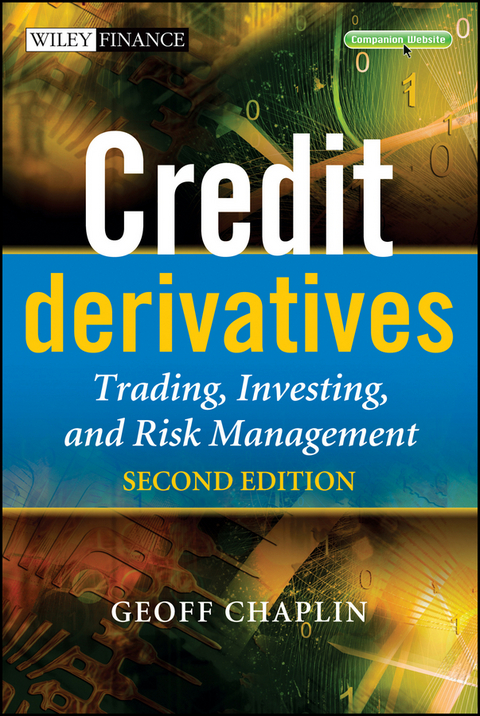
Fully revised and updated to take in to account the new products, markets and risk requirements post financial crisis, Credit Derivatives: Trading, Investing and Risk Management, Second Edition, covers the subject from a real world perspective, tackling issues such as liquidity, poor data, and credit spreads, to the latest innovations in portfolio products, hedging and risk management techniques.
The book concentrates on practical issues and develops an understanding of the products through applications and detailed analysis of the risks and alternative means of trading.
It provides:
- a description of the key products, applications, and an analysis of typical trades including basis trading, hedging, and credit structuring;
- analysis of the industry standard 'default and recovery' and Copula models including many examples, and a description of the models' shortcomings;
- tools and techniques for the management of a portfolio or book of credit risks including appropriate and inappropriate methods of correlation risk management;
- a thorough analysis of counterparty risk;
- an intuitive understanding of credit correlation in reality and in the Copula model.
The book is thoroughly updated to reflect the changes the industry has seen over the past 5 years, notably with an analysis of the lead up and causes of the credit crisis. It contains 50% new material, which includes copula valuation and hedging, portfolio optimisation, portfolio products and correlation risk management, pricing in illiquid environments, chapters on the evolution of credit management systems, the credit meltdown and new chapters on the implementation and testing of credit derivative models and systems.
The book is accompanied by a website which contains tools for credit derivatives valuation and risk management, illustrating the models used in the book and also providing a valuation toolkit.
GEOFF CHAPLIN studied mathematics at Cambridge (MA 1972) and Oxford (MSc 1973, DPhil 1975) and trained as an actuary (FFA 1978) while working in a life insurance company. He moved to the City in 1980 and has worked for major banks (including HSBC, Nomura International, and ABN AMRO). As a partner in Reoch Credit he has consulted to law firms, hedge funds, corporate treasurers, institutional investment funds and risk control departments of major banks in the areas of credit and mortality risk. He has been involved in the credit derivatives market since 1996 and life settlements structures since 2003. Geoff has also maintained strong academic interests - he was a visiting (emeritus) professor at the University of Waterloo, Canada, from 1987 until 1999. He has also published many articles in Risk, the Journal of the Institute and Faculty of Actuaries, and others, speaks regularly at conferences and is the author of Credit Derivatives: Risk Management, Trading and Investing (John Wiley & Sons Ltd, 2005) and co-author of Life Settlements and Longevity Structures: Pricing and Risk Management: Investment and Structured Finance (John Wiley & Sons Ltd, 2009).
The credit derivatives industry has come under close scrutiny over the past few years, with the recent financial crisis highlighting the instability of a number of credit structures and throwing the industry into turmoil. What has been made clear by recent events is the necessity for a thorough understanding of credit derivatives by all parties involved in a transaction, especially traders, structurers, quants and investors. Fully revised and updated to take in to account the new products, markets and risk requirements post financial crisis, Credit Derivatives: Trading, Investing and Risk Management, Second Edition, covers the subject from a real world perspective, tackling issues such as liquidity, poor data, and credit spreads, to the latest innovations in portfolio products, hedging and risk management techniques. The book concentrates on practical issues and develops an understanding of the products through applications and detailed analysis of the risks and alternative means of trading. It provides: a description of the key products, applications, and an analysis of typical trades including basis trading, hedging, and credit structuring; analysis of the industry standard 'default and recovery' and Copula models including many examples, and a description of the models' shortcomings; tools and techniques for the management of a portfolio or book of credit risks including appropriate and inappropriate methods of correlation risk management; a thorough analysis of counterparty risk; an intuitive understanding of credit correlation in reality and in the Copula model. The book is thoroughly updated to reflect the changes the industry has seen over the past 5 years, notably with an analysis of the lead up and causes of the credit crisis. It contains 50% new material, which includes copula valuation and hedging, portfolio optimisation, portfolio products and correlation risk management, pricing in illiquid environments, chapters on the evolution of credit management systems, the credit meltdown and new chapters on the implementation and testing of credit derivative models and systems. The book is accompanied by a website which contains tools for credit derivatives valuation and risk management, illustrating the models used in the book and also providing a valuation toolkit.
GEOFF CHAPLIN studied mathematics at Cambridge (MA 1972) and Oxford (MSc 1973, DPhil 1975) and trained as an actuary (FFA 1978) while working in a life insurance company. He moved to the City in 1980 and has worked for major banks (including HSBC, Nomura International, and ABN AMRO). As a partner in Reoch Credit he has consulted to law firms, hedge funds, corporate treasurers, institutional investment funds and risk control departments of major banks in the areas of credit and mortality risk. He has been involved in the credit derivatives market since 1996 and life settlements structures since 2003. Geoff has also maintained strong academic interests - he was a visiting (emeritus) professor at the University of Waterloo, Canada, from 1987 until 1999. He has also published many articles in Risk, the Journal of the Institute and Faculty of Actuaries, and others, speaks regularly at conferences and is the author of Credit Derivatives: Risk Management, Trading and Investing (John Wiley & Sons Ltd, 2005) and co-author of Life Settlements and Longevity Structures: Pricing and Risk Management: Investment and Structured Finance (John Wiley & Sons Ltd, 2009).
| Erscheint lt. Verlag | 30.7.2010 |
|---|---|
| Reihe/Serie | The Wiley Finance Series | Wiley Finance Series |
| Sprache | englisch |
| Themenwelt | Recht / Steuern ► Wirtschaftsrecht |
| Wirtschaft ► Betriebswirtschaft / Management ► Finanzierung | |
| Schlagworte | clear • Close • credit • credit structures • Derivatives • derivatives industry • Events • Finance & Investments • Financial Engineering • Finanztechnik • Finanz- u. Anlagewesen • Industry • instability • Necessity • New • Number • PAST • Products • recent financial crisis • Requirements • scrutiny • thorough • turmoil • Understanding • years |
| ISBN-10 | 0-470-68988-9 / 0470689889 |
| ISBN-13 | 978-0-470-68988-2 / 9780470689882 |
| Informationen gemäß Produktsicherheitsverordnung (GPSR) | |
| Haben Sie eine Frage zum Produkt? |
 PDF (Adobe DRM)
Kopierschutz: Adobe-DRM
Adobe-DRM ist ein Kopierschutz, der das eBook vor Mißbrauch schützen soll. Dabei wird das eBook bereits beim Download auf Ihre persönliche Adobe-ID autorisiert. Lesen können Sie das eBook dann nur auf den Geräten, welche ebenfalls auf Ihre Adobe-ID registriert sind.
Details zum Adobe-DRM
Dateiformat: PDF (Portable Document Format)
Mit einem festen Seitenlayout eignet sich die PDF besonders für Fachbücher mit Spalten, Tabellen und Abbildungen. Eine PDF kann auf fast allen Geräten angezeigt werden, ist aber für kleine Displays (Smartphone, eReader) nur eingeschränkt geeignet.
Systemvoraussetzungen:
PC/Mac: Mit einem PC oder Mac können Sie dieses eBook lesen. Sie benötigen eine
eReader: Dieses eBook kann mit (fast) allen eBook-Readern gelesen werden. Mit dem amazon-Kindle ist es aber nicht kompatibel.
Smartphone/Tablet: Egal ob Apple oder Android, dieses eBook können Sie lesen. Sie benötigen eine
Geräteliste und zusätzliche Hinweise
Buying eBooks from abroad
For tax law reasons we can sell eBooks just within Germany and Switzerland. Regrettably we cannot fulfill eBook-orders from other countries.
aus dem Bereich