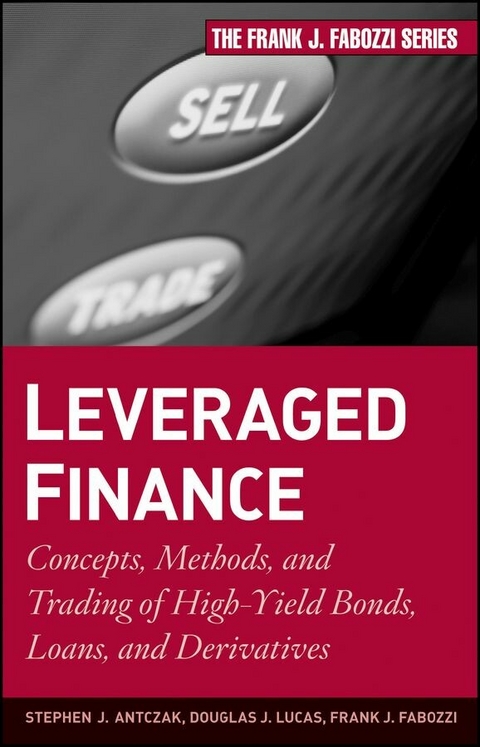
Leveraged Finance (eBook)
John Wiley & Sons (Verlag)
978-0-470-52880-8 (ISBN)
Stephen J. Antczak, CFA, is an Executive Director at UBS. Prior to joining UBS in 2001, he was a senior strategist at Merrill Lynch, and he has also worked at the Bureau of Labor Statistics as an economist. Antczak graduated from the University of Michigan with a BA in economics and an MBA in business economics and finance.
Douglas J. Lucas has been a Group Managing Director and Director of Ratings Research at Moody's Investor Service since November 2008. Prior to that, he was head of CDO Research at UBS. Lucas has a BA magna cum laude in economics from UCLA and an MBA with Honors from the University of Chicago.
Frank J. Fabozzi, PhD, CFA, CPA, is Professor in the Practice of Finance and Becton Fellow at Yale University's School of Management, Editor of the Journal of Portfolio Management, and Associate Editor of the Journal of Structured Finance and the Journal of Fixed Income.
A timely guide to today s high-yield corporate debt markets Leveraged Finance is a comprehensive guide to the instruments and markets that finance much of corporate America. Presented in five sections, this experienced author team covers topics ranging from the basics of bonds and loans to more advanced topics such as valuing CDs, default correlations among CLOs, and hedging strategies across corporate capital structures. Additional topics covered include basic corporate credit, relative value analysis, and various trading strategies used by investors, such as hedging credit risk with the equity derivatives of a different company. Stephen Antczak, Douglas Lucas, and Frank Fabozzi present readers with real-market examples of how investors can identify investment opportunities and how to express their views on the market or specific companies through trading strategies, and examine various underlying assets including loans, corporate bonds, and much more. They also offer readers an overview of synthetic and structured products such as CDS, LCDS, CDX, LCDX, and CLOs. Leveraged Finance has the information you need to succeed in this evolving financial arena.
Stephen J. Antczak, CFA, is an Executive Director at UBS. Prior to joining UBS in 2001, he was a senior strategist at Merrill Lynch, and he has also worked at the Bureau of Labor Statistics as an economist. Antczak graduated from the University of Michigan with a BA in economics and an MBA in business economics and finance. Douglas J. Lucas has been a Group Managing Director and Director of Ratings Research at Moody's Investor Service since November 2008. Prior to that, he was head of CDO Research at UBS. Lucas has a BA magna cum laude in economics from UCLA and an MBA with Honors from the University of Chicago. Frank J. Fabozzi, PhD, CFA, CPA, is Professor in the Practice of Finance and Becton Fellow at Yale University's School of Management, Editor of the Journal of Portfolio Management, and Associate Editor of the Journal of Structured Finance and the Journal of Fixed Income.
Preface.
About the Authors.
Chapter 1: Introduction.
Part One: The Cash Market.
Part Two: The Structured Markets.
Part Three: The Synthetic Markets.
Part Four: How to Trade the Leveraged Finance Market.
Part Five: Default Correlation.
Part One: The Cash Market.
Chapter 2: The High-Yield Bond Market.
The Reasons Companies Are Classified as High-Yield Issuers.
Size and Growth of the Cash Market.
Types of Structures.
A Look at Ratings.
Risk and Return for Bonds.
What's Priced In?
How About Recoveries?
Summary.
Chapter 3: Leveraged Loans.
A Tale of Two Loans.
Introduction to Leveraged Loans.
An Overview of Loan Terms.
Loan Recovery Rates.
Loan Default Rates.
Summary.
Part Two: Structured Market.
Chapter 4: Collateralized Loan Obligations.
Understanding CLOs.
Elaborations and Details.
Summary.
Chapter 5: CLO Returns.
Default and Recovery Scenarios.
Distressed Loan Prices, Overflowing Triple-C Buckets, and CLO
Returns.
Summary.
Chapter 6: CLO Portfolio Overlap.
Collateral Overlap in U.S. CLOs.
Collateral Vintage vs. Deal Vintage.
Favorite CLO Credits.
Single-Name Risk and Tranche Protections.
Excess Over-Collateralization and Excess Over-Collateralization
Delta.
Senior and Subordinate Excess OC Deltas.
Equity Tranches and Distressed Tranches.
Summary.
Part Three: Synthetic Markets.
Chapter 7: Credit Default Swaps and the Indices.
What Are Credit Default Swaps?
Who Uses Protection, and for What?
Growth of the Market.
Marking-Market: SDV01.
Credit Default Swaps Indices.
Contrasting the LCDX and CDX Indices.
Beta: A Study of Movement..
Summary.
Chapter 8: Index Tranches.
Basic Mechanics of the Tranche Market.
Loan Tranches.
Summary.
Part Four: How to Trade the Leveraged Finance Market.
Chapter 9: Recessions and Returns.
Broad Market Performance.
Sector Performance.
Performance by Rating.
Summary.
Chapter 10: Framework for the Credit Analysis of Corporate
Debt.
Approaches to Credit Analysis.
Industry Considerations.
Financial Analysis.
Quantitative Models.
Summary.
Chapter11: Trading the Basis.
The Basic Basis Package.
Constructing the Basic Package.
Moving Away from the Basic Model.
Adding Positive Convexity.
Negative Convexity.
A More Complex Basis Package.
Hedge Ratios for CLO Hedging.
Summary.
Chapter12: How Much Should You Get Paid to Take Risk?
Single Name Credit Risk.
Curve Risk.
Basis Risk.
Capital Structure Risk.
Summary.
Part Five: Default Correlation.
Chapter 13: Default Correlation: The Basics.
Default Correlation Defined.
Default Probability and Default Correlation.
Summary.
Chapter 14: Empirical Default Correlations: Problems and
Solutions.
Empirical Results.
Problems with Historical Default Correlations.
Proposed Solutions.
Summary.
Index.
"...a resource that will be invaluable to traditional and nontraditional investors long after the market recovers." (The Investment Professional)
| Erscheint lt. Verlag | 10.6.2009 |
|---|---|
| Reihe/Serie | Frank J. Fabozzi Series |
| Frank J. Fabozzi Series | Frank J. Fabozzi Series |
| Sprache | englisch |
| Themenwelt | Recht / Steuern ► Wirtschaftsrecht |
| Wirtschaft ► Betriebswirtschaft / Management ► Finanzierung | |
| Schlagworte | bonds, loans, high yield debt, credit, leveraged finance, leveraged loans, bond derivatives, loan derivatives, collateralized loan obligations, portfolio credit products, synthetics, credit default swaps, CDS, credit default swap indices, corporate finance, corporate credit analysis, fixed income derivatives, CDX, CLO, tranche, financial, investment, arbitrage, basis package, default, risk, correlation • Finance & Investments • Finanz- u. Anlagewesen • Investments & Securities • Kapitalanlage • Kapitalanlagen u. Wertpapiere |
| ISBN-10 | 0-470-52880-X / 047052880X |
| ISBN-13 | 978-0-470-52880-8 / 9780470528808 |
| Informationen gemäß Produktsicherheitsverordnung (GPSR) | |
| Haben Sie eine Frage zum Produkt? |
 EPUB (Adobe DRM)
Größe: 4,8 MB
Kopierschutz: Adobe-DRM
Adobe-DRM ist ein Kopierschutz, der das eBook vor Mißbrauch schützen soll. Dabei wird das eBook bereits beim Download auf Ihre persönliche Adobe-ID autorisiert. Lesen können Sie das eBook dann nur auf den Geräten, welche ebenfalls auf Ihre Adobe-ID registriert sind.
Details zum Adobe-DRM
Dateiformat: EPUB (Electronic Publication)
EPUB ist ein offener Standard für eBooks und eignet sich besonders zur Darstellung von Belletristik und Sachbüchern. Der Fließtext wird dynamisch an die Display- und Schriftgröße angepasst. Auch für mobile Lesegeräte ist EPUB daher gut geeignet.
Systemvoraussetzungen:
PC/Mac: Mit einem PC oder Mac können Sie dieses eBook lesen. Sie benötigen eine
eReader: Dieses eBook kann mit (fast) allen eBook-Readern gelesen werden. Mit dem amazon-Kindle ist es aber nicht kompatibel.
Smartphone/Tablet: Egal ob Apple oder Android, dieses eBook können Sie lesen. Sie benötigen eine
Geräteliste und zusätzliche Hinweise
Buying eBooks from abroad
For tax law reasons we can sell eBooks just within Germany and Switzerland. Regrettably we cannot fulfill eBook-orders from other countries.
 PDF (Adobe DRM)
Kopierschutz: Adobe-DRM
Adobe-DRM ist ein Kopierschutz, der das eBook vor Mißbrauch schützen soll. Dabei wird das eBook bereits beim Download auf Ihre persönliche Adobe-ID autorisiert. Lesen können Sie das eBook dann nur auf den Geräten, welche ebenfalls auf Ihre Adobe-ID registriert sind.
Details zum Adobe-DRM
Dateiformat: PDF (Portable Document Format)
Mit einem festen Seitenlayout eignet sich die PDF besonders für Fachbücher mit Spalten, Tabellen und Abbildungen. Eine PDF kann auf fast allen Geräten angezeigt werden, ist aber für kleine Displays (Smartphone, eReader) nur eingeschränkt geeignet.
Systemvoraussetzungen:
PC/Mac: Mit einem PC oder Mac können Sie dieses eBook lesen. Sie benötigen eine
eReader: Dieses eBook kann mit (fast) allen eBook-Readern gelesen werden. Mit dem amazon-Kindle ist es aber nicht kompatibel.
Smartphone/Tablet: Egal ob Apple oder Android, dieses eBook können Sie lesen. Sie benötigen eine
Geräteliste und zusätzliche Hinweise
Buying eBooks from abroad
For tax law reasons we can sell eBooks just within Germany and Switzerland. Regrettably we cannot fulfill eBook-orders from other countries.
aus dem Bereich