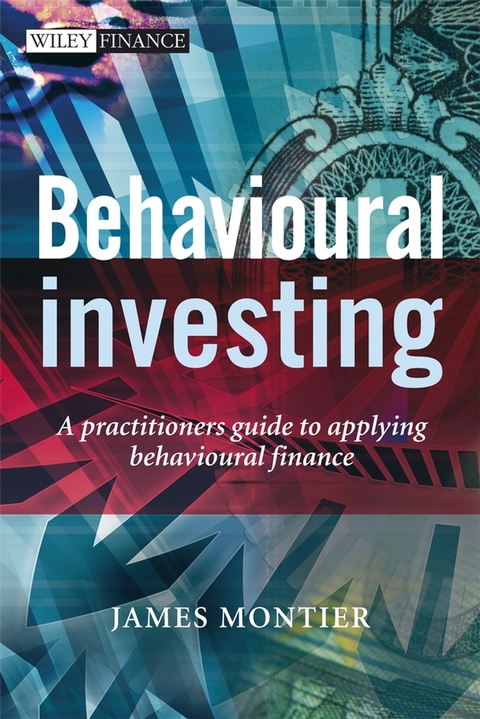
Behavioural Investing (eBook)
John Wiley & Sons (Verlag)
978-0-470-51915-8 (ISBN)
Behavioural Investing: A Practitioner's Guide to Applying Behavioural Finance explores the biases we face, the way in which they show up in the investment process, and urges readers to adopt an empirically based sceptical approach to investing. This book is unique in combining insights from the field of applied psychology with a through understanding of the investment problem. The content is practitioner focused throughout and will be essential reading for any investment professional looking to improve their investing behaviour to maximise returns. Key features include:
- The only book to cover the applications of behavioural finance
- An executive summary for every chapter with key points highlighted at the chapter start
- Information on the key behavioural biases of professional investors, including The seven sins of fund management, Investment myth busting, and The Tao of investing
- Practical examples showing how using a psychologically inspired model can improve on standard, common practice valuation tools
- Written by an internationally renowned expert in the field of behavioural finance
JAMES MONTIER is the global equity strategist at Dresdner Kleinwort in London. He has been the top rated strategist in the annual Extel survey for the last two years. He is also the author of Behavioural Finance, published by Wiley in 2000. James was on the 50 must read analysts list complied by the Business magazine, and was one of the Financial News' Rising Stars.
James is a regular speaker at both academic and practitioner conferences, and is regarded as the leading authority on applying behavioural finance to investment. He is also a visiting fellow at the University of Durham. James is also a fellow of the Royal Society of Arts. He has been described as a maverick by the Sunday Times, an enfant terrible by the FAZ, and a prophet by the Fast Company! When not writing or reading, he can usually be found blowing bubbles at fish and swimming with sharks.
Behavioural investing seeks to bridge the gap between psychology and investing. All too many investors are unaware of the mental pitfalls that await them. Even once we are aware of our biases, we must recognise that knowledge does not equal behaviour. The solution lies is designing and adopting an investment process that is at least partially robust to behavioural decision-making errors. Behavioural Investing: A Practitioner s Guide to Applying Behavioural Finance explores the biases we face, the way in which they show up in the investment process, and urges readers to adopt an empirically based sceptical approach to investing. This book is unique in combining insights from the field of applied psychology with a through understanding of the investment problem. The content is practitioner focused throughout and will be essential reading for any investment professional looking to improve their investing behaviour to maximise returns. Key features include: The only book to cover the applications of behavioural finance An executive summary for every chapter with key points highlighted at the chapter start Information on the key behavioural biases of professional investors, including The seven sins of fund management, Investment myth busting, and The Tao of investing Practical examples showing how using a psychologically inspired model can improve on standard, common practice valuation tools Written by an internationally renowned expert in the field of behavioural finance
JAMES MONTIER is the global equity strategist at Dresdner Kleinwort in London. He has been the top rated strategist in the annual Extel survey for the last two years. He is also the author of Behavioural Finance, published by Wiley in 2000. James was on the 50 must read analysts list complied by the Business magazine, and was one of the Financial News' Rising Stars. James is a regular speaker at both academic and practitioner conferences, and is regarded as the leading authority on applying behavioural finance to investment. He is also a visiting fellow at the University of Durham. James is also a fellow of the Royal Society of Arts. He has been described as a maverick by the Sunday Times, an enfant terrible by the FAZ, and a prophet by the Fast Company! When not writing or reading, he can usually be found blowing bubbles at fish and swimming with sharks.
Preface xvii
Acknowledgments xxi
SECTION I: COMMON MISTAKES AND BASIC BIASES 1
1 Emotion, Neuroscience and Investing: Investors as DopamineAddicts 3
2 Part Man, Part Monkey 17
3 Take aWalk on the Wild Side 37
4 Brain Damage, Addicts and Pigeons 47
5 What Do Secretaries' Dustbins and the Da Vinci Code havein Common? 55
6 The Limits to Learning 63
SECTION II: THE PROFESSIONALS AND THE BIASES 77
7 Behaving Badly 79
SECTION III: THE SEVEN SINS OF FUND MANAGEMENT 95
8 A Behavioural Critique 97
9 The Folly of Forecasting: Ignore all Economists, Strategists,& Analysts 105
10 What Value Analysts? 123
11 The Illusion of Knowledge or Is More Information BetterInformation? 133
12 WhyWaste Your Time Listening to Company Management? 143
13 Who's a Pretty Boy Then? Or Beauty Contests, Rationality andGreater Fools 161
14 ADHD, Time Horizons and Underperformance 179
15 The Story is The Thing (or The Allure of Growth) 189
16 Scepticism is Rare or (Descartes vs Spinoza) 197
17 Are Two Heads Better Than One? 209
SECTION IV: INVESTMENT PROCESS AS BEHAVIOURAL DEFENCE217
18 The Tao of Investing 219
PART A: THE BEHAVIORAL INVESTOR 223
19 Come Out of the Closet (or, Show Me the Alpha) 225
20 Strange Brew 235
21 Contrarian or Conformist? 247
22 Painting by Numbers: An Ode to Quant 259
23 The Perfect Value Investor 271
24 A Blast from the Past 279
25 Why Not Value? The Behavioural Stumbling Blocks 293
PART B: THE EMPIRICAL EVIDENCE: VALUE IN ALL ITS FORMS 305
26 Bargain Hunter (or It Offers Me Protection) 307
Written with Rui Antunes
27 Better Value (or The Dean Was Right!) 329
Written with Rui Antunes
28 The Little Note that Beats the Market 337
Written with Sebastian Lancetti
29 Improving Returns Using Inside Information 355
30 Just a Little Patience: Part I 367
31 Just a Little Patience: Part II 375
Written with Sebastian Lancetti
32 Sectors, Value and Momentum 387
33 Sector-Relative FactorsWorks Best 395
Written with Andrew Lapthorne
34 Cheap Countries Outperform 405
PART C: RISK, BUT NOT AS WE KNOW IT 423
35 CAPM is CRAP (or, The Dead Parrot Lives!) 425
36 Risk Managers or Risk Maniacs? 437
37 Risk: Finance's Favourite Four-Letter Word 445
SECTION V: BUBBLES AND BEHAVIOUR 453
38 The Anatomy of a Bubble 455
39 De-bubbling: Alpha Generation 469
40 Running with the Devil: A Cynical Bubble 493
41 Bubble Echoes: The Empirical Evidence 507
SECTION VI: INVESTMENT MYTH BUSTERS 519
42 Belief Bias and the Zen Investing 521
43 Dividends Do Matter 529
44 Dividends, Repurchases, Earnings and the Coming Slowdown541
45 Return of the Robber Barons 549
46 The Purgatory of Low Returns 563
47 How Important is the Cycle? 573
48 Have We Really Learnt So Little? 581
49 Some Random Musings on Alternative Assets 587
SECTION VII: CORPORATE GOVERNANCE AND ETHICS 597
50 Abu Ghraib: Lesson from Behavioural Finance and for CorporateGovernance 599
51 Doing the Right Thing or the Psychology of Ethics 611
52 Unintended Consequences and Choking under Pressure: ThePsychology of Incentives 631
SECTION VIII: HAPPINESS 645
53 If It Makes You Happy 647
54 Materialism and the Pursuit of Happiness 655
References 667
Index 677
"It is quite simply the best and most comprehensive treatment of
the subject to date." (Financial Times, Monday 3rd
December 2007)
"The Year's most exhaustive, and often entertaining, coverage of
the behavioural literature." (Financial Times,
Saturday 15th December 2007)
"...one of the few 'must read' books on the topic of
investing." (The Herald - Glasgow, Saturday 2nd
February 2008)
"...a fantastic insight into how markets operate...
[and] one of the few "must read" on the topic of investing."
(The Herald, Sat 2nd February 2008)
| Erscheint lt. Verlag | 11.3.2008 |
|---|---|
| Reihe/Serie | The Wiley Finance Series | Wiley Finance Series |
| Sprache | englisch |
| Themenwelt | Recht / Steuern ► Wirtschaftsrecht |
| Wirtschaft ► Betriebswirtschaft / Management ► Finanzierung | |
| Schlagworte | Anlagengeschäft • Anlagengeschäft • Aware • Behaviour • biases • Decisionmaking • EQUAL • Errors • Explores • Finance • Finance & Investments • Finanz- u. Anlagewesen • GAP • Guide • investing seeks • Investment • investors • Knowledge • least • Lies • many • Mental • once • Partially • Pitfalls • Process • Recognise • Robust • Solution • unaware |
| ISBN-10 | 0-470-51915-0 / 0470519150 |
| ISBN-13 | 978-0-470-51915-8 / 9780470519158 |
| Informationen gemäß Produktsicherheitsverordnung (GPSR) | |
| Haben Sie eine Frage zum Produkt? |
 PDF (Adobe DRM)
Kopierschutz: Adobe-DRM
Adobe-DRM ist ein Kopierschutz, der das eBook vor Mißbrauch schützen soll. Dabei wird das eBook bereits beim Download auf Ihre persönliche Adobe-ID autorisiert. Lesen können Sie das eBook dann nur auf den Geräten, welche ebenfalls auf Ihre Adobe-ID registriert sind.
Details zum Adobe-DRM
Dateiformat: PDF (Portable Document Format)
Mit einem festen Seitenlayout eignet sich die PDF besonders für Fachbücher mit Spalten, Tabellen und Abbildungen. Eine PDF kann auf fast allen Geräten angezeigt werden, ist aber für kleine Displays (Smartphone, eReader) nur eingeschränkt geeignet.
Systemvoraussetzungen:
PC/Mac: Mit einem PC oder Mac können Sie dieses eBook lesen. Sie benötigen eine
eReader: Dieses eBook kann mit (fast) allen eBook-Readern gelesen werden. Mit dem amazon-Kindle ist es aber nicht kompatibel.
Smartphone/Tablet: Egal ob Apple oder Android, dieses eBook können Sie lesen. Sie benötigen eine
Geräteliste und zusätzliche Hinweise
Buying eBooks from abroad
For tax law reasons we can sell eBooks just within Germany and Switzerland. Regrettably we cannot fulfill eBook-orders from other countries.
aus dem Bereich