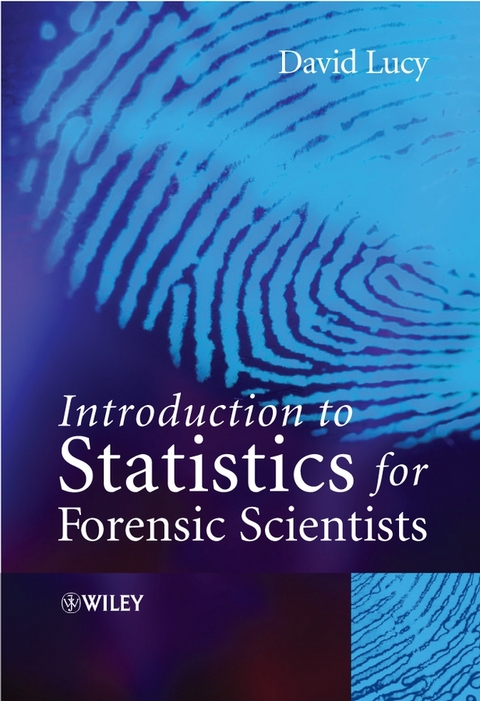
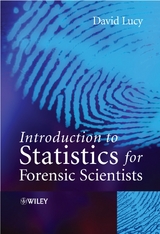
Opening with a brief overview of the history and use of statistics within forensic science, the text then goes on to introduce statistical techniques commonly used to examine data obtained during laboratory experiments. There is a strong emphasis on the evaluation of scientific observation as evidence and modern Bayesian approaches to interpreting forensic data for the courts. The analysis of key forms of evidence are discussed throughout with a particular focus on DNA, fibres and glass.
An invaluable introduction to the statistical interpretation of forensic evidence; this book will be invaluable for all undergraduates taking courses in forensic science.
- Introduction to the key statistical techniques used in the evaluation of forensic evidence
- Includes end of chapter exercises to enhance student understanding
- Numerous examples taken from forensic science to put the subject into context
Dr. David Lucy, School of Mathematics, The University of Edinburgh
Introduction to Statistics for Forensic Scientists is an essential introduction to the subject, gently guiding the reader through the key statistical techniques used to evaluate various types of forensic evidence. Assuming only a modest mathematical background, the book uses real-life examples from the forensic science literature and forensic case-work to illustrate relevant statistical concepts and methods. Opening with a brief overview of the history and use of statistics within forensic science, the text then goes on to introduce statistical techniques commonly used to examine data obtained during laboratory experiments. There is a strong emphasis on the evaluation of scientific observation as evidence and modern Bayesian approaches to interpreting forensic data for the courts. The analysis of key forms of evidence are discussed throughout with a particular focus on DNA, fibres and glass. An invaluable introduction to the statistical interpretation of forensic evidence; this book will be invaluable for all undergraduates taking courses in forensic science. Introduction to the key statistical techniques used in the evaluation of forensic evidence Includes end of chapter exercises to enhance student understanding Numerous examples taken from forensic science to put the subject into context
Dr. David Lucy, School of Mathematics, The University of Edinburgh.
Introduction to Statistics for Forensic Scientists 3
Contents 7
Preface 11
List of figures 13
List of tables 15
1 A short history of statistics in the law 17
1.1 History 17
1.2 Some recent uses of statistics in forensic science 19
1.3 What is probability? 20
2 Data types, location and dispersion 23
2.1 Types of data 23
2.2 Populations and samples 25
2.3 Distributions 25
2.4 Location 27
2.5 Dispersion 29
2.6 Hierarchies of variation 30
3 Probability 33
3.1 Aleatory probability 33
One throw of a six-sided die 33
A single throw with more than one outcome of interest 34
Two six-sided dice 35
3.2 Binomial probability 37
3.3 Poisson probability 40
3.4 Empirical probability 41
Modelled empirical probabilities 41
Truly empirical probabilities 43
4 The normal distribution 45
4.1 The normal distribution 45
4.2 Standard deviation and standard error of the mean 46
4.3 Percentage points of the normal distribution 48
4.4 The t-distribution and the standard error of the mean 50
4.5 t-testing between two independent samples 52
4.6 Testing between paired observations 56
4.7 Confidence, significance and p-values 58
5 Measures of nominal and ordinal association 61
5.1 Association between discrete variables 61
5.2 c(2) test for a 2 × 2 table 62
5.3 Yules Q 64
5.4 c(2) tests for greater than 2 × 2 tables 65
5.5 f(2) and Cramers V(2) 66
5.6 The limitations of c(2) testing 67
5.7 Interpretation and conclusions 68
6 Correlation 71
6.1 Significance tests for correlation coefficients 75
6.2 Correlation coefficients for non-linear data 76
6.3 The coefficient of determination 79
6.4 Partial correlation 79
6.5 Partial correlation controlling for two or more covariates 85
7 Regression and calibration 91
7.1 Linear models 91
7.2 Calculation of a linear regression model 94
7.3 Testing ‘goodness of fit’ 96
7.4 Testing coefficients a and b 97
7.5 Residuals 99
7.6 Calibration 101
A linear calibration model 102
Calculation of a confidence interval for a point 105
7.7 Points to remember 107
8 Evidence evaluation 111
8.1 Verbal statements of evidential value 111
8.2 Evidence types 112
8.3 The value of evidence 113
8.4 Significance testing and evidence evaluation 118
9 Conditional probability and Bayes’ theorem 121
9.1 Conditional probability 121
9.2 Bayes’ theorem 124
9.3 The value of evidence 128
10 Relevance and the formulation of propositions 133
10.1 Relevance 133
10.2 Hierarchy of propositions 134
10.3 Likelihood ratios and relevance 136
10.4 The logic of relevance 138
10.5 The formulation of propositions 139
10.6 What kind of propositions can we not evaluate? 140
11 Evaluation of evidence in practice 145
11.1 Which database to use 145
Type and geographic factors 145
DNA and database selection 147
11.2 Verbal equivalence of the likelihood ratio 149
11.3 Some common criticisms of statistical approaches 152
12 Evidence evaluation examples 155
12.1 Blood group frequencies 155
12.2 Trouser fibres 157
12.3 Shoe types 160
12.4 Airweapon projectiles 164
12.5 Height description from eyewitness 166
13 Errors in interpretation 171
13.1 Statistically based errors of interpretation 171
Transposed conditional 171
Defender’s fallacy 172
Another match error 173
Numerical conversion error 173
13.2 Methodological errors of interpretation 174
Different level error 174
Defendant’s database fallacy 175
Independence assumption 175
14 DNA I 177
14.1 Loci and alleles 177
14.2 Simple case genotypic frequencies 178
14.3 Hardy-Weinberg equilibrium 180
14.4 Simple case allelic frequencies 182
14.5 Accounting for sub-populations 184
15 DNA II 187
15.1 Paternity – mother and father unrelated 187
15.2 Database searches and value of evidence 190
15.3 Discussion 192
16 Sampling and sample size estimation 195
16.1 Estimation of a mean 195
16.2 Sample sizes for t-tests 197
Two sample t-test 197
One sample t-test 199
16.3 How many drugs to sample 200
16.4 Concluding comments 204
17 Epilogue 207
17.1 Graphical models and Bayesian Networks 208
Graphical models 208
Bayesian networks 210
17.2 Kernel density estimation 211
17.3 Multivariate continuous matching 212
Appendices 215
A Worked solutions to questions 215
B Percentage points of the standard normal distribution 241
C Percentage points of t-distributions 243
D Percentage points of c(2)-distributions 245
E Percentage points of beta-beta distributions 247
F Percentage points of F-distributions 249
G Calculating partial correlations using Excel software 251
H Further algebra using the “third law” 255
References 259
Index 265
"It deserves a place in the library of any serious
forensic scientist and I congratulate the author on his
achievement." (Significance, 1 March
2006)
"...useful for those who are becoming introduced to forensic
science." (The American Statistician, August 2007)
"...the book is an easy read...it would appeal to students of
forensic science at both introductory and advanced levels."
(Journal of Tropical Pedriatrics, 2nd February 2006)
" ... deserves a place in the library of any serious
forensic scientist and I congratulate the author on his
achievement." (Significance, Issue 3, 2006)
" ... an easy read with many complex concepts described in a
lucid style." (Journal of Tropical Pediatrics: Vol. 52; 4,
2006)
"One of the most important issues in using likelihood ratios in
a forensic context may well be determining the relevant population
of a sample. This is an are that is discussed throughout the
text...gives insight..." (Canadian Society of Forensic
Science, October 2006)
| Erscheint lt. Verlag | 22.2.2006 |
|---|---|
| Sprache | englisch |
| Themenwelt | Mathematik / Informatik ► Mathematik ► Statistik |
| Mathematik / Informatik ► Mathematik ► Wahrscheinlichkeit / Kombinatorik | |
| Medizin / Pharmazie ► Allgemeines / Lexika | |
| Naturwissenschaften ► Biologie | |
| Naturwissenschaften ► Chemie | |
| Recht / Steuern ► Strafrecht ► Kriminologie | |
| Sozialwissenschaften | |
| Schlagworte | Background • Biostatistics • Biostatistik • Biowissenschaften • Book • Casework • Cell & Molecular Biology • Concepts • Examples • Forensic • Forensic Science • Forensik • Forensische Wissenschaft • illustrate • Introduction • Key • Life Sciences • Mathematical • Modest • Reader • Reallife • relevant • Science • scientists • Statistical • Statistics • Statistik • techniques • Types • various • Zell- u. Molekularbiologie |
| ISBN-13 | 9780470022023 / 9780470022023 |
| Informationen gemäß Produktsicherheitsverordnung (GPSR) | |
| Haben Sie eine Frage zum Produkt? |
 PDF (Adobe DRM)
Kopierschutz: Adobe-DRM
Adobe-DRM ist ein Kopierschutz, der das eBook vor Mißbrauch schützen soll. Dabei wird das eBook bereits beim Download auf Ihre persönliche Adobe-ID autorisiert. Lesen können Sie das eBook dann nur auf den Geräten, welche ebenfalls auf Ihre Adobe-ID registriert sind.
Details zum Adobe-DRM
Dateiformat: PDF (Portable Document Format)
Mit einem festen Seitenlayout eignet sich die PDF besonders für Fachbücher mit Spalten, Tabellen und Abbildungen. Eine PDF kann auf fast allen Geräten angezeigt werden, ist aber für kleine Displays (Smartphone, eReader) nur eingeschränkt geeignet.
Systemvoraussetzungen:
PC/Mac: Mit einem PC oder Mac können Sie dieses eBook lesen. Sie benötigen eine
eReader: Dieses eBook kann mit (fast) allen eBook-Readern gelesen werden. Mit dem amazon-Kindle ist es aber nicht kompatibel.
Smartphone/Tablet: Egal ob Apple oder Android, dieses eBook können Sie lesen. Sie benötigen eine
Geräteliste und zusätzliche Hinweise
Buying eBooks from abroad
For tax law reasons we can sell eBooks just within Germany and Switzerland. Regrettably we cannot fulfill eBook-orders from other countries.
aus dem Bereich