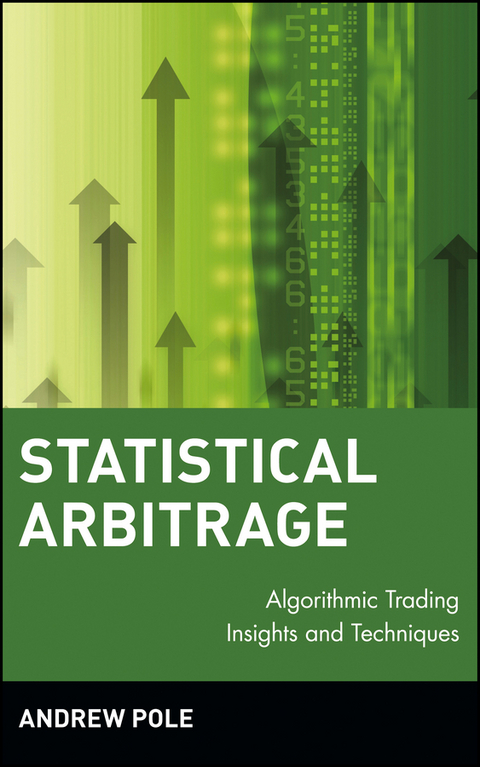
Statistical Arbitrage (eBook)
256 Seiten
John Wiley & Sons (Verlag)
9781118160732 (ISBN)
experienced dramatic changes in dynamics beginning in 2000?new
developments in algorithmic trading have allowed it to rise from
the ashes of that fire. Based on the results of author Andrew
Pole?s own research and experience running a statistical arbitrage
hedge fund for eight years?in partnership with a group whose own
history stretches back to the dawn of what was first called pairs
trading?this unique guide provides detailed insights into the
nuances of a proven investment strategy. Filled with in-depth
insights and expert advice, Statistical Arbitrage contains
comprehensive analysis that will appeal to both investors looking
for an overview of this discipline, as well as quants looking for
critical insights into modeling, risk management, and
implementation of the strategy.
Andrew Pole is a Managing Director at TIG Advisors, LLC, a registered investment advisor in New York. He specializes in quantitative trading strategies and risk management. This book is the result of his own research and experience running a statistical arbitrage hedge fund for eight years. Pole is also the coauthor of Applied Bayesian Forecasting and Time Series Analysis.
Preface.
Foreword.
Acknowledgments.
Chapter 1. Monte Carlo or Bust.
Beginning.
Whither? And Allusions.
Chapter 2. Statistical Arbitrage.
Introduction.
Noise Models.
Reverse Bets.
Multiple Bets.
Rule Calibration.
Spread Margins for Trade Rules.
Popcorn Process.
Identifying Pairs.
Refining Pair Selection.
Event Analysis.
Correlation Search in the Twenty-First Century.
Portfolio Configuration and Risk Control.
Exposure to Market Factors.
Market Impact.
Risk Control Using Event Correlations.
Dynamics and Calibration.
Evolutionary Operation: Single Parameter Illustration.
Chapter 3. Structural Models.
Introduction.
Formal Forecast Functions.
Exponentially Weighted Moving Average.
Classical Time Series Models.
Autoregression and Cointegration.
Dynamic Linear Model.
Volatility Modeling.
Pattern Finding Techniques.
Fractal Analysis.
Which Return?
A Factor Model.
Factor Analysis.
Defactored Returns.
Prediction Model.
Stochastic Resonance.
Practical Matters.
Doubling: A Deeper Perspective.
Factor Analysis Primer.
Prediction Model for Defactored Returns.
Chapter 4. Law of Reversion.
Introduction.
Model and Result.
The 75 percent Rule.
Proof of the 75 percent Rule.
Analytic Proof of the 75 percent Rule.
Discrete Counter.
Generalizations.
Inhomogeneous Variances.
Volatility Bursts.
Numerical Illustration.
First-Order Serial Correlation.
Analytic Proof.
Examples.
Nonconstant Distributions.
Applicability of the Result.
Application to U.S. Bond Futures.
Summary.
Appendix 4.1: Looking Several Days Ahead.
Chapter 5. Gauss is Not the God of Reversion.
Introduction.
Camels and Dromedaries.
Dry River Flow.
Some Bells Clang.
Chapter 6. Interstock Volatility.
Introduction.
Theoretical Explanation.
Theory versus Practice.
Finish the Theory.
Finish the Examples.
Primer on Measuring Spread Volatility.
Chapter 7. Quantifying Reversion Opportunities.
Introduction.
Reversion in a Stationary Random Process.
Frequency of Reversionary Moves.
Amount of Reversion.
Movements from Quantiles Other Than the Median.
Nonstationary Processes: Inhomogeneous Variance.
Sequentially Structured Variances.
Sequentially Unstructured Variances.
Serial Correlation.
Appendix 7.1: Details of the Lognormal Case in Example.
Chapter 8. Nobel Difficulties.
Introduction.
Event Risk.
Will Narrowing Spreads Guarantee Profits?
Rise of a New Risk Factor.
Redemption Tension.
Supercharged Destruction.
The Story of Regulation Fair Disclosure (FD).
Correlation During Loss Episodes.
Chapter 9. Trinity Troubles.
Introduction.
Decimalization.
European Experience.
Advocating the Devil.
Stat. Arb. Arbed Away.
Competition.
Institutional Investors.
Volatility Is the Key.
Interest Rates and Volatility.
Temporal Considerations.
Truth in Fiction.
A Litany of Bad Behavior.
A Perspective on 2003.
Realities of Structural Change.
Recap.
Chapter 10. Arise Black Boxes.
Introduction.
Modeling Expected Transaction Volume and Market Impact.
Dynamic Updating.
More Black Boxes.
Market Deflation.
Chapter 11. Statistical Arbitrage Rising.
Catastrophe Process.
Catastrophic Forecasts.
Trend Change Identification.
Using the Cuscore to Identify a Catastrophe.
Is It Over?
Catastrophe Theoretic Interpretation.
Implications for Risk Management.
Appendix 11.1: Understanding the Cuscore.
Bibliography.
Index.
"Over time, anything that creates an edge for a particular group of bettors--including the most astute observers of horse flesh--gets factored into the odds and becomes unreliable as a system. That's the classic argument of random walk theorists, and the equally classic response is that there's a lot of money to be made before that factoring is complete. This book is a contribution to that never-ending debate." (Hedgeworld.com)
| Erscheint lt. Verlag | 7.7.2011 |
|---|---|
| Reihe/Serie | Wiley Finance Editions | Wiley Finance Editions |
| Sprache | englisch |
| Themenwelt | Recht / Steuern ► Wirtschaftsrecht |
| Wirtschaft ► Betriebswirtschaft / Management ► Finanzierung | |
| Schlagworte | Finance & Investments • Finanz- u. Anlagewesen • Institutional & Corporate Finance • Institutionelle Finanzplanung |
| ISBN-13 | 9781118160732 / 9781118160732 |
| Informationen gemäß Produktsicherheitsverordnung (GPSR) | |
| Haben Sie eine Frage zum Produkt? |
 EPUB (Adobe DRM)
Kopierschutz: Adobe-DRM
Adobe-DRM ist ein Kopierschutz, der das eBook vor Mißbrauch schützen soll. Dabei wird das eBook bereits beim Download auf Ihre persönliche Adobe-ID autorisiert. Lesen können Sie das eBook dann nur auf den Geräten, welche ebenfalls auf Ihre Adobe-ID registriert sind.
Details zum Adobe-DRM
Dateiformat: EPUB (Electronic Publication)
EPUB ist ein offener Standard für eBooks und eignet sich besonders zur Darstellung von Belletristik und Sachbüchern. Der Fließtext wird dynamisch an die Display- und Schriftgröße angepasst. Auch für mobile Lesegeräte ist EPUB daher gut geeignet.
Systemvoraussetzungen:
PC/Mac: Mit einem PC oder Mac können Sie dieses eBook lesen. Sie benötigen eine
eReader: Dieses eBook kann mit (fast) allen eBook-Readern gelesen werden. Mit dem amazon-Kindle ist es aber nicht kompatibel.
Smartphone/Tablet: Egal ob Apple oder Android, dieses eBook können Sie lesen. Sie benötigen eine
Geräteliste und zusätzliche Hinweise
Buying eBooks from abroad
For tax law reasons we can sell eBooks just within Germany and Switzerland. Regrettably we cannot fulfill eBook-orders from other countries.
aus dem Bereich