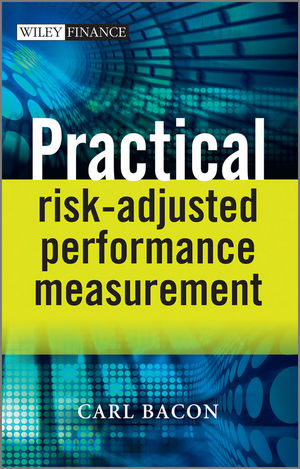
Practical Risk-Adjusted Performance Measurement (eBook)
John Wiley & Sons (Verlag)
978-1-118-39152-5 (ISBN)
Risk within asset management firms has an undeserved reputation for being an overly complex, mathematical subject. This book simplifies the subject and demonstrates with practical examples that risk is perfectly straightforward and not as complicated as it might seem. Unlike most books written on portfolio risk, which generally focus on ex-ante risk from an academic perspective using complicated language and no worked examples, this book focuses on ex-post risk from a buy side, asset management, risk practitioners perspective, including a number of practical worked examples for risk measures and their interpretation.
CARL BACON CIPM, joined StatPro Group plc as Chairman in April 2000. StatPro is a platform for Portfolio Analytics, Valuation, Reporting and Research for the investment community. Carl also runs his own consultancy business providing advice to asset managers on various risk and performance measurement issues. Prior to joining StatPro Carl was Director of Risk Control and Performance at Foreign & Colonial Management Ltd, Vice President Head of Performance (Europe) for J P Morgan Investment Management Inc., and Head of Performance for Royal Insurance Asset Management. Carl holds a BSc Hons. in Mathematics from Manchester University and is a member of the Advisory Board of the Journal of Performance Measurement A founder member of both the Investment Performance Council and GIPS®, Carl is chair of the GIPS Executive Committee, chair of the Verification Sub-Committee and a member of the UK Investment Performance Committee. Carl is also the founder of The Freedom Index Company and is also the author of Practical Portfolio Performance Measurement and Attribution part of the Wiley Finance Series, numerous articles and papers and editor of Advanced Portfolio Attribution Analysis.
A practitioner's guide to ex-post performance measurement techniques Risk within asset management firms has an undeserved reputation for being an overly complex, mathematical subject. This book simplifies the subject and demonstrates with practical examples that risk is perfectly straightforward and not as complicated as it might seem. Unlike most books written on portfolio risk, which generally focus on ex-ante risk from an academic perspective using complicated language and no worked examples, this book focuses on ex-post risk from a buy side, asset management, risk practitioners perspective, including a number of practical worked examples for risk measures and their interpretation.
CARL BACON CIPM, joined StatPro Group plc as Chairman in April 2000. StatPro is a platform for Portfolio Analytics, Valuation, Reporting and Research for the investment community. Carl also runs his own consultancy business providing advice to asset managers on various risk and performance measurement issues. Prior to joining StatPro Carl was Director of Risk Control and Performance at Foreign & Colonial Management Ltd, Vice President Head of Performance (Europe) for J P Morgan Investment Management Inc., and Head of Performance for Royal Insurance Asset Management. Carl holds a BSc Hons. in Mathematics from Manchester University and is a member of the Advisory Board of the Journal of Performance Measurement A founder member of both the Investment Performance Council and GIPS®, Carl is chair of the GIPS Executive Committee, chair of the Verification Sub-Committee and a member of the UK Investment Performance Committee. Carl is also the founder of The Freedom Index Company and is also the author of Practical Portfolio Performance Measurement and Attribution part of the Wiley Finance Series, numerous articles and papers and editor of Advanced Portfolio Attribution Analysis.
2
Descriptive Statistics
“I am always doing that which I cannot do, in order that I might learn how to do it.”
Pablo Picasso (1881–1973)
“Do not worry about your difficulties in Mathematics. I can assure you mine are still greater.”
Albert Einstein (1879–1955)
Performance measurement is two dimensional; we are concerned with both the return of the portfolio manager over a period of time and the risk of that return measured by the variability of return or another dispersion measure. Both the return and the shape of the return distribution are of interest to investors. We need descriptive statistics to help understand the underlying distribution of returns. The classic descriptive statistics are the mean, variance, skewness and kurtosis known as the first, second, third and fourth moments of the return distribution. These descriptive statistics are the basic components of many of the ex-post risk measures we shall encounter in this book.
Mean (or arithmetic mean)
The mean is the sum of returns divided by the total number of returns:
(2.1)
Where:
n = number of observations
ri = return in month i.
Note this mean (or average) return is calculated arithmetically which should not be confused with the annualised return which is calculated geometrically. The average is a measure of central tendency; the median and the mode are also average measures. The mode is the most frequently occurring return and the median is the middle ranked when returns are ranked in order of size.
The annual arithmetic mean return or annual average return is simply the mean of annual returns over the time period being evaluated.
Annualised return
The annualised return is the annual return which compounded with itself will generate the cumulative return of the portfolio over multiple years.
(2.2)
Where:
t = frequency of underlying data. For monthly t = 12 and quarterly t = 4 etc.
Note the annualised return will always be lower than or equal to the annual arithmetic mean return and better reflects the return achieved by the portfolio manager. Typically annualised rather than cumulative returns are used to present performance over multiple years. It is bad performance measurement practice to annualise periods for less than one year since that implies that the rate of return achieved so far in the year will be maintained, which is not a valid assumption.
Continuously compounded returns (or log returns)
The returns used in this book are all simple returns as opposed to continuously compounded (or log) returns. Ideally for all statistical calculations, continuously compounded returns should be used, but in practice, simple returns are more typically used. Positive simple returns are simply not equivalent in impact to negative simple returns of the same absolute size; for example if a positive return of 10% is followed by a negative return of 10% the combined return over both periods is not 0.0%, the portfolio has not returned to its starting value. On the other hand positive and negative continuously compounded returns are equivalent. Simple returns are positively biased. The continuously compounded or log return is derived as follows:
(2.3)
Simple return compound through time as follows:
(2.4)
Where:
rc = cumulative return over the entire n periods.
Continuously compounded returns add through time as follows:
(2.5)
In practice given other issues such as accuracy of data, annualisation of risk numbers and other assumptions, the decision to use simple rather than continuous returns is perhaps less of an oversight than it first appears. For example the simple annualised return is equivalent to the arithmetic mean of continuously compounded returns and the geometric excess return is equivalent to the continuously compounded arithmetic excess return. It is of much greater importance that risk measures are calculated consistently for comparison purposes.
Winsorised mean
The Winsorised mean (named after Charles P. Winsor) adjusts for extreme returns (or outliers) that might impact the mean calculation. Both the extreme high and low returns are replaced with the next highest and next lowest or a fixed percentage of high and low returns are replaced. In other industries it may be appropriate to adjust for extreme values, making the assumption they are measurement errors. However, in finance this is almost never the case; extreme returns are rarely measurement errors and on the contrary are of great interest to potential investors, portfolio managers and risk controllers.
A trimmed or truncated mean is similar to a Winsorised mean except that the extreme returns are simply removed from the calculation rather than replaced.
Mean absolute deviation (or mean deviation)
The mean of the distribution of returns provides useful information but as investors we are also interested in the deviation from the mean as shown in Figure 2.1.
Figure 2.1 Deviation from the mean
Clearly, if summed the positive and negative differences of each return from the mean return would cancel, however using the absolute difference (i.e. ignoring the sign) we are able to calculate the mean or average absolute deviation as follows:
(2.6)
Variance
The variance of returns is the average squared deviation of returns from the mean.
Squaring the deviations from the mean avoids the problem of negative deviations cancelling with positive deviations and also penalises larger deviations from the mean.
Variance is a measure of variability (or dispersion) of returns from the average or mean return. Winsorised and trimmed variances can be calculated in just the same way as Winsorised and trimmed means.
Table 2.1 contains 36 monthly portfolio returns. We will return to this standard portfolio data many times during the course of this book. The mean, annualised return, mean absolute deviation and variance for this portfolio are calculated in Exhibit 2.1
Table 2.1 Portfolio variability
Exhibit 2.1 Portfolio mean and variance
Table 2.2 contains 36 months of benchmark returns associated with the portfolio in Table 2.1. The mean, annualised return, mean absolute deviation and variance for this benchmark are calculated in Exhibit 2.2.
Table 2.2 Benchmark variability
Exhibit 2.2 Benchmark mean and variance
Mean difference (absolute mean difference or Gini mean difference)
Mean difference, defined below, is a measure of variability developed by Corrado Gini1 in 1912 which is the absolute mean of the difference between each pair of returns rather than the mean of the deviations from the mean. Mean difference is a more appropriate, but rarely used measure for the dispersion of non-normal return distributions. Gini is perhaps better known for the related statistic, the Gini coefficient, which measures income disparity.
Gini disliked variance and mean absolute deviation because they were linked to the mean and he argued that these measures were distinct and not linked and therefore proposed pair wise deviations between all returns as a measure of variability.
(2.8)
The denominator in the mean difference is of course the total number of paired returns in the distribution.
Relative mean difference
The mean difference is normalised by dividing by the arithmetic mean.2
(2.9)
Bessel's correction (population or sample, n or n−1)
It might seem obvious that we should use n in the denominator of the calculation of variance, however if we are using sample data to estimate the variance of the population, the sample mean will typically differ from the real mean of the population μ and as a consequence underestimate variance.
For example using the original data in Table 2.1 we can use the returns of the first, second and third month of each quarter as shown in Table 2.3 to calculate sample means for three groups, each of 12 months of portfolio returns and then calculate variances in Exhibit 2.3 using both the sample mean and the true population mean of the total population of 36 months.
Exhibit 2.3 Bessel's correction
Table 2.3 Bessel's correction
Bessel's correction helps correct this underestimation by multiplying by the term .
For a more detailed discussion on Bessel's correction see So.3
It is a moot point whether or not the mean of the full period of 36 months is a sample of the portfolio manager's returns or the true mean of the population being analysed – I incline to the full population. In any event for large n there is little practical difference and the industry standard is n not (n − 1). This is sensible from the performance measurer's ex-post perspective; it is easy to appreciate from the risk controller's more conservative ex-ante perspective that (n − 1) might be chosen.
The CFA-Institute (previously the Association for Investment Management and Research) effectively reinforced the standard use of n in the 1997, 2nd edition of the AIMR Performance Presentation Standards...
| Erscheint lt. Verlag | 5.10.2012 |
|---|---|
| Reihe/Serie | The Wiley Finance Series | Wiley Finance Series |
| Sprache | englisch |
| Themenwelt | Recht / Steuern ► Wirtschaftsrecht |
| Wirtschaft ► Betriebswirtschaft / Management ► Finanzierung | |
| Schlagworte | asset • begins • Book • Buy Side • Complex • Complicated • ConText • demonstrates • descriptive • Examples • expost risk • Finance & Investments • Finanz- u. Anlagewesen • firms • Institutional & Corporate Finance • Institutionelle Finanzplanung • introducing • measure • overly • Perspective • Practical • Reputation • Risk • riskadjusted performance • Undeserved |
| ISBN-10 | 1-118-39152-7 / 1118391527 |
| ISBN-13 | 978-1-118-39152-5 / 9781118391525 |
| Informationen gemäß Produktsicherheitsverordnung (GPSR) | |
| Haben Sie eine Frage zum Produkt? |
 EPUB (Adobe DRM)
Kopierschutz: Adobe-DRM
Adobe-DRM ist ein Kopierschutz, der das eBook vor Mißbrauch schützen soll. Dabei wird das eBook bereits beim Download auf Ihre persönliche Adobe-ID autorisiert. Lesen können Sie das eBook dann nur auf den Geräten, welche ebenfalls auf Ihre Adobe-ID registriert sind.
Details zum Adobe-DRM
Dateiformat: EPUB (Electronic Publication)
EPUB ist ein offener Standard für eBooks und eignet sich besonders zur Darstellung von Belletristik und Sachbüchern. Der Fließtext wird dynamisch an die Display- und Schriftgröße angepasst. Auch für mobile Lesegeräte ist EPUB daher gut geeignet.
Systemvoraussetzungen:
PC/Mac: Mit einem PC oder Mac können Sie dieses eBook lesen. Sie benötigen eine
eReader: Dieses eBook kann mit (fast) allen eBook-Readern gelesen werden. Mit dem amazon-Kindle ist es aber nicht kompatibel.
Smartphone/Tablet: Egal ob Apple oder Android, dieses eBook können Sie lesen. Sie benötigen eine
Geräteliste und zusätzliche Hinweise
Buying eBooks from abroad
For tax law reasons we can sell eBooks just within Germany and Switzerland. Regrettably we cannot fulfill eBook-orders from other countries.
aus dem Bereich