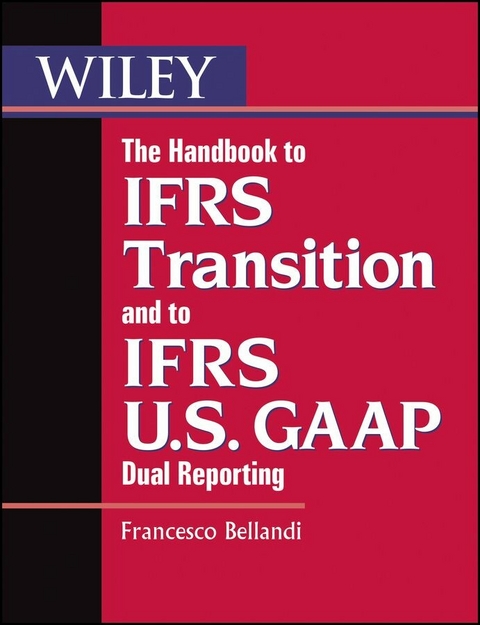
The Handbook to IFRS Transition and to IFRS U.S. GAAP Dual Reporting (eBook)
640 Seiten
John Wiley & Sons (Verlag)
978-1-119-96034-8 (ISBN)
IFRS/GAAP financial reporting
U.S. financial reporting will undergo an unprecedented level of
change within the next several years. U.S. companies face a
convergence between U.S. GAAP and IFRS, affecting several major
accounting standards--most notably in the areas of leasing,
revenue recognition, and financial instruments. It is imperative
that U.S. companies understand these major changes and their
business and operational implications. The IFRS U.S. GAAP Dual
Reporting Handbook to First-Time Adoption offers a
comprehensive treatment of both the principles and techniques of
dual reporting under IFRS/U.S. GAAP, while exploring the practical
implications for accounting professionals of reporting under both
sets of standards.
* Takes an operating approach to the implementation and
application of the dual standards
* Draws upon the author's extensive firsthand experience to
dispel uncertainty and offer decision makers expert technical
assistance
* Defines systemic changes businesses will need to make to
accommodate IFRS standards
* Compares the two bodies of standards item-by-item and
identifies solutions under one set of standards to issues arising
under the other
* Explores the strategic impact of structuring a company for IFRS
transition
In addition to covering the full range of critical issues
surrounding adopting IFRS, this indispensable handbook is a rich
resource of dual reporting tools, including financial statement
formats, charts of accounts, accounting check-lists, reconciliation
schedules, and operating manuals.
Francesco Bellandi (Surrey, UK) is a practitioner in US GAAP/IFRS dual reporting. A former Director of Finance at Alitalia, and CFO for the Cobalt Waterline Group. He is a Subject Matter Expert for the AICPA's IFRS Certificate of Accomplishment Program and is IFRS reviewer for the CPA Journal. He manages www.dualgaap.com, a website on IFRSs/US GAAP Dual Reporting, which develops research on accounting standards, analyzes implementation, develops cases and exercises, and offers training solutions, technical inquiry services, and consulting.
Preface xxxiii
About the Author xxxv
1 Introduction and Scope of Book 1
1.1 Nature of Accounting Literature and Pertinent Pronouncements1
1.2 Significance of the IFRS Transition 1
1.3 IFRS Transition Scenario 3
1.4 Scope of the Book 6
2 IFRS First-Time Adoption Requirements and Interaction withU.S. GAAP and SEC Rules and Regulations 11
2.1 Chapter Preview 11
2.2 IFRS 1 Amendments and Effective Dates 11
2.3 Rationale of IFRS 1 12
2.4 Accounting Steps in Migrating to IFRSs 18
2.5 First IFRS Financial Statements 20
2.6 Entities Affected by IFRS 1 28
2.7 Compliance with IFRSs 29
2.8 Transition Date 37
2.9 Accounting Policies 37
2.10 The Impact of Alternative Bases of Reporting 46
2.11 Accounting Estimates 54
2.12 The Opening IFRS Statement of Financial Position 61
2.13 Comparative Information 67
2.14 Exceptions and Exemptions in the Context of Comparability80
2.15 Interim Reporting 87
2.16 Reconciliations and Disclosures 95
2.17 Exceptions to the Retrospective Application of Other IFRSs101
2.18 Exemption for Past Business Combinations 126
2.19 Exemptions from Other IFRSs 149
2.20 Short-Term Exemptions from Other IFRSs 205
2.21 Implications for Financial Statement Preparers 210
3 Dual Reporting for The Statement of Financial Position215
3.1 Chapter Preview 215
3.2 Context of the Statement of Financial Position 216
3.3 Structure of the Statement of Financial Position 220
3.4 Certain Other Structural Elements of the Statement ofFinancial Position 234
3.5 Captions and Line Items 241
3.6 Implications for Financial Statement Preparers 344
4 Dual Reporting for the Statements of Income 347
4.1 Chapter Preview 347
4.2 Different Forms of Statements of Income 348
4.3 Context of Statements 357
4.4 Structure of the Statement of Income 363
4.5 Aggregations and Subtotals 366
4.6 Analysis of Expenses 440
4.7 Captions and Line Items 450
4.8 Implications for Financial Statement Preparers 516
5 Dual Reporting for the Statement of Cash Flows 521
5.1 Chapter Preview 521
5.2 Context of the Statement of Cash Flows 522
5.3 Cash and Cash Equivalents 527
5.4 Direct versus IndirectMethod 536
5.5 Other Structural Elements of the Statement of Cash Flows547
5.6 Special Issues 597
5.7 Captions and Line Items 636
5.8 Implications for Financial Statement Preparers 646
6 Dual Reporting for the Statement of Changes in Equity655
6.1 Chapter Preview 655
6.2 Context of the Statement of Changes in Equity 656
6.3 Different Concepts of the Statement of Changes in Equity664
6.4 The Structure of the Statement of Changes in Equity 669
6.5 Specific Elements 696
6.6 Captions and Line Items 703
6.7 Implications for Financial Statement Preparers 727
7 Dual Reporting for Interim Financial Statement 731
7.1 Chapter Preview 731
7.2 Accounting Principles for Interim Financial Statements732
7.3 Types of Interim Financial Information 742
7.4 Reporting Entities 744
7.5 Approaches to Interim Reporting 752
7.6 Bases of Accounting in Interim Financial Statements 755
7.7 Periods to be Covered 758
7.8 Frequency of Reporting 763
7.9 Reporting Deadlines 763
7.10 Audited versus Unaudited 764
7.11 Set of Interim Financial Statements 765
7.12 Condensed Format of Interim Financial Statements 770
7.13 Implications for Financial Statement Preparers 777
Key Elements and Decisions 777
Other Control Points 778
Table of Exhibits 781
Bibliography 785
Index 789
| Erscheint lt. Verlag | 3.5.2012 |
|---|---|
| Reihe/Serie | Wiley Regulatory Reporting | Wiley Regulatory Reporting |
| Sprache | englisch |
| Themenwelt | Recht / Steuern ► Wirtschaftsrecht |
| Wirtschaft ► Betriebswirtschaft / Management ► Rechnungswesen / Bilanzen | |
| Schlagworte | Accounting • Financial Accounting • Finanzbuchhaltung • Rechnungswesen |
| ISBN-10 | 1-119-96034-7 / 1119960347 |
| ISBN-13 | 978-1-119-96034-8 / 9781119960348 |
| Informationen gemäß Produktsicherheitsverordnung (GPSR) | |
| Haben Sie eine Frage zum Produkt? |
 EPUB (Adobe DRM)
Kopierschutz: Adobe-DRM
Adobe-DRM ist ein Kopierschutz, der das eBook vor Mißbrauch schützen soll. Dabei wird das eBook bereits beim Download auf Ihre persönliche Adobe-ID autorisiert. Lesen können Sie das eBook dann nur auf den Geräten, welche ebenfalls auf Ihre Adobe-ID registriert sind.
Details zum Adobe-DRM
Dateiformat: EPUB (Electronic Publication)
EPUB ist ein offener Standard für eBooks und eignet sich besonders zur Darstellung von Belletristik und Sachbüchern. Der Fließtext wird dynamisch an die Display- und Schriftgröße angepasst. Auch für mobile Lesegeräte ist EPUB daher gut geeignet.
Systemvoraussetzungen:
PC/Mac: Mit einem PC oder Mac können Sie dieses eBook lesen. Sie benötigen eine
eReader: Dieses eBook kann mit (fast) allen eBook-Readern gelesen werden. Mit dem amazon-Kindle ist es aber nicht kompatibel.
Smartphone/Tablet: Egal ob Apple oder Android, dieses eBook können Sie lesen. Sie benötigen eine
Geräteliste und zusätzliche Hinweise
Buying eBooks from abroad
For tax law reasons we can sell eBooks just within Germany and Switzerland. Regrettably we cannot fulfill eBook-orders from other countries.
aus dem Bereich