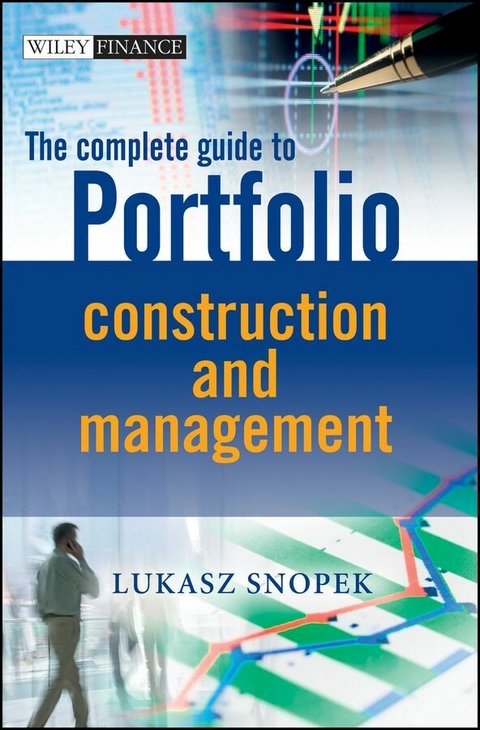
The Complete Guide to Portfolio Construction and Management (eBook)
John Wiley & Sons (Verlag)
978-1-119-95304-3 (ISBN)
Written by a high-profile investment adviser, this book reveals a practical portfolio management framework and new approach to portfolio construction based on four key market forces: macro, fundamental, technical, and behavioural. It is an insight that takes the focus off numbers, looking instead at the role of risk and behavior in finance.
As we have seen with the recent finance meltdown, traditional portfolio management techniques are flawed. Investors need to understand those flaws and learn how to incorporate risk management and behavioral finance into their asset management strategies.
With a foreword by industry leader Francois-Serge L'habitant, this is your one-stop guide, with new ways for you to manage, grow and preserve your investment portfolio, even in uncertain markets.
LUKASZ SNOPEK has been working for many years as a wealth manager and investment consultant in the private banking sector. His qualifications include a Master of Law and a Master's degree in Business Administration (HEC), the Swiss Federal Diploma for Experts in Finance and Investments and the International Wealth Manager Certificate (CIWM). Lukasz Snopek is also a corrector for the Swiss Financial Analysts Association and teaches portfolio construction and management at the Institut Supérieur de Formation Bancaire (ISFB) in Geneva.
In the wake of the recent financial crisis, many will agree that it is time for a fresh approach to portfolio management. The Complete Guide to Portfolio Construction and Management provides practical investment advice for building a robust, diversified portfolio. Written by a high-profile investment adviser, this book reveals a practical portfolio management framework and new approach to portfolio construction based on four key market forces: macro, fundamental, technical, and behavioural. It is an insight that takes the focus off numbers, looking instead at the role of risk and behavior in finance. As we have seen with the recent finance meltdown, traditional portfolio management techniques are flawed. Investors need to understand those flaws and learn how to incorporate risk management and behavioral finance into their asset management strategies. With a foreword by industry leader Francois-Serge L'habitant, this is your one-stop guide, with new ways for you to manage, grow and preserve your investment portfolio, even in uncertain markets.
LUKASZ SNOPEK has been working for many years as a wealth manager and investment consultant in the private banking sector. His qualifications include a Master of Law and a Master's degree in Business Administration (HEC), the Swiss Federal Diploma for Experts in Finance and Investments and the International Wealth Manager Certificate (CIWM). Lukasz Snopek is also a corrector for the Swiss Financial Analysts Association and teaches portfolio construction and management at the Institut Supérieur de Formation Bancaire (ISFB) in Geneva.
The Complete Guide to Portfolio Construction and Management 3
Contents 7
Foreword 15
About the Author 17
Acknowledgements 19
Introduction 21
Part I Investors and Risk 23
1 Basic Principles 25
1.1 Investors 25
1.2 Inflation 25
1.3 Choices for Investors in Terms of Investments 27
2 Measures of Risk 29
2.1 Volatility or Standard Deviation 29
2.2 Beta as a Measure of Risk 33
2.3 Value-at-Risk (VaR) 35
2.4 Investor Behaviour Towards Risk 36
Part II Asset Classes and Their Degree of Risk 39
3 Asset Classes and Associated Risks 41
3.1 Money Market Investments 41
3.1.1 Definition 41
3.1.2 Risks associated with money market investments 42
3.2 Bonds 44
3.2.1 Definition 44
3.2.2 Risks associated with bonds 48
3.3 Stocks 55
3.3.1 Definition 55
3.3.2 Risks associated with stocks 58
3.4 Real Estate 67
3.4.1 Definition 67
3.4.2 Risks associated with real estate 68
3.5 Commodities and Metals 70
3.5.1 Definition 70
3.5.2 Risks associated with commodities and metals 73
3.6 Private Equity 76
3.6.1 Definition 76
3.6.2 Risks associated with private equity 76
3.7 Other Asset Classes 78
4 Particular Forms of Investment within Asset Classes 81
4.1 Hedge Funds 81
4.1.1 Definition 81
4.1.2 Risks associated with hedge funds 82
4.2 Structured Products 85
4.2.1 Definition 85
4.2.2 Risks associated with structured products 86
4.3 Options 87
4.3.1 Definition 87
4.3.2 Risks associated with options 88
5 Classification of Asset Classes According to their Degree of Risk 93
5.1 Selected Criteria for Classification of Asset Classes 93
5.2 Classification of the Different Asset Classes 97
Part III The Market 99
6 Market Efficiency 101
6.1 Weak Form Market Efficiency 101
6.2 Semi-strong Form Market Efficiency 102
6.3 Strong Form Market Efficiency 102
6.4 Conclusion on Market Efficiency 103
7 Fundamental Analysis 105
7.1 Discounted Cash Flow 105
7.2 Relative Measures 107
7.2.1 Price to Earnings Ratio (P/E) 107
7.2.2 Price to Book 107
7.3 Strategic Analysis 108
7.3.1 The business model 108
7.3.2 External analysis 110
7.3.3 Internal analysis 117
7.3.4 The SWOT table (Strengths, Weaknesses, Opportunities and Threats) 119
7.4 Criticism of Fundamental Analysis 120
8 Technical Analysis 123
8.1 The Three Fundamental Principles of Technical Analysis 123
8.1.1 Prices reflect all available information 123
8.1.2 Prices move in trends 124
8.1.3 History repeats 126
8.1.4 Criticism of technical analysis 127
8.2 Conclusion on Technical Analysis 128
9 Investment Approach Based on “Psychological Principles” 131
Part IV Valuation of Financial Assets 133
10 Valuation of Money Market Investments 135
11 Valuation of Bonds 137
12 Valuation of Stocks 139
13 Valuation of Options 141
14 Valuation of Real Estate 143
15 Valuation of Commodities and Metals 145
16 Conclusion on Valuation 147
Part V Three Practical Approaches to Security Selection: Buffett, Graham and Lynch 149
17 Warren Buffet’s Value Investing Approach 151
18 Benjamin Graham’s Approach 155
18.1 The Defensive Investor 155
18.2 The Enterprising Investor 156
18.3 Security Analysis 157
18.3.1 Bond selection 157
18.3.2 Stock selection 157
18.4 The Margin of Safety Concept 158
19 Peter Lynch’s Approach 159
19.1 Stock Categories 160
19.1.1 Slow growers 160
19.1.2 The stalwarts 160
19.1.3 The fast growers 161
19.1.4 Cyclicals 161
19.1.5 Turnarounds 162
19.1.6 The asset plays 162
19.2 The Perfect Company According to Lynch 162
19.3 Earnings and Earnings Growth 165
19.4 Selection Criteria 166
19.4.1 The sales percentage 166
19.4.2 The P/E ratio 167
19.4.3 Liquid assets 167
19.4.4 Debt 167
19.4.5 Dividends 168
19.4.6 Hidden assets 168
19.4.7 Cash flow 168
19.4.8 Inventories 168
19.4.9 Growth rate 168
19.4.10 Gross profits 168
19.5 Conclusion on Peter Lynch’s Approach 169
Part VI Behavioural Finance 171
20 Investors in Behavioural Finance 173
21 Heuristics and Cognitive Biases 175
21.1 Information Selection 175
21.1.1 Availability heuristic 175
21.1.2 Herding 175
21.1.3 Ambiguity aversion 176
21.1.4 Wishful thinking 176
21.2 Information Processing 176
21.2.1 Representation bias 176
21.2.2 Confirmation bias 176
21.2.3 Narrative fallacy 177
21.2.4 Gambler’s fallacy 177
21.2.5 Anchoring 177
21.2.6 Framing 177
21.2.7 Probability matching 177
21.2.8 Wearing blinkers 178
21.2.9 Overconfidence bias 178
21.2.10 Illusion of control 179
21.3 The Use of Assets 179
21.3.1 Mental accounting 179
21.3.2 Disposition effect 180
21.3.3 House money effect 180
21.3.4 Endowment effect 180
21.3.5 Home bias 180
21.3.6 No go’s 180
21.3.7 Sunk costs 180
21.3.8 Lack of control 181
21.3.9 Pride and regret 181
22 Investment Approach Based on Behavioural Finance 183
22.1 Momentum Strategy 183
23 Criticism of Behavioural Finance 187
Part VII Forecasting Market Movements 189
24 Investment Approach Based on Probabilities 191
25 Random Walk Theory 193
26 Market Timing 195
27 Macroeconomic Investment Approach 199
27.1 State Interventions 201
27.1.1 Tax and fiscal policy 202
27.1.2 Monetary policy 203
27.1.3 The appropriate policy 203
27.2 The Major Macroeconomic Forces 204
27.2.1 Inflation 204
27.2.2 Economic growth 207
27.2.3 Recession 214
27.2.4 Productivity and technological change 217
27.2.5 Regulations and taxes 219
27.3 Sectorial Analysis 219
27.4 Peter Navarro’s Approach 220
27.4.1 Trends and stock picking 221
27.4.2 Sector rotation 222
27.5 Criticism of the Macroeconomic Approach 224
Part VIII Modelling Market Movements 225
28 Suggested Investment Approach 229
29 The Forces 231
29.1 The Macroeconomic Force 231
29.2 The Fundamental Force 231
29.3 The Technical Force 231
29.4 The Behavioural Force 232
29.5 The Luck Force 232
30 The Forces’ Strength 233
31 The Beauty of the Approach 235
Part IX Portfolio Construction and Management 237
32 Modern Portfolio Theory According to Markowitz 239
32.1 David Swensen’s Approach 241
33 The Capital Asset Pricing Model (CAPM) 243
34 The Minimum Variance Portfolio 245
35 Value-at-Risk (VaR) 249
36 Discretionary Mandates 251
37 The Dollar-cost Averaging Approach 253
38 Our Portfolio Construction Method 255
38.1 Basic Principles of Portfolio Construction 255
38.1.1 10 rules for protecting your capital 256
38.1.2 The 12 rules of risk management 257
38.2 The Portfolio Construction Process 260
38.2.1 The investor’s life objectives 260
38.2.2 The investor’s life cycle and investment time horizon 260
38.2.3 Choosing a reference currency 260
38.2.4 Evaluating the risk profile 260
38.2.5 Estimating a return target 261
38.2.6 The investor’s tax rate 262
38.2.7 Determining the proportion of risky assets 262
38.2.8 Evaluating the expected degree of liquidity (share of illiquid assets) 262
38.2.9 Portfolio construction and management 262
38.3 A Practical Example of Portfolio Construction 271
Part X Attractiveness of the Different Asset Classes 275
39 Asset Classes 277
39.1 Money Market Investments 277
39.2 Bonds 277
39.3 Stocks 278
39.4 Real Estate 279
39.5 Commodities and Precious and Industrial Metals 280
40 The Four Forces of the Investment Model 281
40.1 The Macroeconomic Force 281
40.1.1 The Macroeconomic Force and money market investments 281
40.1.2 The Macroeconomic Force and bonds 281
40.1.3 The Macroeconomic Force and stocks 282
40.1.4 The Macroeconomic Force and real estate 283
40.1.5 The Macroeconomic Force and commodities, precious and industrial metals 284
40.2 The Fundamental Force 284
40.2.1 The Fundamental Force and money market investments 284
40.2.2 The Fundamental Force and bonds 285
40.2.3 The Fundamental Force and stocks 285
40.2.4 The Fundamental Force and real estate 291
40.2.5 The Fundamental Force and commodities, precious and industrial metals 291
40.3 The Technical Force 291
40.3.1 The Technical Force and money market investments 291
40.3.2 The Technical Force and bonds 292
40.3.3 The Technical Force and stocks 292
40.3.4 The Technical Force and real estate 292
40.3.5 The Technical Force and commodities, precious and industrial metals 293
40.4 The Behavioural Force 293
40.4.1 The Behavioural Force and money market investments 293
40.4.2 The Behavioural Force and bonds 293
40.4.3 The Behavioural Force and stocks 293
40.4.4 The Behavioural Force and real estate 294
40.4.5 The Behavioural Force and commodities, preciousand industrial metals 294
41 Table Summarising the Different Forces 295
42 A Final Example: Analysis of the Subprime Crisis 299
Conclusion 303
Bibliography 305
Index 307
| Erscheint lt. Verlag | 30.11.2011 |
|---|---|
| Reihe/Serie | The Wiley Finance Series | Wiley Finance Series |
| Sprache | englisch |
| Themenwelt | Recht / Steuern ► Wirtschaftsrecht |
| Wirtschaft ► Betriebswirtschaft / Management ► Finanzierung | |
| Schlagworte | Finance & Investments • Finanz- u. Anlagewesen • Institutional & Corporate Finance • Institutionelle Finanzplanung • risk, financial, portfolio management, asset management, risk management, investment advice, investment portfolio, portfolio investment, private banking, behavioural finance, portfolio management, portfolio construction, diversified portfolio, portfolio management framework, traditional portfolio management techniques, developing investment portfolios, investment and portfolio construction advice, portfolio of investments, portfolio construction and management, new portfolio management techniques, modern po |
| ISBN-10 | 1-119-95304-9 / 1119953049 |
| ISBN-13 | 978-1-119-95304-3 / 9781119953043 |
| Informationen gemäß Produktsicherheitsverordnung (GPSR) | |
| Haben Sie eine Frage zum Produkt? |
 PDF (Adobe DRM)
Kopierschutz: Adobe-DRM
Adobe-DRM ist ein Kopierschutz, der das eBook vor Mißbrauch schützen soll. Dabei wird das eBook bereits beim Download auf Ihre persönliche Adobe-ID autorisiert. Lesen können Sie das eBook dann nur auf den Geräten, welche ebenfalls auf Ihre Adobe-ID registriert sind.
Details zum Adobe-DRM
Dateiformat: PDF (Portable Document Format)
Mit einem festen Seitenlayout eignet sich die PDF besonders für Fachbücher mit Spalten, Tabellen und Abbildungen. Eine PDF kann auf fast allen Geräten angezeigt werden, ist aber für kleine Displays (Smartphone, eReader) nur eingeschränkt geeignet.
Systemvoraussetzungen:
PC/Mac: Mit einem PC oder Mac können Sie dieses eBook lesen. Sie benötigen eine
eReader: Dieses eBook kann mit (fast) allen eBook-Readern gelesen werden. Mit dem amazon-Kindle ist es aber nicht kompatibel.
Smartphone/Tablet: Egal ob Apple oder Android, dieses eBook können Sie lesen. Sie benötigen eine
Geräteliste und zusätzliche Hinweise
Buying eBooks from abroad
For tax law reasons we can sell eBooks just within Germany and Switzerland. Regrettably we cannot fulfill eBook-orders from other countries.
aus dem Bereich