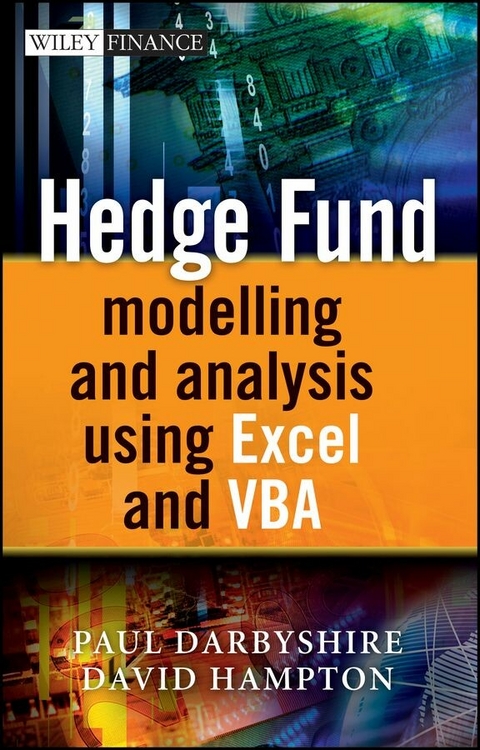
Hedge Fund Modelling and Analysis Using Excel and VBA (eBook)
John Wiley & Sons (Verlag)
978-1-119-94564-2 (ISBN)
The book provides hands-on coverage of the visual and theoretical methods for measuring and modelling hedge fund performance with an emphasis on risk-adjusted performance metrics and techniques. A range of sophisticated risk analysis models and risk management strategies are also described in detail. Throughout, coverage is supplemented with helpful skill building exercises and worked examples in Excel and VBA.
The book's dedicated website, www.darbyshirehampton.com provides Excel spreadsheets and VBA source code which can be freely downloaded and also features links to other relevant and useful resources.
A comprehensive course in hedge fund modelling and analysis, this book arms you with the knowledge and tools required to effectively manage your risks and to optimise the return profile of your investment style.
PAUL DARBYSHIRE gained his PhD in Theoretical Physics from King’s College London and then began his career working has a Quantitative Analyst and Trader at HSBC on the Exotic Derivatives and Structured Products desk. He has subsequently been involved in the development and implementation of a variety of trading and risk management platforms for a number of major investment banks around the globe. Over the past several years Paul has been responsible for the analysis and design of cutting edge algorithms in the development of behavioural finance models at Oxford University. Paul has also provided many private equity firms, hedge funds and asset management companies with consultancy in areas such as dynamic portfolio optimisation, trading platform design, software engineering and risk management.
DAVID HAMPTON gained his PhD in Electrical Engineering from the Queen’s University of Belfast and an international MBA from Institut Superieur de Gestion in Paris, New York and Tokyo before joining Bank of America Capital Markets in London. David was previously an Adjunct Finance Professor at Skema Business School in Sophia Antipolis where he taught Financial Engineering and Excel/VBA Programming at the MSc level. At EDHEC Business School in Nice, he was responsible for managing their range of five MSc courses as Assistant Dean of the Financial Economics Track. An NFA registered CTA since 1997, David has been active as a consultant to the hedge fund community and as a Hedge Fund Manager with particular expertise in Global Macro Managed Futures and Long Short Equity investment styles.
Both David and Paul are Directors of darbyshirehampton; an innovative quantitative research, advisory, and consultancy firm specialising in hedge funds and the alternative investment industry. Website: www.darbyshirehampton.com.
Co-authored by two respected authorities on hedge funds and asset management, this implementation-oriented guide shows you how to employ a range of the most commonly used analysis tools and techniques both in industry and academia, for understanding, identifying and managing risk as well as for quantifying return factors across several key investment strategies. The book is also suitable for use as a core textbook for specialised graduate level courses in hedge funds and alternative investments. The book provides hands-on coverage of the visual and theoretical methods for measuring and modelling hedge fund performance with an emphasis on risk-adjusted performance metrics and techniques. A range of sophisticated risk analysis models and risk management strategies are also described in detail. Throughout, coverage is supplemented with helpful skill building exercises and worked examples in Excel and VBA. The book's dedicated website, www.darbyshirehampton.com provides Excel spreadsheets and VBA source code which can be freely downloaded and also features links to other relevant and useful resources. A comprehensive course in hedge fund modelling and analysis, this book arms you with the knowledge and tools required to effectively manage your risks and to optimise the return profile of your investment style.
PAUL DARBYSHIRE gained his PhD in Theoretical Physics from King's College London and then began his career working has a Quantitative Analyst and Trader at HSBC on the Exotic Derivatives and Structured Products desk. He has subsequently been involved in the development and implementation of a variety of trading and risk management platforms for a number of major investment banks around the globe. Over the past several years Paul has been responsible for the analysis and design of cutting edge algorithms in the development of behavioural finance models at Oxford University. Paul has also provided many private equity firms, hedge funds and asset management companies with consultancy in areas such as dynamic portfolio optimisation, trading platform design, software engineering and risk management. DAVID HAMPTON gained his PhD in Electrical Engineering from the Queen's University of Belfast and an international MBA from Institut Superieur de Gestion in Paris, New York and Tokyo before joining Bank of America Capital Markets in London. David was previously an Adjunct Finance Professor at Skema Business School in Sophia Antipolis where he taught Financial Engineering and Excel/VBA Programming at the MSc level. At EDHEC Business School in Nice, he was responsible for managing their range of five MSc courses as Assistant Dean of the Financial Economics Track. An NFA registered CTA since 1997, David has been active as a consultant to the hedge fund community and as a Hedge Fund Manager with particular expertise in Global Macro Managed Futures and Long Short Equity investment styles. Both David and Paul are Directors of darbyshirehampton; an innovative quantitative research, advisory, and consultancy firm specialising in hedge funds and the alternative investment industry. Website: href="https://euemail.wiley.com/owa/coltraneuk@wiley.com/redir.aspx?C=9e78baef3f9743cfbaa17c095f7e0dd2&URL=http%3a%2f%2fwww.darbyshirehampton.com" target="_blank">www.darbyshirehampton.com.
2
Major Hedge Fund Strategies
Hedge funds can be classified in a number of different ways, e.g. by particular asset, geographical location of strategy or industrial sector. The most common hedge fund classification is by strategy and then by style within that strategy. There are three major hedge fund strat- egies, namely relative value, event-driven and tactical, each with its own individual strategy styles.
This chapter introduces the most common investment strategies within each of the major hedge fund strategy styles. Emphasis is placed on equity related strategies since these will be the focus of more detailed quantitative modelling and analysis in later chapters.
2.1 SINGLE- AND MULTI-STRATEGY HEDGE FUNDS
Hedge funds are a private investment vehicle with a collective pool of money designed to exploit superior manager skills in order to make above average returns for investors. Single-strategy funds rely heavily on the expertise and knowledge of the hedge fund manager(s) to provide such returns using a specific investment strategy (see Figure 2.1). Considerable and effective due diligence is required when attempting to select top (or star) managers in single strategy funds. Such research can be very time-consuming and costly along with the additional problems associated with gaining access to a professional network of top managers.
Figure 2.1 A schematic of the single-strategy, single- and multi-manager hedge fund
Figure 2.2 A schematic of the multi-strategy hedge fund
Although fund managers are usually willing to discuss the general structure of a particular chosen strategy, they are unlikely to divulge sensitive or potentially profitable information. Those involved in single-strategy hedge fund investing will usually have a high degree of ex- perience in qualitative and quantitative analysis. There are obvious drawbacks to single-strategy hedge fund investing and the investor needs to accept a suitable trade-off between ongoing exhaustive research and the return expected on their investment. There is also the problem of investing in a fund that offers no diversification, making the investor extremely vulnerable to the success of a single strategy.
Multi-strategy hedge funds can provide an attractive alternative to single-strategy funds. Their objective is to provide positive returns regardless of the directional movement in a variety of asset classes and sectors, such as equity, fixed income and currency markets. The general multi-strategy fund is based on a selection of hedge fund strategies in a single portfolio operated by a team of managers in a single hedge fund (see Figure 2.2). Such a strategy can prove lucrative to investors who have strong knowledge of, or confidence in, a particular hedge fund management team as well as the added benefits of diversification of investing across a range of asset classes and sectors. This can, however, also be the most convincing argument against multi-strategy hedge funds since the majority of failures are related to operational inefficiencies within the hedge fund. Multi-strategy hedge funds are also faced with the problem of retaining and employing highly skilled managers that have expertise across a range of different investment strategies and sectors. It is often thought that the best managers concentrate on a single or limited group of hedge fund strategies and these can be difficult to source and locate without the necessary experience and network of contacts.
Figure 2.3 A schematic of the FoHFs structure
2.2 FUND OF HEDGE FUNDS
A common investment vehicle for an inexperienced investor or one who has had limited exposure to the alternative investment market is the fund of hedge funds (FoHFs) strategy. Of course, this strategy is not necessarily only for inexperienced investors. If an investor does not have the time or resources to design an efficient hedge fund, select qualified managers for each strategy, determine optimal weightings of investable assets, negotiate the legal documents and then monitor monthly per- formance, a FoHFs strategy may be a more realistic approach to investing. Such investments are also ideal for individual investors who may not be able to attract the interest of leading hedge fund managers.
Funds of hedge funds allocate their capital by investing in hedge funds with different strategies, or investing in multiple hedge funds with the same strategy (see Figure 2.3). A FoHFs manager will usually construct a portfolio of hedge funds (on average 10–20 hedge funds) in order to achieve a certain risk–return profile and level of diversification that is suitable to a range of investors. The manager is responsible for all the due diligence and qualitative and quantitative analysis of potential hedge funds and the termination of poorly performing ones, as well as deciding the management fee structure. Since there are fees associated with each individual hedge fund making up the FoHFs and an additional fee for the FoHFs manager, such investments are normally more expensive than standard hedge fund investing.
Despite the additional layer of fees, there are clear advantages to investing in FoHFs when considering the extent of the skills and expertise offered by the fund manager as well as the expected higher risk-adjusted returns. It is often the case that gaining access to the hedge fund arena can be very expensive with prohibitively high initial minimum investments, whereas FoHFs investors can get involved in the market with much lower minimums whilst accessing the same potential underlying hedge funds. Another advantage of FoHFs is that the manager will also have access to a professional network of individual hedge funds and information usually not available to normal investors along with detailed market knowledge. They will also be highly trained in sourcing talented and often undiscovered star managers whom the general investment community would be much less likely to reach.
This well-diversified portfolio of hedge fund investments can protect an investor from suffering large losses due to the poor performance or failure of a single strategy. However, over the past several years, AuMs in global FoHFs have experienced a dramatic downturn since peaking in early 2008. During the financial crisis, FoHFs suffered massive losses and record redemptions (see Figure 2.4).
Figure 2.4 Growth of the global FoHFs industry since 2000
Source: Eurekahedge
The poor asset flows into the FoHFs industry over the past several years are mainly a result of investors preferring to allocate capital to a single hedge fund rather than multiple managers. As a result of single hedge funds outperforming FoHFs in 2008 and 2009, and the use of gated provisions during the financial crisis, investors have had a change of sentiment towards investing in multi-manager structures. Investors are also unwilling to pay an additional layer of fees to FoHFs managers without the level of returns expected from similar investments. Managers have since begun to address these issues by offering investors lower fee structures, more frequent redemptions and increased transparency. Despite these changes, FoHFs managers need to show improved performance and consistently higher returns in order to entice investors back to investing in the FoHFs industry.
2.3 HEDGE FUND STRATEGIES
Hedge funds can be classified in a number of different ways, for example by particular asset, geographical location of strategy or industrial sector. The most common hedge fund classification is by strategy and then by style within that strategy. As can be seen in Table 2.1 there are three major hedge fund strategies, namely relative value, event-driven and tactical, each with its own individual strategy styles. However, it is important to note that there is no definitive hedge fund strategy classification and the boundaries between them are very blurred.
Table 2.1 The major hedge fund strategies and their individual strategy styles
| Relative value | Event-driven | Tactical |
| Equity market neutral | Distressed securities | Global macro |
| Convertible arbitrage | Risk arbitrage | Long/short equity |
| Fixed income arbitrage | Managed futures |
| Capital structure arbitrage |
| Swap-spread arbitrage |
| Yield curve arbitrage |
In addition to classifying hedge funds by strategy and individual strategy styles, they can also be categorised in terms of their risk–return characteristics and the volatility of each strategy. Figure 2.5 is a schematic diagram of the relationship between each major hedge fund strategy and the associated risk, return and volatility. Tactical strategies offer the highest return but for the greatest risk and are generally highly volatile strategies requiring exceptional skills, ability and experience from the fund manager. On the other hand, relative value strategies offer a much lower return but with the added incentive of lower risk and volatility.
Figure 2.5 The major hedge fund strategies in relation to increasing return, volatility and risk
2.3.1 Tactical Strategies
2.3.1.1 Global Macro
The global macro strategy attempts to make superior returns based on leveraged trades on price...
| Erscheint lt. Verlag | 23.2.2012 |
|---|---|
| Reihe/Serie | The Wiley Finance Series |
| Wiley Finance Series | Wiley Finance Series |
| Sprache | englisch |
| Themenwelt | Recht / Steuern ► Wirtschaftsrecht |
| Wirtschaft ► Betriebswirtschaft / Management ► Finanzierung | |
| Schlagworte | Assets • challenges • Clients • Crisis • Finance & Investments • Financial • Financial Engineering • Finanztechnik • Finanz- u. Anlagewesen • Fund • Funds • George • Global • greater • grown • Hedge • Horizon • Major • Managers • Markets • Meltdown • niche • obscure • Player • popularised • potentially • Returns • Seeking • Soros • Trillion • US • usd • worse |
| ISBN-10 | 1-119-94564-X / 111994564X |
| ISBN-13 | 978-1-119-94564-2 / 9781119945642 |
| Informationen gemäß Produktsicherheitsverordnung (GPSR) | |
| Haben Sie eine Frage zum Produkt? |
 EPUB (Adobe DRM)
Kopierschutz: Adobe-DRM
Adobe-DRM ist ein Kopierschutz, der das eBook vor Mißbrauch schützen soll. Dabei wird das eBook bereits beim Download auf Ihre persönliche Adobe-ID autorisiert. Lesen können Sie das eBook dann nur auf den Geräten, welche ebenfalls auf Ihre Adobe-ID registriert sind.
Details zum Adobe-DRM
Dateiformat: EPUB (Electronic Publication)
EPUB ist ein offener Standard für eBooks und eignet sich besonders zur Darstellung von Belletristik und Sachbüchern. Der Fließtext wird dynamisch an die Display- und Schriftgröße angepasst. Auch für mobile Lesegeräte ist EPUB daher gut geeignet.
Systemvoraussetzungen:
PC/Mac: Mit einem PC oder Mac können Sie dieses eBook lesen. Sie benötigen eine
eReader: Dieses eBook kann mit (fast) allen eBook-Readern gelesen werden. Mit dem amazon-Kindle ist es aber nicht kompatibel.
Smartphone/Tablet: Egal ob Apple oder Android, dieses eBook können Sie lesen. Sie benötigen eine
Geräteliste und zusätzliche Hinweise
Buying eBooks from abroad
For tax law reasons we can sell eBooks just within Germany and Switzerland. Regrettably we cannot fulfill eBook-orders from other countries.
aus dem Bereich