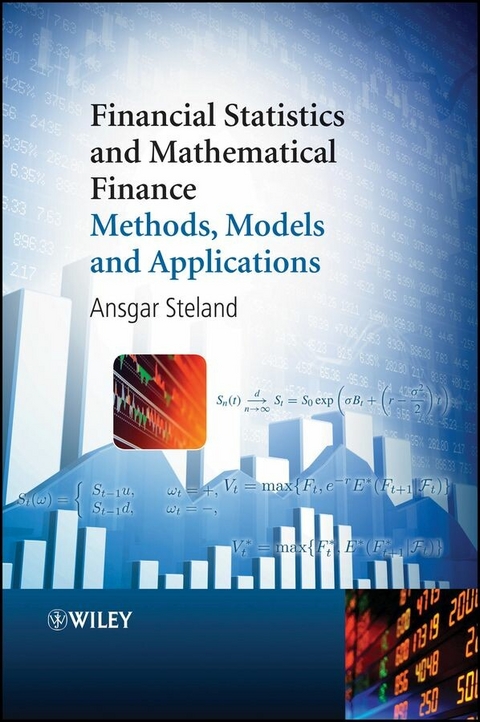
Financial Statistics and Mathematical Finance (eBook)
John Wiley & Sons (Verlag)
978-1-118-31656-6 (ISBN)
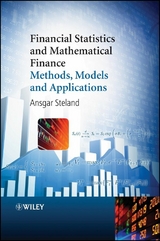
Mathematical finance has grown into a huge area of research which requires a lot of care and a large number of sophisticated mathematical tools. Mathematically rigorous and yet accessible to advanced level practitioners and mathematicians alike, it considers various aspects of the application of statistical methods in finance and illustrates some of the many ways that statistical tools are used in financial applications.
Financial Statistics and Mathematical Finance:
- Provides an introduction to the basics of financial statistics and mathematical finance.
- Explains the use and importance of statistical methods in econometrics and financial engineering.
- Illustrates the importance of derivatives and calculus to aid understanding in methods and results.
- Looks at advanced topics such as martingale theory, stochastic processes and stochastic integration.
- Features examples throughout to illustrate applications in mathematical and statistical finance.
- Is supported by an accompanying website featuring R code and data sets.
Financial Statistics and Mathematical Finance introduces the financial methodology and the relevant mathematical tools in a style that is both mathematically rigorous and yet accessible to advanced level practitioners and mathematicians alike, both graduate students and researchers in statistics, finance, econometrics and business administration will benefit from this book.
Ansgar Steland, Institute for Statistics and Economics, RWTH Aachen University, Germany.
Financial Statistics and Mathematical Finance: Methods, Models and Applications 1
Contents 7
Preface 13
Acknowledgements 17
1 Elementary financial calculus 19
1.1 Motivating examples 19
1.2 Cashflows, interest rates, prices and returns 20
1.2.1 Bonds and the term structure of interest rates 23
1.2.2 Asset returns 24
1.2.3 Some basic models for asset prices 26
1.3 Elementary statistical analysis of returns 29
1.3.1 Measuring location 31
1.3.2 Measuring dispersion and risk 34
1.3.3 Measuring skewness and kurtosis 38
1.3.4 Estimation of the distribution 39
1.3.5 Testing for normality 45
1.4 Financial instruments 46
1.4.1 Contingent claims 46
1.4.2 Spot contracts and forwards 47
1.4.3 Futures contracts 47
1.4.4 Options 48
1.4.5 Barrier options 49
1.4.6 Financial engineering 50
1.5 A primer on option pricing 50
1.5.1 The no-arbitrage principle 50
1.5.2 Risk-neutral evaluation 51
1.5.3 Hedging and replication 54
1.5.4 Nonexistence of a risk-neutral measure 55
1.5.5 The Black–Scholes pricing formula 55
1.5.6 The Greeks 57
1.5.7 Calibration, implied volatility and the smile 59
1.5.8 Option prices and the risk-neutral density 59
1.6 Notes and further reading 61
References 61
2 Arbitrage theory for the one-period model 63
2.1 Definitions and preliminaries 63
2.2 Linear pricing measures 65
2.3 More on arbitrage 68
2.4 Separation theorems in Rn 71
2.5 No-arbitrage and martingale measures 74
2.6 Arbitrage-free pricing of contingent claims 83
2.7 Construction of martingale measures: general case 88
2.8 Complete financial markets 91
2.9 Notes and further reading 94
References 94
3 Financial models in discrete time 97
3.1 Adapted stochastic processes in discrete time 99
3.2 Martingales and martingale differences 103
3.2.1 The martingale transformation 109
3.2.2 Stopping times, optional sampling and a maximal inequality 111
3.2.3 Extensions to Rd 119
3.3 Stationarity 120
3.3.1 Weak and strict stationarity 120
3.4 Linear processes and ARMA models 129
3.4.1 Linear processes and the lag operator 129
3.4.2 Inversion 134
3.4.3 AR(p) and AR(8) processes 137
3.4.4 ARMA processes 140
3.5 The frequency domain 142
3.5.1 The spectrum 142
3.5.2 The periodogram 144
3.6 Estimation of ARMA processes 150
3.7 (G)ARCH models 151
3.8 Long-memory series 157
3.8.1 Fractional differences 157
3.8.2 Fractionally integrated processes 162
3.9 Notes and further reading 162
References 163
4 Arbitrage theory for the multiperiod model 165
4.1 Definitions and preliminaries 166
4.2 Self-financing trading strategies 166
4.3 No-arbitrage and martingale measures 170
4.4 European claims on arbitrage-free markets 172
4.5 The martingale representation theorem in discrete time 177
4.6 The Cox–Ross–Rubinstein binomial model 178
4.7 The Black–Scholes formula 183
4.8 American options and contingent claims 189
4.8.1 Arbitrage-free pricing and the optimal exercise strategy 189
4.8.2 Pricing american options using binomial trees 192
4.9 Notes and further reading 193
References 193
5 Brownian motion and related processes in continuous time 195
5.1 Preliminaries 195
5.2 Brownian motion 199
5.2.1 Definition and basic properties 199
5.2.2 Brownian motion and the central limit theorem 206
5.2.3 Path properties 208
5.2.4 Brownian motion in higher dimensions 209
5.3 Continuity and differentiability 210
5.4 Self-similarity and fractional Brownian motion 211
5.5 Counting processes 213
5.5.1 The poisson process 213
5.5.2 The compound poisson process 214
5.6 Lévy processes 217
5.7 Notes and further reading 219
References 219
6 Itô Calculus 221
6.1 Total and quadratic variation 222
6.2 Stochastic Stieltjes integration 226
6.3 The Itô integral 230
6.4 Quadratic covariation 243
6.5 Itô’s formula 244
6.6 Itô processes 247
6.7 Diffusion processes and ergodicity 254
6.8 Numerical approximations and statistical estimation 256
6.9 Notes and further reading 257
References 258
7 The Black–Scholes model 259
7.1 The model and first properties 259
7.2 Girsanov’s theorem 265
7.3 Equivalent martingale measure 269
7.4 Arbitrage-free pricing and hedging claims 270
7.5 The delta hedge 274
7.6 Time-dependent volatility 275
7.7 The generalized Black–Scholes model 277
7.8 Notes and further reading 279
References 280
8 Limit theory for discrete-time processes 281
8.1 Limit theorems for correlated time series 282
8.2 A regression model for financial time series 291
8.2.1 Least squares estimation 294
8.3 Limit theorems for martingale difference 296
8.4 Asymptotics 301
8.5 Density estimation and nonparametric regression 305
8.5.1 Multivariate density estimation 306
8.5.2 Nonparametric regression 313
8.6 The CLT for linear processes 320
8.7 Mixing processes 324
8.7.1 Mixing coefficients 324
8.7.2 Inequalities 326
8.8 Limit theorems for mixing processes 331
8.9 Notes and further reading 341
References 341
9 Special topics 343
9.1 Copulas – and the 2008 financial crisis 343
9.1.1 Copulas 344
9.1.2 The financial crisis 350
9.1.3 Models for credit defaults and CDOs 353
9.2 Local Linear nonparametric regression 356
9.2.1 Applications in finance: estimation of martingale measures and Itô diffusions 357
9.2.2 Method and asymptotics 358
9.3 Change-point detection and monitoring 368
9.3.1 Offline detection 369
9.3.2 Online detection 377
9.4 Unit roots and random walk 381
9.4.1 The OLS estimator in the stationary AR(1) model 382
9.4.2 Nonparametric definitions for the degree of integration 386
9.4.3 The Dickey–Fuller test 388
9.4.4 Detecting unit roots and stationarity 391
9.5 Notes and further reading 399
References 400
Appendix A
403
A.1 (Stochastic) Landau symbols 403
A.2 Bochner’s lemma 405
A.3 Conditional expectation 405
A.4 Inequalities 406
A.5 Random series 407
A.6 Local martingales in discrete time 407
Appendix B:
409
B.1 Convergence in distribution 409
B.2 Weak convergence 410
B.3 Prohorov’s theorem 416
B.4 Sufficient criteria 417
B.5 More on Skorohod spaces 419
B.6 Central limit theorems for martingale differences 420
B.7 Functional central limit theorems 421
B.8 Strong approximations 423
References 425
Index 427
| Erscheint lt. Verlag | 21.6.2012 |
|---|---|
| Sprache | englisch |
| Themenwelt | Mathematik / Informatik ► Mathematik ► Wahrscheinlichkeit / Kombinatorik |
| Recht / Steuern ► Wirtschaftsrecht | |
| Wirtschaft ► Betriebswirtschaft / Management ► Finanzierung | |
| Schlagworte | Ãkonometrie • Ãkonometrie u. statistische Methoden • Business & Finance • Econometric & Statistical Methods • Econometrics • Economics • Financial Statistics and Mathematical Finance, martingale theory, stochastic processes, stochastic integration, arbitrage theory for the one-period model, financial models in discrete time, abitrage theory for the multi-period model, brownian motion, Levy processes, Black-Scholes Model, limit theory for discrete-time processes • Mathematics • Mathematik • Mathematik in Wirtschaft u. Finanzwesen • Ökonometrie • Ökonometrie u. statistische Methoden • Statistics • Statistik • Volkswirtschaftslehre |
| ISBN-10 | 1-118-31656-8 / 1118316568 |
| ISBN-13 | 978-1-118-31656-6 / 9781118316566 |
| Informationen gemäß Produktsicherheitsverordnung (GPSR) | |
| Haben Sie eine Frage zum Produkt? |
 PDF (Adobe DRM)
Größe: 2,8 MB
Kopierschutz: Adobe-DRM
Adobe-DRM ist ein Kopierschutz, der das eBook vor Mißbrauch schützen soll. Dabei wird das eBook bereits beim Download auf Ihre persönliche Adobe-ID autorisiert. Lesen können Sie das eBook dann nur auf den Geräten, welche ebenfalls auf Ihre Adobe-ID registriert sind.
Details zum Adobe-DRM
Dateiformat: PDF (Portable Document Format)
Mit einem festen Seitenlayout eignet sich die PDF besonders für Fachbücher mit Spalten, Tabellen und Abbildungen. Eine PDF kann auf fast allen Geräten angezeigt werden, ist aber für kleine Displays (Smartphone, eReader) nur eingeschränkt geeignet.
Systemvoraussetzungen:
PC/Mac: Mit einem PC oder Mac können Sie dieses eBook lesen. Sie benötigen eine
eReader: Dieses eBook kann mit (fast) allen eBook-Readern gelesen werden. Mit dem amazon-Kindle ist es aber nicht kompatibel.
Smartphone/Tablet: Egal ob Apple oder Android, dieses eBook können Sie lesen. Sie benötigen eine
Geräteliste und zusätzliche Hinweise
Zusätzliches Feature: Online Lesen
Dieses eBook können Sie zusätzlich zum Download auch online im Webbrowser lesen.
Buying eBooks from abroad
For tax law reasons we can sell eBooks just within Germany and Switzerland. Regrettably we cannot fulfill eBook-orders from other countries.
 EPUB (Adobe DRM)
Kopierschutz: Adobe-DRM
Adobe-DRM ist ein Kopierschutz, der das eBook vor Mißbrauch schützen soll. Dabei wird das eBook bereits beim Download auf Ihre persönliche Adobe-ID autorisiert. Lesen können Sie das eBook dann nur auf den Geräten, welche ebenfalls auf Ihre Adobe-ID registriert sind.
Details zum Adobe-DRM
Dateiformat: EPUB (Electronic Publication)
EPUB ist ein offener Standard für eBooks und eignet sich besonders zur Darstellung von Belletristik und Sachbüchern. Der Fließtext wird dynamisch an die Display- und Schriftgröße angepasst. Auch für mobile Lesegeräte ist EPUB daher gut geeignet.
Systemvoraussetzungen:
PC/Mac: Mit einem PC oder Mac können Sie dieses eBook lesen. Sie benötigen eine
eReader: Dieses eBook kann mit (fast) allen eBook-Readern gelesen werden. Mit dem amazon-Kindle ist es aber nicht kompatibel.
Smartphone/Tablet: Egal ob Apple oder Android, dieses eBook können Sie lesen. Sie benötigen eine
Geräteliste und zusätzliche Hinweise
Buying eBooks from abroad
For tax law reasons we can sell eBooks just within Germany and Switzerland. Regrettably we cannot fulfill eBook-orders from other countries.
aus dem Bereich