


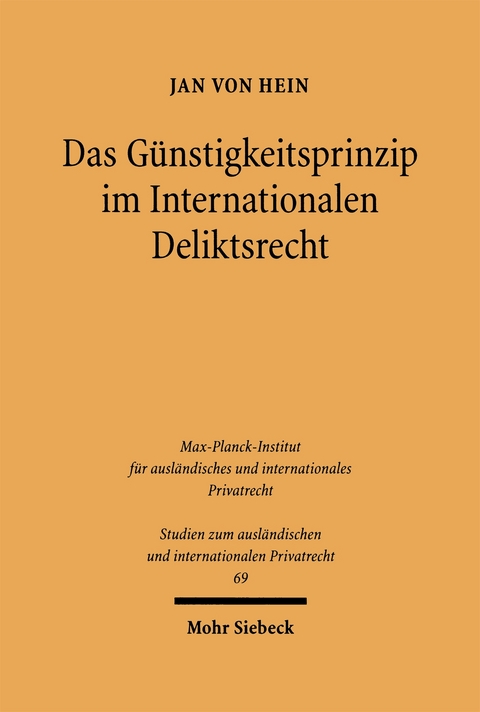
Das Günstigkeitsprinzip im Internationalen Deliktsrecht
Seiten
1999
Mohr Siebeck (Verlag)
978-3-16-147119-3 (ISBN)
Mohr Siebeck (Verlag)
978-3-16-147119-3 (ISBN)
Ist es gerechtfertigt, den durch ein Delikt Geschädigten bei einem Auseinanderfallen von Handlungs- und Erfolgsort dadurch zu begünstigen, daß das für ihn günstigere Recht angewandt wird? Jan von Hein untersucht dies auf rechtsvergleichender Grundlage.
Ist es gerechtfertigt, den durch ein Delikt Geschädigten bei einem Auseinanderfallen von Handlungs- und Erfolgsort dadurch zu begünstigen, daß das für ihn günstigere Recht angewandt wird? Jan von Hein untersucht dies auf rechtsvergleichender Grundlage. Against the background of a 1998 reform proposal of the German government as well as in the light of recent reforms of the private international law of torts in Italy, the UK and Switzerland, von Hein analyses from a comparative perspective the principle of the more favorable law that has dominated the German international law of torts for more than a hundred years. Instead of favoring the victim regardless of the type of tort in question, the author embraces the principle of proximity as the basis of the international law of torts, thus confining the more-favorable-law-principle to specific groups of cases in which objective reasons call for imposing upon the tortfeasor a standard of liability that is more severe than that in force at the place of injury.
Ist es gerechtfertigt, den durch ein Delikt Geschädigten bei einem Auseinanderfallen von Handlungs- und Erfolgsort dadurch zu begünstigen, daß das für ihn günstigere Recht angewandt wird? Jan von Hein untersucht dies auf rechtsvergleichender Grundlage. Against the background of a 1998 reform proposal of the German government as well as in the light of recent reforms of the private international law of torts in Italy, the UK and Switzerland, von Hein analyses from a comparative perspective the principle of the more favorable law that has dominated the German international law of torts for more than a hundred years. Instead of favoring the victim regardless of the type of tort in question, the author embraces the principle of proximity as the basis of the international law of torts, thus confining the more-favorable-law-principle to specific groups of cases in which objective reasons call for imposing upon the tortfeasor a standard of liability that is more severe than that in force at the place of injury.
ist Professor für Bürgerliches Recht, Internationales Privatrecht und Rechtsvergleichung sowie Direktor am Institut für ausländisches und internationales Privatrecht, Abt. III, an der Universität Freiburg i. Br.
| Erscheint lt. Verlag | 11.1.1999 |
|---|---|
| Reihe/Serie | Studien zum ausländischen und internationalen Privatrecht |
| Verlagsort | Tübingen |
| Sprache | deutsch |
| Maße | 154 x 231 mm |
| Gewicht | 755 g |
| Themenwelt | Recht / Steuern ► Allgemeines / Lexika |
| Recht / Steuern ► EU / Internationales Recht | |
| Recht / Steuern ► Privatrecht / Bürgerliches Recht ► Sachenrecht | |
| Schlagworte | Günstigkeitsprinzip • Hardcover, Softcover / Recht/Internationales Recht, Ausländisches Recht • HC/Recht/Internationales Recht, Ausländisches Recht • internationalen • Internationales • Internationales Privatrecht • Privatrecht |
| ISBN-10 | 3-16-147119-9 / 3161471199 |
| ISBN-13 | 978-3-16-147119-3 / 9783161471193 |
| Zustand | Neuware |
| Informationen gemäß Produktsicherheitsverordnung (GPSR) | |
| Haben Sie eine Frage zum Produkt? |
Mehr entdecken
aus dem Bereich

aus dem Bereich
Gesetz über das Wohnungseigentum und das Dauerwohnrecht : Kommentar
Buch | Hardcover (2025)
C.H.Beck (Verlag)
CHF 124,60
Gesetz über das Wohnungseigentum und das Dauerwohnrecht …
Buch | Hardcover (2025)
C.H.Beck (Verlag)
CHF 166,60


