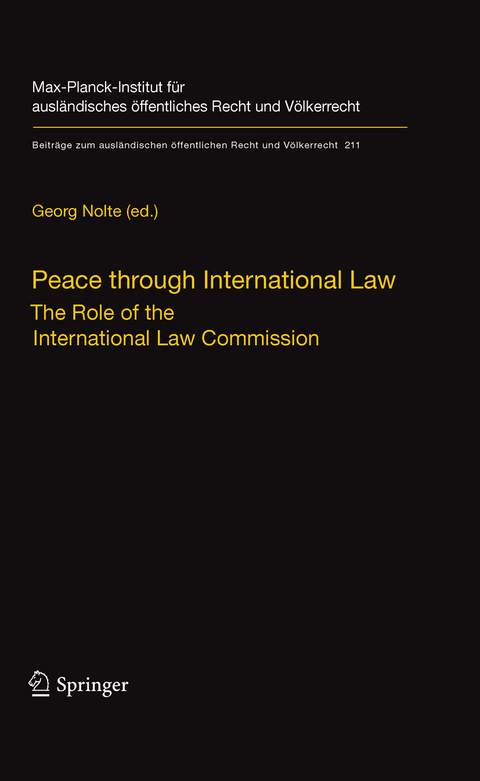
Peace through International Law (eBook)
IX, 197 Seiten
Springer Berlin (Verlag)
978-3-642-03380-3 (ISBN)
Acknowledgements 6
Table of Contents 7
I. Introduction 10
Introduction 11
Address 13
Address 15
II. State Responsibility and Peace 18
The Normative Environment for Peace – On theContribution of the ILC’s Articles on StateResponsibility 19
I. Introduction 19
II. State Responsibility as a Means to PromoteInternational Peace 21
1. An Intuitive Assumption 21
2. Three Objections 23
III. The Conceptual Objection: The ILC Articles asSecondary Rules 25
1. World Order Issues in the Drafting History of the ILC Articles 25
2. “Peace Through the Maturing of the International Legal Order”? 27
3. The Issue of Self-Judgment and the “Culture of Formalism” 29
IV. The Objection of Diminishing Relevance 34
1. The Emergence of New Mechanisms 34
2. New Functions of the Law of State Responsibility 38
3. The Case of International Organizations 40
V. The Realist Objection: State Responsibility and “HardCases” 43
1. A Mixed Balance 43
2. The Discussion on Responsibility for Harbouring TerroristGroups 47
VI. Concluding Remarks 49
Comment: State Responsibility and Peace 53
I. Introduction 53
II. State Responsibility and Post Conflict Peace Building 53
III. Issues of Self-defense 54
IV. Responsibility of International Organizations 55
V. Responsibility for Violation of Obligations Erga Omnes 56
VI. Conclusion 57
Comment: The Impact of Security CouncilResolutions on State Responsibility 58
I. Introduction 58
II. The Impact of Binding Decisions 59
III. The Effects of Non-Binding Resolutions 61
IV. Resolutions Concerning Serious Breaches ofObligations under Peremptory Norms 63
V. The Requirement of Validity of Security CouncilResolutions 64
Comment: State Responsibility and Peace 66
III. The Law of Treaties and Peace 70
The Merits of Reasonable Flexibility: TheContribution of the Law of Treaties to Peace 71
I. Introduction 71
II. Creating the Regime: A Short History of the ViennaConvention on the Law of Treaties 73
III. Peace through Law: Does the Law of Treaties MakeTreaties a Stabilising Factor? 76
IV. The Principles of a Stable Treaty Regime 81
1. Pacta Sunt Servanda 81
2. Reasonable Flexibility 82
3. Limits to Flexibility 86
V. The Limits of World Order: Peremptory Norms andTermination / Suspension of Treaties 88
1. Termination and Suspension 88
2. The Peremptory Nature of Ius Cogens: Invalidity and Terminationby Application of Articles 53 and 64 96
3. Unequal Treaties 102
VI. Conclusion 106
Comment: The Contribution of the Law ofTreaties to Peace 109
I. Main Thesis 109
II. Identification of Assumptions 110
III. Alternative Approach 111
Comment: The Vienna Convention on the Lawof Treaties and its Contribution to Peace 114
I. Introduction 114
II. Codification vs. Customary International Law 114
III. The Vienna Convention on the Law of Treaties:Stability or Flexibility 117
1. The Vienna Convention as an Instrument of Stabilization 117
2. Grounds for Adjustment not Foreseen in the Vienna Convention 117
3. Conclusion 118
IV. The Need for Change: A Proposal 119
Comment: The Contribution of the Law ofTreaties to Peace 121
IV. International Law of Shared NaturalResources and Peace 124
The Benefits of Positivism: The ILC’sContribution to the Peaceful Sharing ofTransboundary Groundwater 125
I. Introduction 125
II. Conflicts Concerning Natural Resources 126
1. Environmental Law and International Security 126
2. The Geographical Sharing of Resources 129
3. International Law Applicable to Groundwater 132
III. Peace Through the “Law of Transboundary Aquifers” 134
1. Why Legal Regulation? 135
2. Why the Legal Regulation the ILC Has Adopted? 141
IV. Excluded Topics 146
1. Water Resources Exclusively Under the Jurisdiction of One State 146
2. Dispute Settlement 148
V. A Framework for Peace: Conclusions 149
Comment: International Law of Shared NaturalResources and Peace 151
Comment: Trends in the Law Applicable toFreshwaters 156
I. Introduction 156
II. The ILC’s Work on International Freshwater Law andits Relation to More Specific Instruments 157
1. The “Negotium” and “Instrumentum” Notions in the ILC’s Work 158
2. The Concept of lex specialis 161
III. Prevention and dispute settlement 162
1. Judicial procedures 163
2. Joint Bodies and Commissions 165
IV. Conclusion 170
Comment: The ILC’s Contribution to thePeaceful Sharing of TransboundaryGroundwater 172
V. Concluding Discussion 175
The ILC and Informalization 176
The Role of the ILC’s Work in Promoting Peaceand Security – Definition and Evaluation 180
Peace through Law: The Role of the ILC 185
List of Contributors 189
Authors of the main presentations 189
Commentators 190
| Erscheint lt. Verlag | 3.10.2009 |
|---|---|
| Reihe/Serie | Beiträge zum ausländischen öffentlichen Recht und Völkerrecht | Beiträge zum ausländischen öffentlichen Recht und Völkerrecht |
| Zusatzinfo | IX, 197 p. |
| Verlagsort | Berlin |
| Sprache | englisch |
| Themenwelt | Recht / Steuern ► EU / Internationales Recht |
| Sozialwissenschaften ► Politik / Verwaltung | |
| Schlagworte | International Environmental Law • International Law • International Law Commission • international treaties • Peace • state responsibility • United Nations |
| ISBN-10 | 3-642-03380-6 / 3642033806 |
| ISBN-13 | 978-3-642-03380-3 / 9783642033803 |
| Informationen gemäß Produktsicherheitsverordnung (GPSR) | |
| Haben Sie eine Frage zum Produkt? |
 PDF (Wasserzeichen)
DRM: Digitales Wasserzeichen
Dieses eBook enthält ein digitales Wasserzeichen und ist damit für Sie personalisiert. Bei einer missbräuchlichen Weitergabe des eBooks an Dritte ist eine Rückverfolgung an die Quelle möglich.
Dateiformat: PDF (Portable Document Format)
Mit einem festen Seitenlayout eignet sich die PDF besonders für Fachbücher mit Spalten, Tabellen und Abbildungen. Eine PDF kann auf fast allen Geräten angezeigt werden, ist aber für kleine Displays (Smartphone, eReader) nur eingeschränkt geeignet.
Systemvoraussetzungen:
PC/Mac: Mit einem PC oder Mac können Sie dieses eBook lesen. Sie benötigen dafür einen PDF-Viewer - z.B. den Adobe Reader oder Adobe Digital Editions.
eReader: Dieses eBook kann mit (fast) allen eBook-Readern gelesen werden. Mit dem amazon-Kindle ist es aber nicht kompatibel.
Smartphone/Tablet: Egal ob Apple oder Android, dieses eBook können Sie lesen. Sie benötigen dafür einen PDF-Viewer - z.B. die kostenlose Adobe Digital Editions-App.
Buying eBooks from abroad
For tax law reasons we can sell eBooks just within Germany and Switzerland. Regrettably we cannot fulfill eBook-orders from other countries.
aus dem Bereich