


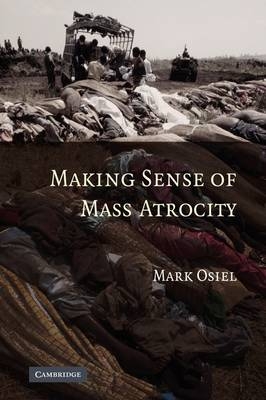
Making Sense of Mass Atrocity
Seiten
2011
Cambridge University Press (Verlag)
978-1-107-40318-5 (ISBN)
Cambridge University Press (Verlag)
978-1-107-40318-5 (ISBN)
Responsibility for mass atrocity is always shared, yet criminal law prefers to blame particular individuals for isolated acts. Is such law, therefore, constitutionally unable to make any sense of the most catastrophic conflagrations of our time? Drawing on the experience of several prosecutions, this book, trenchantly diagnoses the law's limits.
Genocide, crimes against humanity, and the worst war crimes are possible only when the state or other organisations mobilise and co-ordinate the efforts of many people. Responsibility for mass atrocity is always widely shared, often by thousands. Yet criminal law, with its liberal underpinnings, prefers to blame particular individuals for isolated acts. Is such law, therefore, constitutionally unable to make any sense of the most catastrophic conflagrations of our time? Drawing on the experience of several prosecutions, this book both trenchantly diagnoses the law's limits at such times and offers a spirited defence of its moral and intellectual resources for meeting the vexing challenge of holding anyone criminally accountable for mass atrocity. Just as war criminals develop new methods of eluding law's historic grasp, so criminal law flexibly devises novel responses to their stratagems. Mark Osiel examines several such legal innovations in international jurisprudence and proposes still others.
Genocide, crimes against humanity, and the worst war crimes are possible only when the state or other organisations mobilise and co-ordinate the efforts of many people. Responsibility for mass atrocity is always widely shared, often by thousands. Yet criminal law, with its liberal underpinnings, prefers to blame particular individuals for isolated acts. Is such law, therefore, constitutionally unable to make any sense of the most catastrophic conflagrations of our time? Drawing on the experience of several prosecutions, this book both trenchantly diagnoses the law's limits at such times and offers a spirited defence of its moral and intellectual resources for meeting the vexing challenge of holding anyone criminally accountable for mass atrocity. Just as war criminals develop new methods of eluding law's historic grasp, so criminal law flexibly devises novel responses to their stratagems. Mark Osiel examines several such legal innovations in international jurisprudence and proposes still others.
1. The challenge of prosecuting mass atrocity; Part I. Legal Rules and their Problems: 2. The responsibility of superiors; 3. Participating in a criminal enterprise; 4. Defining the criminal enterprise; Part II. The Political Context of Legal Choice: 5. Must national prosecutions serve global concerns?; 6. The conflicting incentives of national and international prosecutors; Part III. New Possibilities and Solutions: 7. The bureaucracy of murder; 8. Collective sanctions for collective wrong; 9. The collective responsibility of military officers; 10. Being economical with amnesty.
| Erscheint lt. Verlag | 18.8.2011 |
|---|---|
| Zusatzinfo | Worked examples or Exercises |
| Verlagsort | Cambridge |
| Sprache | englisch |
| Maße | 152 x 229 mm |
| Gewicht | 370 g |
| Themenwelt | Recht / Steuern ► EU / Internationales Recht |
| Recht / Steuern ► Öffentliches Recht ► Völkerrecht | |
| Recht / Steuern ► Strafrecht ► Kriminologie | |
| ISBN-10 | 1-107-40318-9 / 1107403189 |
| ISBN-13 | 978-1-107-40318-5 / 9781107403185 |
| Zustand | Neuware |
| Informationen gemäß Produktsicherheitsverordnung (GPSR) | |
| Haben Sie eine Frage zum Produkt? |
Mehr entdecken
aus dem Bereich
aus dem Bereich
Die Rechtsprechung des Gerichtshofs der Europäischen Union, deutscher …
Buch | Softcover (2025)
Nomos (Verlag)
CHF 53,50


