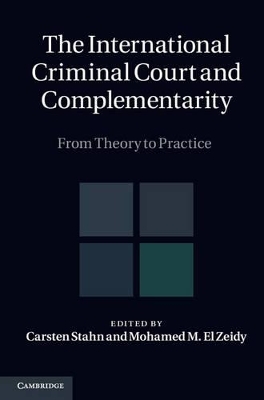
The International Criminal Court and Complementarity 2 Volume Set
Cambridge University Press
978-1-107-01158-8 (ISBN)
This systematic, contextual and practice-oriented account of complementarity explores the background and historical expectations associated with complementarity, its interpretation in prosecutorial policy and judicial practice, its context (ad hoc tribunals, universal jurisdiction, R2P) and its impact in specific situations (Colombia, Congo, Uganda, Central African Republic, Sudan and Kenya). Written by leading experts from inside and outside the Court and scholars from multiple disciplines, the essays combine theoretical inquiry with policy recommendations and the first-hand experience of practitioners. It is geared towards academics, lawyers and policy-makers who deal with the impact and application of international criminal justice and its interplay with peace and security, transitional justice and international relations.
Carsten Stahn is Professor of International Criminal Law and Global Justice at Leiden University and Programme Director of the Grotius Centre for International Legal Studies. Mohamed M. El Zeidy is a Legal Officer in the Pre-Trial Division of the International Criminal Court. From 1997 to 2007 he served as a Judge and a Senior Public Prosecutor at the Egyptian Ministry of Justice.
Volume 1: Introduction: bridge over troubled waters? Complementarity themes and debates in context; Part I. General Reflections: 1. A positive approach to complementarity: the impact of the Office of the Prosecutor; 2. Justice and prevention; 3. Proactive complementarity: a registrar's perspective and plans; Part II. Origin and Genesis of Complementarity: 4. The genesis of complementarity; 5. Reflections on complementarity at the Rome Conference and beyond; 6. The rise and fall of complementarity; Part III. Analytical Dimensions of Complementarity: 7. Complementarity as global governance; 8. Policy through complementarity: the atrocity trial as justice; 9. Taking complementarity seriously: on the sense and sensibility of 'classical', 'positive' and 'negative' complementarity; 10. International criminal justice in the era of failed states: the ICC and the self-referral debate; 11. The quest for constructive complementarity; 12. Reframing positive complementarity: reflections on the first decade and insights from the US federal criminal justice system; 13. Too much of a good thing? Implementation and the uses of complementarity; Part IV. Interpretation and Application: 14. The application of the principle of complementarity to the decision of where to open an investigation: the admissibility of 'situations'; 15. Situations and case: defining the parameters; 16. The inaction controversy: neglected words and new opportunities; 17. Admissibility procedure; 18. The evolution of the ICC jurisprudence on admissibility; 19. Interpretative gravity under the ICC statute: identifying common gravity criteria; 20. Complementarity and burden allocation. Volume 2: 21. States' obligations to investigate and prosecute perpetrators of international crimes: the perspective of the European Court of Human Rights; 22. The law and policy of complementarity in relation to 'criminal proceedings' carried out by non-state organized armed groups; 23. Complementarity and the crime of aggression; 24. Complementarity and alternative forms of justice: a new test for ICC admissibility; 25. Complementarity and 'reverse cooperation'; 26. In the hands of the state: implementing legislation and complementarity; Part V. Complementarity in Perspective: 27. Horizontal complementarity; 28. The International Criminal Tribunal for the Former Yugoslavia ('ICTY') and the transfer of cases and materials to national judicial authorities: lessons in complementarity; 29. Positive complementarity in practice: ICTY rule 11bis and the use of the tribunal's evidence in the Srebrenica trials before the Bosnian War Crimes Chamber; 30. Complementarity of procedures: how to avoid reinventing the wheel; Part VI. Complementarity in Practice: 31. Making complementarity work: maximising the limited role of the prosecutor; 32. Positive complementarity in action; 33. Complementarity and the construction of national ability; 34. The Colombian Peace Process (Law 975 of 2005) and the ICC's principle of complementarity; 35. Darfur: complementarity as the drafters intended?; 36. Complementarity in Uganda: domestic diversity or international imposition?; 37. Courts, conflict and complementarity in Uganda; 38. Chasing cases: the ICC and the politics of state referral in the Democratic Republic of Congo and Uganda; 39. A problem, not a solution: complementarity in the Central African Republic and Democratic Republic of Congo; 40. Complementarity and the impact of the Rome Statute and the International Criminal Court in Kenya.
| Erscheint lt. Verlag | 6.10.2011 |
|---|---|
| Zusatzinfo | Worked examples or Exercises |
| Verlagsort | Cambridge |
| Sprache | englisch |
| Maße | 157 x 235 mm |
| Gewicht | 2350 g |
| Themenwelt | Recht / Steuern ► EU / Internationales Recht |
| ISBN-10 | 1-107-01158-2 / 1107011582 |
| ISBN-13 | 978-1-107-01158-8 / 9781107011588 |
| Zustand | Neuware |
| Informationen gemäß Produktsicherheitsverordnung (GPSR) | |
| Haben Sie eine Frage zum Produkt? |
aus dem Bereich