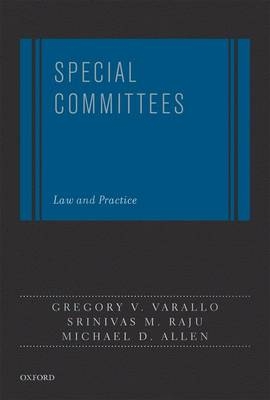
Special Committees
Oxford University Press Inc (Verlag)
978-0-19-973513-6 (ISBN)
- Titel ist leider vergriffen;
keine Neuauflage - Artikel merken
Since the early 1980s, the body of corporate law has favored the resolution of conflict of interest transactions through the use of committees of the board of directors commonly referred to as "special" (or "independent" or "conflicts") committees. Special committees are recognized as effective tools to resolve conflicts in transactions, to investigate potential corporate wrongdoing and to assert the board's control over pending derivative litigation. Given the widespread use of special committees and the body of law that has grown up relating to its use, Special Committees: Law and Practice is the definitive reference on this emerging area of law.
Gregory Varallo serves as vice chair of Richards, Layton & Finger's Corporate Department focusing his practice on complex business litigation, corporate governance, and corporate transactions. Mr. Varallo is the past chair of the Subcommittee on Corporate Counseling and Litigation of the ABA and past co-chair of the ABA Task Force on Litigation Reform. He is a frequent panelist at the Securities Regulation Law Institute (PLI), and speaks at various PLI, ABA, and other programs. He co-authored Fundamentals of Corporate Governance: Guide for Directors and Corporate Counsel and was a contributor to the Handbook for the Conduct of Shareholders' Meetings. Co-author Srinivas M. Raju is a director at Richards, Layton & Finger and member of the Corporate Department. His current practice focuses on corporate advisory and governance, transactional and complex litigation matters. Co-author Michael D. Allen is also a director at Richards, Layton & Finger in the Corporate Department. Prior to joining the firm, Mr. Allen was a law clerk to Justice Hartnett of the Delaware Supreme Court.
CHAPTER ONE: THE SPECIAL COMMITTEE AND THE CIRCUMSTANCES IN WHICH IT IS USED, OR, WHAT MAKES A SPECIAL COMMITTEE SO SPECIAL?; CHAPTER TWO: THE ROLE OF THE SPECIAL COMMITTEE AND LEGAL CONSEQUENCES OF ITS USE; CHAPTER THREE: FORMING THE SPECIAL COMMITTEE; CHAPTER FOUR: GETTING READY: DIRECTOR INDOCTRINATION; CHAPTER FIVE: COMMITTEE'S FIRST STEPS; CHAPTER SIX: GETTING DOWN TO WORK (INVESTIGATIVE COMMITTEES); CHAPTER SEVEN: GETTING DOWN TO WORK (TRANSACTIONAL COMMITTEES); CHAPTER EIGHT: DRAFTING THE FORENSIC COMMITTEE'S REPORT; CHAPTER NINE: NEGOTIATING THE TRANSACTION DOCUMENTS; CHAPTER TEN: WHAT TO DO? (FORENSIC COMMITTEE); CHAPTER ELEVEN: CONTROLLING FALLOUT FROM THE COMMITTEE PROCESS; CHAPTER TWELVE: THE IN-HOUSE LAWYER'S ROLE: WHAT TO EXPECT AND HOW TO COPE; CHAPTER THIRTEEN: THE ROLE OF THE CONTROLLING STOCKHOLDER AND MANAGEMENT: WHAT TO EXPECT AND HOW TO COPE
| Erscheint lt. Verlag | 10.3.2011 |
|---|---|
| Verlagsort | New York |
| Sprache | englisch |
| Maße | 181 x 253 mm |
| Gewicht | 700 g |
| Themenwelt | Recht / Steuern ► EU / Internationales Recht |
| Recht / Steuern ► Wirtschaftsrecht ► Gesellschaftsrecht | |
| ISBN-10 | 0-19-973513-1 / 0199735131 |
| ISBN-13 | 978-0-19-973513-6 / 9780199735136 |
| Zustand | Neuware |
| Informationen gemäß Produktsicherheitsverordnung (GPSR) | |
| Haben Sie eine Frage zum Produkt? |
aus dem Bereich