


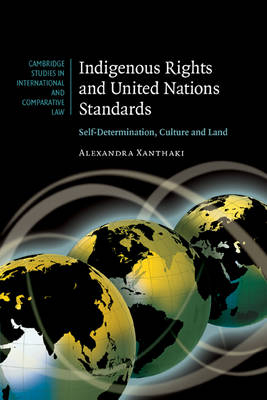
Indigenous Rights and United Nations Standards
Self-Determination, Culture and Land
Seiten
2010
Cambridge University Press (Verlag)
978-0-521-17289-9 (ISBN)
Cambridge University Press (Verlag)
978-0-521-17289-9 (ISBN)
The debate on indigenous rights has revealed some serious difficulties for international law, posed mainly by different understandings of important concepts. This book explores the extent to which indigenous claims, as recorded in the United Nations forums, can be accommodated by international law.
The debate on indigenous rights has revealed some serious difficulties for current international law, posed mainly by different understandings of important concepts. This book explores the extent to which indigenous claims, as recorded in the United Nations forums, can be accommodated by international law. By doing so, it also highlights how the indigenous debate has stretched the contours and ultimately evolved international human rights standards. The book first reflects on the international law responses to the theoretical arguments on cultural membership. After a comprehensive analysis of the existing instruments on indigenous rights, the discussion turns to self-determination. Different views are assessed and a fresh perspective on the right to self-determination is outlined. Ultimately, the author refuses to shy away from difficult questions and challenging issues and offers a comprehensive discussion of indigenous rights and their contribution to international law.
The debate on indigenous rights has revealed some serious difficulties for current international law, posed mainly by different understandings of important concepts. This book explores the extent to which indigenous claims, as recorded in the United Nations forums, can be accommodated by international law. By doing so, it also highlights how the indigenous debate has stretched the contours and ultimately evolved international human rights standards. The book first reflects on the international law responses to the theoretical arguments on cultural membership. After a comprehensive analysis of the existing instruments on indigenous rights, the discussion turns to self-determination. Different views are assessed and a fresh perspective on the right to self-determination is outlined. Ultimately, the author refuses to shy away from difficult questions and challenging issues and offers a comprehensive discussion of indigenous rights and their contribution to international law.
Introduction; 1. Recognition of cultural membership; 2. United Nations instruments on indigenous peoples; 3. Emerging law: the United Nations draft declaration on indigenous peoples; 4. Do indigenous peoples have the right to self-determination?; 5. Indigenous cultural rights; 6. Indigenous land rights; Conclusions.
| Erscheint lt. Verlag | 25.11.2010 |
|---|---|
| Reihe/Serie | Cambridge Studies in International and Comparative Law |
| Zusatzinfo | Worked examples or Exercises |
| Verlagsort | Cambridge |
| Sprache | englisch |
| Maße | 152 x 229 mm |
| Gewicht | 530 g |
| Themenwelt | Recht / Steuern ► EU / Internationales Recht |
| Recht / Steuern ► Öffentliches Recht ► Völkerrecht | |
| Sozialwissenschaften ► Ethnologie | |
| Sozialwissenschaften ► Politik / Verwaltung ► Europäische / Internationale Politik | |
| Sozialwissenschaften ► Soziologie | |
| ISBN-10 | 0-521-17289-6 / 0521172896 |
| ISBN-13 | 978-0-521-17289-9 / 9780521172899 |
| Zustand | Neuware |
| Informationen gemäß Produktsicherheitsverordnung (GPSR) | |
| Haben Sie eine Frage zum Produkt? |
Mehr entdecken
aus dem Bereich
aus dem Bereich
Die Rechtsprechung des Gerichtshofs der Europäischen Union, deutscher …
Buch | Softcover (2025)
Nomos (Verlag)
CHF 53,50


