


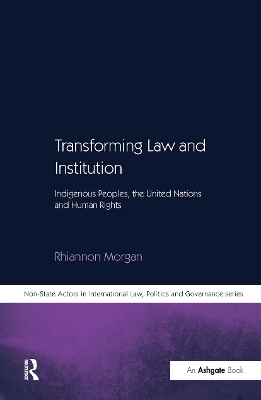
Transforming Law and Institution
Indigenous Peoples, the United Nations and Human Rights
Seiten
2011
Routledge (Verlag)
978-0-7546-7445-0 (ISBN)
Routledge (Verlag)
978-0-7546-7445-0 (ISBN)
Describes, analyses, and evaluates the efforts of the global indigenous movement to engender changes in UN discourse and international law on indigenous peoples' rights and to bring about certain institutional developments reflective of a heightened international concern.
In the past thirty or so years, discussions of the status and rights of indigenous peoples have come to the forefront of the United Nations human rights agenda. During this period, indigenous peoples have emerged as legitimate subjects of international law with rights to exist as distinct peoples. At the same time, we have witnessed the establishment of a number of UN fora and mechanisms on indigenous issues, including the UN Permanent Forum on Indigenous Issues, all pointing to the importance that the UN has come to place on the promotion and protection of indigenous peoples' rights. Morgan describes, analyses, and evaluates the efforts of the global indigenous movement to engender changes in UN discourse and international law on indigenous peoples' rights and to bring about certain institutional developments reflective of a heightened international concern. By the same token, focusing on the interaction of the global indigenous movement with the UN system, this book examines the reverse influence, that is, the ways in which interacting with the UN system has influenced the claims, tactical repertoires, and organizational structures of the movement.
In the past thirty or so years, discussions of the status and rights of indigenous peoples have come to the forefront of the United Nations human rights agenda. During this period, indigenous peoples have emerged as legitimate subjects of international law with rights to exist as distinct peoples. At the same time, we have witnessed the establishment of a number of UN fora and mechanisms on indigenous issues, including the UN Permanent Forum on Indigenous Issues, all pointing to the importance that the UN has come to place on the promotion and protection of indigenous peoples' rights. Morgan describes, analyses, and evaluates the efforts of the global indigenous movement to engender changes in UN discourse and international law on indigenous peoples' rights and to bring about certain institutional developments reflective of a heightened international concern. By the same token, focusing on the interaction of the global indigenous movement with the UN system, this book examines the reverse influence, that is, the ways in which interacting with the UN system has influenced the claims, tactical repertoires, and organizational structures of the movement.
Dr Rhiannon Morgan, Senior Lecturer in Political Sociology, Oxford Brookes University, UK
Contents: Introduction: indigenous peoples, the United Nations and human rights; United Nations engagement with indigenous issues; Theoretical framing; The development of a global movement; Claims of the global indigenous movement; Reconfiguring human rights; The impact of the global indigenous movement; References; Index.
| Erscheint lt. Verlag | 28.12.2011 |
|---|---|
| Reihe/Serie | Non-State Actors in Global Governance |
| Verlagsort | London |
| Sprache | englisch |
| Maße | 156 x 234 mm |
| Gewicht | 521 g |
| Themenwelt | Recht / Steuern ► EU / Internationales Recht |
| Recht / Steuern ► Öffentliches Recht ► Völkerrecht | |
| Sozialwissenschaften ► Politik / Verwaltung ► Europäische / Internationale Politik | |
| ISBN-10 | 0-7546-7445-2 / 0754674452 |
| ISBN-13 | 978-0-7546-7445-0 / 9780754674450 |
| Zustand | Neuware |
| Informationen gemäß Produktsicherheitsverordnung (GPSR) | |
| Haben Sie eine Frage zum Produkt? |
Mehr entdecken
aus dem Bereich
aus dem Bereich
Die Rechtsprechung des Gerichtshofs der Europäischen Union, deutscher …
Buch | Softcover (2025)
Nomos (Verlag)
CHF 53,50


