


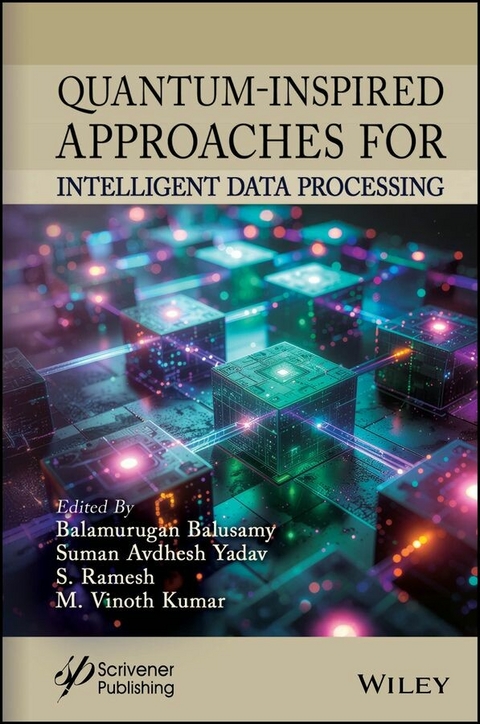
Quantum-Inspired Approaches for Intelligent Data Processing (eBook)
320 Seiten
Wiley-Scrivener (Verlag)
978-1-394-33642-5 (ISBN)
Stay ahead of the technological curve with this comprehensive, practical guide that showcases how the fusion of quantum principles and soft computing is delivering transformative solutions across finance, healthcare, and manufacturing.
Quantum-Inspired Approaches for Intelligent Data Processing explores the cutting-edge fusion of quantum computing principles and soft computing techniques, unraveling the synergistic potential of these two paradigms. The book uses a comprehensive interdisciplinary approach, delving into the foundations of quantum mechanics and soft computing essentials, including fuzzy logic, genetic algorithms, and neural networks. Distinctive in its practical focus, the book showcases how this integration enhances intelligent data processing across various industries, offering tangible solutions to complex challenges. Through real-world applications, this book illuminates the transformative impact of quantum-inspired soft computing across multiple industries, from finance and healthcare to manufacturing. It incorporates case studies, examples, and market analyses, providing a holistic understanding of the subject and exploring emerging trends, challenges, and future opportunities, making it an invaluable resource for researchers and industrialists navigating the dynamic intersection of quantum computing and soft computing in intelligent data processing.
Balamurugan Balusamy, PhD is an Associate Dean of Students at Shiv Nadar University with more than 12 years of academic experience. He has published more than 200 articles in international journals and conferences, authored and edited more than 80 books, and given more than 195 talks in international symposia. His research focuses on engineering education, blockchain, and data sciences.
Suman Avdhesh Yadav is an Assistant Professor in the Department of Computer Science Engineering and Head of the Internal Quality Assurance Cell at Amity University. She has published one book, six book chapters, three patents, and more than 33 articles in peer-reviewed journals and conferences of international repute. Her research interests include IoT, soft computing, wireless sensor networks, network security, cloud computing, and AI.
S. Ramesh, PhD is an Associate Professor in the Department of Applied Machine Learning in the Saveetha School of Engineering at the Saveetha Institute of Medical and Technical Sciences with more than 13 years of teaching and research experience. He has published more than 60 research articles and holds 19 patents. His research interests involve machine learning, artificial intelligence, computer vision, and the Internet of Things.
M. Vinoth Kumar, PhD is an Assistant Professor in the Department of Electronics and Communication Engineering at the SRM Institute of Science and Technology. He has more than 25 publications in international journals and conferences. His research interests are optical fiber communication networks, free-space optical communication systems, photonics, and radio-over-fiber.
1
Introduction to Soft Computing for Intelligent Data Processing
Tiyas Sarkar†, Manik Rakhra* and Baljinder Kaur‡
School of Computer Science & Engineering, Lovely Professional University, Phagwara, Punjab, India
Abstract
Soft computing has emerged as a powerful tool for intelligent data processing in the context of ever-growing and increasingly complex data. This study introduces the concepts of soft computing and its core techniques: fuzzy logic, neural networks, probabilistic reasoning, and evolutionary computation. It contrasts soft computing with traditional computing methods, highlighting its ability to handle imprecision and uncertainty inherent in real-world data. This study explores existing literature that demonstrates the effectiveness of soft computing across various domains, including data mining, pattern recognition, image processing, and control systems. It then delves into the proposed methodologies that combine different soft computing techniques for enhanced performance. Finally, the discussion emphasizes exciting areas for future research, such as integration with deep learning, multi-objective optimization, and explainable soft computing. By embracing the “soft revolution” in data processing, we unlock the potential to extract valuable insights from complex data and drive informed decision making across various fields. This study serves as a springboard for the further exploration of soft computing techniques and their applications in the ever-evolving world of intelligent data processing.
Keywords: Soft computing, data processing, fuzzy logic, neural network, bayesian network, data mining
1.1 Introduction
Standard computing techniques are severely challenged by the continually increasing amount and complexity of data. Mathematical models or well-defined principles are often absent from real-world scenarios. Here, a potent instrument of soft computing for intelligent processing of information is shown. The opposite of hard computing, soft computing welcomes ambiguity and imprecision. It uses several approaches motivated by human thinking and biological processes to derive important conclusions from intricate data. An introduction to the fascinating field of soft computing and its use in sophisticated data processing is presented in this study.
1.1.1 Limitations of Traditional Computing
For many jobs, traditional computing, sometimes referred to as on-premise computing, has worked successfully. Handling clearly defined issues with structured data is where they shine. However, dealing with the complexity of the real world has several serious drawbacks. The sheer intractable nature of many real-world issues is a significant obstacle. Frequently complex, these issues resist exact modeling. The subtleties and exceptions included in the actual data are difficult to capture using traditional techniques [27]. An alternative restriction is imprecise tolerance. Effective operation of traditional computers often depends on clean and comprehensive data. Data are often noisy, lacking, or contradictory. As traditional approaches find it difficult to manage these flaws, the outcomes may be erroneous or untrustworthy. Finally, conventional computing techniques often have rigidities [28]. They are not meant to pick up on and adjust to shifting data or settings. Their inflexibility may render them inappropriate for jobs that require ongoing education and development. These drawbacks of conventional computers emphasize the need for more adaptable and reliable data-processing methods. This is where developments in machine learning and artificial intelligence have become useful, providing fresh approaches to difficult issues and extracting insights from jumbled data.
1.1.2 The Philosophy of Soft Computing
Soft-computing approaches problems are philosophically different from conventional techniques. It concentrates on obtaining real-world data and accepts natural messiness. Soft computing provides tolerance for the error top priority. Soft computing approaches can manage noisy, partial, or even ambiguous data, unlike conventional methods, which require pristine data. Therefore, they may therefore work well in practical situations in which data are seldom perfect. The emphasis of soft computing is on approximation [29]. Sometimes, the search for an elusive ideal solution is less beneficial than an approximate but workable solution in complicated situations. These “good enough” approaches that are nevertheless advantageous can be found using soft computing methods.
Learning and adaption have been emphasized in soft computing. Over time, these methods may change their behavior based on the data. Thus, they can manage circumstances in which conventional, inflexible techniques would find difficult and continue to improve. Soft computing provides a useful substitute for handling the complexity of the actual world by addressing challenges that are unsolvable by conventional techniques [30].
1.1.3 Core Components of Soft Computing
In computing, soft computing addresses approximate, rather than exact, answers to computational issues. It includes many approaches for managing ambiguous, imprecise, and ambiguous information. The fundamental elements of soft computing consist of soft computing encompassing a collection of powerful techniques, including, as shown in Figure 1.1:
Figure 1.1 An illustration of the hierarchical architecture of soft computing.
- → Probabilistic reasoning: Using the probability theory, this method helps explain ambiguous circumstances. It provides various outcome probabilities, which enables us to make judgments with partial knowledge.
- → Fuzzy logic: Fuzzy logic permits partial truths and different levels of membership in sets, unlike classical logic, which primarily deals with concretes (0 or 1, true or false). It can handle erroneous data and imitate human thinking in unclear circumstances. The membership function, usually expressed as, defines the degree of membership:
- μ_A(k): Degree of membership of element k in fuzzy set A.
- k: Input value.
- l: Lower bound of the fuzzy set
- u: Upper bound of the fuzzy set.
- Example Formula (Triangular Membership Function):
This formula calculates the degree of membership of k in set A, ranging from 0 (not a member) to 1 (fully a member).- → Neural networks: Networks of linked nodes that may extract information from data are called neural networks, and are modeled after the structure and operation of the human brain. For jobs such as voice and picture recognition, they are excellent at seeing intricate patterns and connections in data.
- → Evolutionary computation: Evolving algorithms, motivated by Darwin’s idea of natural selection, can imperatively optimize solutions. They produce a population of possible answers, assess them, and choose the best to produce future generations with better traits. If the best answer is discovered, the cycle continues [31].
1.1.4 Data Processing and Its Importance
Processing data involves taking a ton of disjointed notes and turning them into a coherent report. Unprocessed raw data resemble disorganized notes; it is full of knowledge but not direction or clarity. Data processing involves arranging, cleaning, and sorting this information to make it more comprehensible. The key reason for data processing is so important is the capacity to extract value from data. Processed data allow us to see trends and patterns that might not otherwise be apparent. For companies, these revelations are like gold; they help them to increase productivity, make wiser choices, and gain an advantage over competitors. Accuracy was also significantly enhanced by data processing. This ensures that the information utilized for analysis is trustworthy and accurate by helping to clean and fix mistakes in the raw data, as shown in Figure 1.2.
Figure 1.2 To illustrating processing data consequential manner.
Moreover, data processing makes information readable. Envision the differences between having notes arranged in logical diagrams, charts, or reports and combing through them. We save time and effort by using data that are simpler to evaluate and understand in this structured manner. Finally, data processing has major economic advantages. Massively processing data by hand is not only laborious but also prone to mistakes. Through automation of this procedure, data processing systems can save companies a great deal of time and money. Fundamentally, the secret to convert unprocessed data into useful insights and enable us to make wiser verdicts in a variety of domains is data processing [32].
1.1.5 Advantages of Soft Computing for Intelligent Data Processing
Soft computing offers several advantages in intelligent data processing:
- Effective handling of complex and imprecise data: Soft computing methods can extract meaningful insights from visualizations in a noisy, incomplete, or ambiguous manner.
- Improved problem-solving capabilities: Soft computing addresses problems that are intractable to traditional approaches because of their inherent complexity.
- Learning and adaptation: Soft computing techniques can learn from data and adapt to changing environments. making them ideal for applications in which data are constantly evolving [33].
- Robustness: Soft computing...
| Erscheint lt. Verlag | 6.1.2026 |
|---|---|
| Sprache | englisch |
| ISBN-10 | 1-394-33642-X / 139433642X |
| ISBN-13 | 978-1-394-33642-5 / 9781394336425 |
| Informationen gemäß Produktsicherheitsverordnung (GPSR) | |
| Haben Sie eine Frage zum Produkt? |
 EPUB (Adobe DRM)
Größe: 3,8 MB
Kopierschutz: Adobe-DRM
Adobe-DRM ist ein Kopierschutz, der das eBook vor Mißbrauch schützen soll. Dabei wird das eBook bereits beim Download auf Ihre persönliche Adobe-ID autorisiert. Lesen können Sie das eBook dann nur auf den Geräten, welche ebenfalls auf Ihre Adobe-ID registriert sind.
Details zum Adobe-DRM
Dateiformat: EPUB (Electronic Publication)
EPUB ist ein offener Standard für eBooks und eignet sich besonders zur Darstellung von Belletristik und Sachbüchern. Der Fließtext wird dynamisch an die Display- und Schriftgröße angepasst. Auch für mobile Lesegeräte ist EPUB daher gut geeignet.
Systemvoraussetzungen:
PC/Mac: Mit einem PC oder Mac können Sie dieses eBook lesen. Sie benötigen eine
eReader: Dieses eBook kann mit (fast) allen eBook-Readern gelesen werden. Mit dem amazon-Kindle ist es aber nicht kompatibel.
Smartphone/Tablet: Egal ob Apple oder Android, dieses eBook können Sie lesen. Sie benötigen eine
Geräteliste und zusätzliche Hinweise
Buying eBooks from abroad
For tax law reasons we can sell eBooks just within Germany and Switzerland. Regrettably we cannot fulfill eBook-orders from other countries.


