


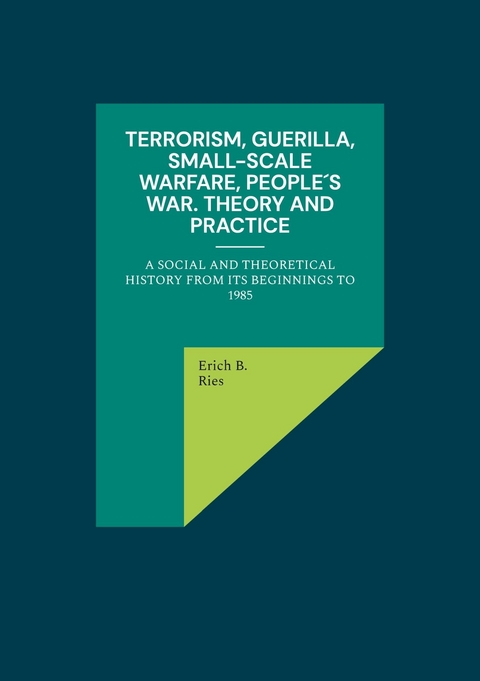
Terrorism, Guerilla, Small-Scale Warfare, People´s War. Theory and Practice (eBook)
392 Seiten
Books on Demand (Verlag)
9783769330670 (ISBN)
Erich B. Ries, born in 1955, is a graduate social scientist and martial arts master who has studied the issues of self-defence and small-scale warfare in great depth. Erich B. Ries is a member of the Reservists' Association of the German Bundeswehr and lives in northern Germany.
Chapter 1
Terminology and history
The terms that have been coined by nations in the course of history for the "little war" are more diverse than the purposes for which it was and is waged.
In addition to the terms detachment war, outpost war, light war (Clausewitz), which were commonly used in the 18th and early 19th centuries, terms such as partisan war, partisan war, underground war, underground struggle, irregular war, insurrection war, later also revolutionary war, people's war, subversive war, covert war, covert struggle were in use.
Occasionally it is also referred to - pejoratively - as gang warfare or erroneously and simplistically as terrorism.
During the Spanish People's War against the Napoleonic invasion armies (1807 - 1814), the term "guerrilla" (small war) emerged, which is most commonly used today, especially in the West.
Contrary to widespread opinion (Haffner, S. 1966:5), the guerrilla is not an invention of the communists, although the small war with the beginning of decolonisation after the end of the Second World War under the leadership of communist parties (China, Malaya, Vietnam, the Philippines, etc.) has come to the attention of the wider world public.
The ancient Greeks knew and practised small-scale warfare, as did the Romans and Germanic tribes.
The small-scale war tactics of Arminius / Hermann the Cheruscan against the Romans, in particular the annihilation battle in the Teuteburg Forest in 9 AD, where three legions inflicted one of their most devastating defeats on the Romans in the famous Varus Battle...
"Small-scale wars also took place in the Middle Ages and in the early modern period, in the 16th and 17th centuries." (Hahlweg, W.: 1968:25) In my opinion, Hahlweg's book is the best academic work on the history of guerrillas.
In fact, guerrilla warfare is almost as old as mankind itself.
(Cf. Wilkins, 1963:30; Guevara, a, 1972:124; Kutger, 1963:79)
Guerrilla in the 18th century
The 18th century is characterised by the thoroughly purposeful interaction of regular line troops and small war units.
The small war detachments consisted of specially qualified and equipped soldiers who nevertheless remained part of the regular army.
Small-scale warfare had a supporting function in the context of overall warfare and occasionally proved to be of strategic importance beyond its purely tactical-operational function.
One example is the retreat of the Prussian army from Bohemia in November 1744, where small Austrian detachments inflicted heavy losses on the Prussian army and forced Frederick the Great to evacuate Prague on 20 November 1744. (Hahlweg, W., 1968:27,28)
The experience of the War of the Spanish Succession, the First and Second Silesian Wars and the Seven Years' War helped to further develop the technical and practical side of guerrilla warfare, and small-scale warfare and the military personnel involved in it were thoroughly accepted.
However, this changed at the end of the 19th century and in the 20th century, when the guerrilla as an agent of social revolutionary movements and revolutionary state creation, which were directed against the state and the military, became increasingly objectionable in traditionally conservative military circles due to its totality of method and objective.
The wars of absolutism were not total wars in which it was a matter of life and death for the civilian population, of the attempt to enslave and exterminate entire peoples, as was exemplified by the Second World War, but were limited in terms of ends and means.
The political goals were also defined by the absolutist state without the people being granted any significant influence over them. (Haffner, S.:14,15; Hahlweg, W.: 26).
As a rule, there was no general conscription, the armies consisted of professional soldiers and, in addition, of recruits hired or pressed as required, the combatants were exclusively military personnel and generally had no primary interest in the political goals pursued with their help. Incidentally, this is probably one of the reasons for the success of so many wars of liberation, from the American War of Independence to the Vietnam War: The "irregulars" fighting for their own interests were and are (1986) confronted by mercenaries or conscripts with no or only secondary personal motivation.
The situation was different in the colonies, however, where it was often a question of exterminating or enslaving entire peoples, and the armed conflicts therefore took on other, usually more total and brutal forms.
In addition to the limited political objectives that determined the appearance of war in the 18th century and the early 19th century and consequently limited military conflicts to the military, there was a second reason that made the involvement of the whole people, i.e. also outside the strictly regulated military apparatus, appear dangerous for national defence, for example. In the chapter on popular armament in his epoch-making work "On War", Clausewitz writes: "In cultivated Europe, popular war is a phenomenon of the 19th century. It has its supporters and its opponents, the latter for political reasons, because they consider it a revolutionary means, a state of anarchy declared to be lawful, which is as dangerous to the social order within as it is to the enemy..." (Clausewitz, C. von, 1963:173)
With the American War of Independence (1775-1783), the French Revolution and the associated wars of liberation against the French invading armies in the Vendée (1793-1796), in Spain (1808-1814), in Tyrol (1809), in Germany (1809) and finally in Russia (1812), the guerrilla underwent a decisive transformation and expansion of its objectives, as well as an accompanying qualitative change in its forms: While small-scale warfare had been continuously perfected and refined into a military art over the course of the 18th century as an integral part of regular "cherished" warfare, a new actor now came into play: the people.
The military historian Werner Hahlweg and Lenin were in complete agreement that the participation of the masses in warfare at the end of the 18th and beginning of the 19th century represented a caesura in the history of modern warfare, raising the small war to a completely new level.
Hahlweg writes: "While small-scale warfare in the militarytechnical sphere was more or less carried over unchanged from the previous epoch, its manifestation changed with regard to the impulses that arose from the political, social and economic spheres, which made it as long-lasting as it was intense in terms of its objectives. Small-scale warfare had become an essential part of the struggle for the existence of nations.
For the development of small-scale warfare, the seemingly modern era of 1775-1789-1815 represents a turning point: this is where the path to our present day begins. The smallscale wars of this epoch exhibit almost all the characteristics, combination and combination possibilities that can be found today in advanced, further differentiated forms in modern guerrilla warfare.
The repeated and close connection between small-scale war and people's war thus represents what is actually new in the development of this form of war during the period 1775-1788-1815." (Emphasis mine). (Hahlweg 1968:60)
In his article "The Case of Port Arthur", published in January 1905, LENIN writes: "Those times are irretrievably gone when wars were waged by mercenaries or representatives of a caste half-alienated from the people...Wars are now waged by the peoples..." (Lenin, a, 1952:43)
As the peoples themselves stepped onto the political stage and thus no longer left the craft of war exclusively to the military, not only did the political objective become more total, but also "warfare as a means of politics" (Clausewitz 1963:22) became irregular in several respects:
Insofar as the essence of small-scale warfare consisted in surprise, in avoiding regular battles, and conversely in covert individual combat, it was always "irregular". However, as the people entered the military arena largely unencumbered by centuries-old traditions and thought patterns, the distinction between combatant and civilian also became blurred: This was already evident in the counter-revolutionary uprising of the Vendeér peasants, who ambushed the revolutionary armies, only to return to their farms by stealth and peacefully go about their work as harmless civilians until the next attack.
So while the small war detachments of the 18th century consisted of soldiers and remained identifiable as such (even when fighting undercover), the identifiability of the fighter was now over: every man, every woman, even every child was a potentially dangerous opponent.
Now the war no longer took place on clear fronts, the front was now everywhere, the war was waged in the depths of space, not only in a geographical but also in a social sense. Not only the covert way of fighting, but even more so the involvement of the civilian population transcended war as a predominantly military form of action into a form of total confrontation between groups or nations.
So reports the journal of a German fighter corps fighting on the English side in the American War of Independence:
It is "almost impossible to surprise the enemy on any occasion, because every house near which one comes is, so to speak, a forward picket; for the farmer or his son or servant, and even his wife and daughter, shoot with a shotgun or use surreptitious means of signalling the approach...
| Erscheint lt. Verlag | 19.11.2024 |
|---|---|
| Sprache | englisch |
| ISBN-13 | 9783769330670 / 9783769330670 |
| Informationen gemäß Produktsicherheitsverordnung (GPSR) | |
| Haben Sie eine Frage zum Produkt? |
 EPUB (Wasserzeichen)
Größe: 267 KB
DRM: Digitales Wasserzeichen
Dieses eBook enthält ein digitales Wasserzeichen und ist damit für Sie personalisiert. Bei einer missbräuchlichen Weitergabe des eBooks an Dritte ist eine Rückverfolgung an die Quelle möglich.
Dateiformat: EPUB (Electronic Publication)
EPUB ist ein offener Standard für eBooks und eignet sich besonders zur Darstellung von Belletristik und Sachbüchern. Der Fließtext wird dynamisch an die Display- und Schriftgröße angepasst. Auch für mobile Lesegeräte ist EPUB daher gut geeignet.
Systemvoraussetzungen:
PC/Mac: Mit einem PC oder Mac können Sie dieses eBook lesen. Sie benötigen dafür die kostenlose Software Adobe Digital Editions.
eReader: Dieses eBook kann mit (fast) allen eBook-Readern gelesen werden. Mit dem amazon-Kindle ist es aber nicht kompatibel.
Smartphone/Tablet: Egal ob Apple oder Android, dieses eBook können Sie lesen. Sie benötigen dafür eine kostenlose App.
Geräteliste und zusätzliche Hinweise
Buying eBooks from abroad
For tax law reasons we can sell eBooks just within Germany and Switzerland. Regrettably we cannot fulfill eBook-orders from other countries.


