


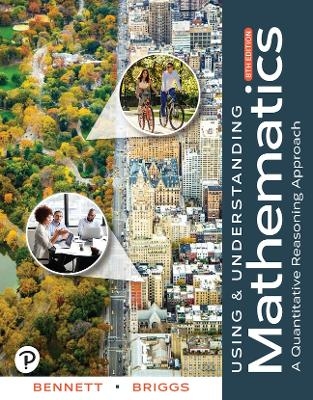
MyLab Math with Pearson eText (18 Weeks) for Using & Understanding Mathematics
Pearson (Hersteller)
9780137575022 (ISBN)
About our authors Jeffrey Bennett served as the first director of the program "Quantitative Reasoning and Mathematical Skills" at the University of Colorado at Boulder, where he developed the groundbreaking curriculum that became the basis of this textbook. He holds a BA in biophysics (University of California, San Diego) and an MS and a PhD in astrophysics (University of Colorado), and has focused his career on math and science education. In addition to co-authoring this textbook, he is also the lead author of best-selling college textbooks on statistical reasoning, astronomy, and astrobiology, and of more than a dozen books for children and adults. All 6 of his children's books have been selected for NASA's Story Time From Space. Among his other projects, Dr. Bennett proposed and co-led the development of the Voyage Scale Model Solar System in Washington, DC; created the free Totality app to help people learn about total solar eclipses; wrote an online primer on global warming; and developed a free, online curriculum for middle school Earth and Space Science. Learn more at Dr. Bennett's websites, Jeffrey Bennett: Astronomer, Teacher, & Writer, and Big Kid Science. William L. Briggs was on the mathematics faculty at Clarkson University for 6 years and at the University of Colorado at Denver for 23 years, where he taught both undergraduate and graduate courses, with a special interest in applied mathematics. During much of that time he designed and taught courses in quantitative reasoning. In addition to this book, he has co-authored textbooks on statistical reasoning and calculus, as well as monographs in computational mathematics. He is also author of How America Got Its Guns (University of New Mexico Press). Dr. Briggs is a University of Colorado President's Teaching Scholar and the recipient of a Fulbright Fellowship to Ireland; he holds a BA degree from the University of Colorado and an MS and a PhD from Harvard University.
I. LOGIC AND PROBLEM SOLVING
GETTING STARTED: LITERACY FOR THE MODERN WORLD
Activity: Job Satisfaction
What is Quantitative Reasoning?
Quantitative Reasoning and Culture
Quantitative Reasoning in the Work Force
Misconceptions About Mathematics
What Is Mathematics?
How to Succeed in Mathematics
Thinking Critically
Activity: Pandemic Math
1A. Living in the Media Age
1B. Propositions and Truth Values
1C. Sets and Venn Diagrams
1D. Analyzing Arguments
1E. Critical Thinking in Everyday Life
Chapter 1 Summary
Chapter 1 Review Questions
Approaches to Problem Solving
Activity: Global Melting
2A. Understand, Solve, and Explain
Using Technology: Currency Exchange Rates
2B. Extending Unit Analysis
Using Technology: Metric Conversions
2C. Problem-Solving Hints
Chapter 2 Summary
Chapter 2 Review Questions
II. QUANTITATIVE INFORMATION IN EVERYDAY LIFE
Numbers in the Real World
Activity: More Pandemic Math: Is 90% Good Enough?
3A. Uses and Abuses of Percentages
3B. Putting Numbers in Perspective
Using Technology: Scientific Notation
3C. Dealing with Uncertainty
Using Technology: Rounding in Excel
3D. Index Numbers: The CPI and Beyond
3E. Numerical Surprises: Polygraphs, Mammograms, and More
Chapter 3 Summary
Chapter 3 Review Questions
Managing Money
Activity: Student Loans
4A. Taking Control of Your Finances
4B. The Power of Compounding
Using Technology: Powers
Using Technology: The Compound Interest Formula
Using Technology: The Compound Interest Formula for Interest Paid More Than Once a Year
Using Technology: APY in Excel
Using Technology: Powers of e
4C. Savings Plans and Investments
Using Technology: The Savings Plan Formula
Using Technology: Fractional Powers (Roots)
4D. Loan Payments, Credit Cards, and Mortgages
Using Technology: The Loan Payment Formula (Installment Loans)
Using Technology: Principal and Interest Portions of Loan Payments
4E. Income Taxes
4F. Understanding the Federal Budget
Chapter 4 Summary
Chapter 4 Review Questions
III. STATISTICS AND PROBABILITY
Statistical Reasoning
Activity: Cell Phones and Driving
5A. Fundamentals of Statistics
Using Technology: Random Numbers
5B. Should You Believe a Statistical Study?
5C. Statistical Tables and Graphs
Using Technology: Frequency Tables in Spreadsheets
Using Technology: Bar Graphs and Pie Charts
Using Technology: Line Charts
5D. Graphics in the Media
Using Technology: Graphs with Multiple Data Sets
5E. Correlation and Causality
Using Technology: Scatterplots
Chapter 5 Summary
Chapter 5 Review Questions
Putting Statistics to Work
Activity: Are We Smarter Than Our Parents?
6A. Characterizing Data
Using Technology: Mean, Median, and Mode
6B. Measures of Variation
Using Technology: Standard Deviation
6C. The Normal Distribution
Using Technology: Standard Scores and Percentiles
6D. Statistical Inference
Chapter 6 Summary
Chapter 6 Review Questions
Probability: Living With The Odds
Activity: Lotteries
7A. Fundamentals of Probability
7B. Combining Probabilities
7C. The Law of Large Numbers
7D. Assessing Risk
7E. Counting and Probability
Using Technology: Factorials
Using Technology: Permutations
Using Technology: Combinations
Chapter 7 Summary
Chapter 7 Review Questions
IV. MODELING
Exponential Astonishment
Activity: Towers of Hanoi
8A. Growth: Linear vs. Exponential
8B. Doubling Time and Half-Life
Using Technology: Logarithms
8C. Real Population Growth
8D. Logarithmic Scales: Earthquakes, Sounds, and Acids
Chapter 8 Summary
Chapter 8 Review Questions
Modeling Our World
Activity: Climate Modeling
9A. Functions: The Building Blocks of Mathematical Models
9B. Linear Modeling
Using Technology: Graphing Functions
9C. Exponential Modeling
Chapter 9 Summary
Chapter 9 Review Questions
Modeling With Geometry
Activity: Eyes in the Sky
10A. Fundamentals of Geometry
10B. Problem Solving with Geometry
10C. Fractal Geometry
Chapter 10 Summary
Chapter 10 Review Questions
V. FURTHER APPLICATIONS
Mathematics and The Arts
Activity: Digital Music Files
11A. Mathematics and Music
11B. Perspective and Symmetry
11C. Proportion and the Golden Ratio
Chapter 11 Summary
Chapter 11 Review Questions
Mathematics and Politics
Activity: Partisan Redistricting
12A. Voting: Does the Majority Always Rule?
12B. Theory of Voting
12C. Apportionment: The House of Representatives and Beyond
12D. Dividing the Political Pie
Chapter 12 Summary
Chapter 12 Review Questions
Mathematics and Business (online only)
13A. Network Analysis
13B. The Traveling Salesperson Problem
13C. Scheduling Problems
Chapter 13 Summary
| Erscheint lt. Verlag | 25.7.2024 |
|---|---|
| Sprache | englisch |
| ISBN-13 | 9780137575022 / 9780137575022 |
| Zustand | Neuware |
| Informationen gemäß Produktsicherheitsverordnung (GPSR) | |
| Haben Sie eine Frage zum Produkt? |


