


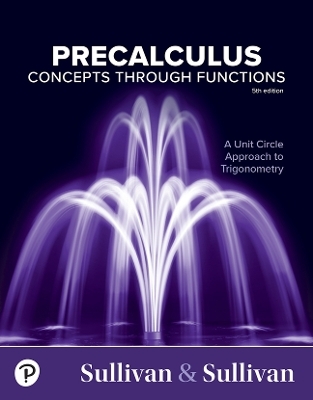
Precalculus
Pearson Education (US) (Hersteller)
978-0-13-791305-3 (ISBN)
- Titel nicht im Sortiment
- Artikel merken
About our authors Michael Sullivan, Emeritus Professor of Mathematics at Chicago State University, received a Ph.D. in mathematics from the Illinois Institute of Technology. He is a native of Chicago’s South Side and divides his time between Oak Lawn, Illinois and Naples, Florida. Mike is a member of the American Mathematical Society and the Mathematical Association of America. He is a past president of the Text and Academic Authors Association and is currently Treasurer of its Foundation. He is a member of the TAA Council of Fellows, and was awarded the TAA Mike Keedy award in 1997 and the Lifetime Achievement Award in 2007. In addition, he represents TAA on the Authors Coalition of America. He has been writing textbooks for more than 35 years and currently has 15 books in print, 12 with Pearson Education. When not writing he enjoys tennis, golf, gardening and travel. Mike has 4 children: Kathleen teaches college mathematics; Michael III teaches college mathematics and is his co-author on 2 precalculus series; Dan works in publishing; and Colleen teaches middle school and secondary school mathematics. 12 grandchildren round out the family. Mike Sullivan III is a professor of mathematics at Joliet Junior College. He holds graduate degrees from DePaul University in both mathematics and economics. Mike is an author or co-author on more than 20 books, including a statistics book and a developmental mathematics series. Mike is the father of 3 children and an avid golfer, who tries to spend as much of his limited free time as possible on the golf course.
Applications Index F. Foundations: A Prelude to Functions
F.1 The Distance and Midpoint Formulas
F.2 Graphs of Equations in Two Variables; Intercepts; Symmetry
F.3 Lines
F.4 Circles
Chapter Project
1. Functions and Their Graphs
1.1 Functions
1.2 The Graph of a Function
1.3 Properties of Functions
1.4 Library of Functions; Piecewise-defined Functions
1.5 Graphing Techniques: Transformations
1.6 Building Mathematical Models from Verbal Descriptions
1.7 Building Mathematical Models Using Variation
Chapter Review
Chapter Test
Chapter Projects
2. Linear and Quadratic Functions
2.1 Properties of Linear Functions and Linear Models
2.2 Building Linear Models from Data
2.3 Quadratic Functions and Their Zeros
2.4 Properties of Quadratic Functions
2.5 Inequalities Involving Quadratic Functions
2.6 Building Quadratic Models from Verbal Descriptions and from Data
2.7 Complex Zeros of a Quadratic Function
2.8 Equations and Inequalities Involving the Absolute Value Function
Chapter Review
Chapter Test
Cumulative Review
Chapter Projects
3. Polynomial and Rational Functions
3.1 Polynomial Functions
3.2 Graphing Polynomial Functions; Models
3.3 The Real Zeros of a Polynomial Function
3.4 Complex Zeros; Fundamental Theorem of Algebra
3.5 Properties of Rational Functions
3.6 The Graph of a Rational Function
3.7 Polynomial and Rational Inequalities
Chapter Review
Chapter Test
Cumulative Review
Chapter Projects
4. Exponential and Logarithmic Functions
4.1 Composite Functions
4.2 One-to-One Functions; Inverse Functions
4.3 Exponential Functions
4.4 Logarithmic Functions
4.5 Properties of Logarithms
4.6 Logarithmic and Exponential Equations
4.7 Financial Models
4.8 Exponential Growth and Decay Models; Newton’s Law; Logistic Growth and Decay Models
4.9 Building Exponential, Logarithmic, and Logistic Models from Data
Chapter Review
Chapter Test
Cumulative Review
Chapter Projects
5. Trigonometric Functions
5.1 Angles, Arc Length, and Circular Motion
5.2 Trigonometric Functions: Unit Circle Approach
5.3 Properties of the Trigonometric Functions
5.4 Graphs of the Sine and Cosine Functions
5.5 Graphs of the Tangent, Cotangent, Cosecant, and Secant Functions
5.6 Phase Shift; Sinusoidal Curve Fitting
Chapter Review
Chapter Test
Cumulative Review
Chapter Projects
6. Analytic Trigonometry
6.1 The Inverse Sine, Cosine, and Tangent Functions
6.2 The Inverse Trigonometric Functions (Continued)
6.3 Trigonometric Equations
6.4 Trigonometric Identities
6.5 Sum and Difference Formulas
6.6 Double-angle and Half-angle Formulas
6.7 Product-to-Sum and Sum-to-Product Formulas
Chapter Review
Chapter Test
Cumulative Review
Chapter Projects
7. Applications of Trigonometric Functions
7.1 Right Triangle Trigonometry; Applications
7.2 The Law of Sines
7.3 The Law of Cosines
7.4 Area of a Triangle
7.5 Simple Harmonic Motion; Damped Motion; Combining Waves
Chapter Review
Chapter Test
Cumulative Review
Chapter Projects
8. Polar Coordinates; Vectors
8.1 Polar Coordinates
8.2 Polar Equations and Graphs
8.3 The Complex Plane; De Moivre’s Theorem
8.4 Vectors
8.5 The Dot Product
8.6 Vectors in Space
8.7 The Cross Product
Chapter Review
Chapter Test
Cumulative Review
Chapter Projects
9. Analytic Geometry
9.1 Conics
9.2 The Parabola
9.3 The Ellipse
9.4 The Hyperbola
9.5 Rotation of Axes; General Form of a Conic
9.6 Polar Equations of Conics
9.7 Plane Curves and Parametric Equations
Chapter Review
Chapter Test
Cumulative Review
Chapter Projects
10. Systems of Equations and Inequalities
10.1 Systems of Linear Equations: Substitution and Elimination
10.2 Systems of Linear Equations: Matrices
10.3 Systems of Linear Equations: Determinants
10.4 Matrix Algebra
10.5 Partial Fraction Decomposition
10.6 Systems of Nonlinear Equations
10.7 Systems of Inequalities
10.8 Linear Programming
Chapter Review
Chapter Test
Cumulative Review
Chapter Projects
11. Sequences; Induction; the Binomial Theorem
11.1 Sequences
11.2 Arithmetic Sequences
11.3 Geometric Sequences; Geometric Series
11.4 Mathematical Induction
11.5 The Binomial Theorem
Chapter Review
Chapter Test
Cumulative Review
Chapter Projects
12. Counting and Probability
12.1 Counting
12.2 Permutations and Combinations
12.3 Probability
Chapter Review
Chapter Test
Cumulative Review
Chapter Projects
13. A Preview of Calculus: The Limit, Derivative, and Integral of a Function
13.1 Investigating Limits Using Tables and Graphs
13.2 Algebraic Techniques for Finding Limits
13.3 One-sided Limits; Continuity
13.4 The Tangent Problem; The Derivative
13.5 The Area Problem; The Integral
Chapter Review
Chapter Test
Chapter Projects
APPENDICES
A. Review
A.1 Algebra Essentials
A.2 Geometry Essentials
A.3 Polynomials
A.4 Factoring Polynomials
A.5 Synthetic Division
A.6 Rational Expressions
A.7 nth Roots; Rational Exponents
A.8 Solving Equations
A.9 Problem Solving: Interest, Mixture, Uniform Motion, Constant Rate Job Applications
A.10 Interval Notation; Solving Inequalities
A.11 Complex Numbers
B. Graphing Utilities
B.1 The Viewing Rectangle
B.2 Using a Graphing Utility to Graph Equations
B.3 Using a Graphing Utility to Locate Intercepts and Check for Symmetry
B.4 Using a Graphing Utility to Solve Equations
B.5 Square Screens
B.6 Using a Graphing Utility to Graph Inequalities
B.7 Using a Graphing Utility to Solve Systems of Linear Equations
B.8 Using a Graphing Utility to Graph a Polar Equation
B.9 Using a Graphing Utility to Graph Parametric Equations
| Erscheint lt. Verlag | 2.1.2023 |
|---|---|
| Verlagsort | Upper Saddle River |
| Sprache | englisch |
| ISBN-10 | 0-13-791305-2 / 0137913052 |
| ISBN-13 | 978-0-13-791305-3 / 9780137913053 |
| Zustand | Neuware |
| Informationen gemäß Produktsicherheitsverordnung (GPSR) | |
| Haben Sie eine Frage zum Produkt? |


