


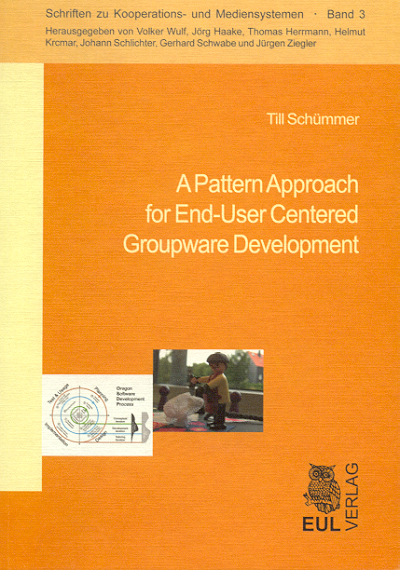
A Pattern Approach for End-User Centered Groupware Development (eBook)
302 Seiten
Josef Eul Verlag
978-3-89936-383-8 (ISBN)
The approach presented in this thesis sheds light on the problem of groupware development by taking a closer look at theoretic approaches to design. Especially, the situatedness of design as it is propagated by the philosopher Martin Heidegger and the architect Christopher Alexander motivates that groupware development has to pay special attention to the group.s situation. Empowering the end-users to express their needs in a specific group situation is therefore crucial to any groupware development.
The Oregon Software Development Process presented in this thesis reflects these ideas. It fosters the communication and interaction between developers and endusers during all phases of software development and ensures that end-user involvement and end-user tailorability is achieved.
Groupware patterns serve as an educational means for empowering end-users to behave like groupware development experts. They describe how to design social interaction in groupware systems as well as technical aspects of groupware systems. A selection of groupware patterns is presented in this thesis.
The approach is validated through analyzing its impact in different case studies: the first case is a two year development project of the collaborative learning system CURE involving six developers and a large user community; the second case describes the application in three smaller student projects.
Preface 6
Abstract 8
Zusammenfassung 10
Acknowledgements 14
Contents 16
Chapter 1 Introduction 20
1.1 Motivation 20
1.2 Problem Statement 23
1.3 Approach 24
1.4 Organization of this thesis 24
Chapter 2 Theory of Development Activities 26
2.1 Heidegger – Understanding Situatedness 29
2.2 Alexander – The Synthesis of Form 30
2.3 Rittel and Webber – Wicked Problems 33
2.4 Schön – Reflection in Action 34
2.5 Alexander – Patterns in the Context of Design 36
2.5.1 Garfinkel – Ethnomethodology 38
2.6 Alexander – The Oregon Experiment 40
2.7 The Scandinavian Approach – Participatory Design 43
2.8 Alexander – The Nature of Order 44
2.9 Takeuchi and Nonaka – The Rugby Approach 50
2.10 Requirements for a Process that Supports End- User Centered Groupware Development 52
Chapter 3 State of the Art 58
3.1 Software Development Processes 58
3.1.1 Sequential Non-Iterative Development 59
3.1.2 Iterative Development Processes 64
3.1.3 Agile Methods for Software Development 68
3.1.4 Participatory Design and End-User Development 79
3.1.5 Patterns in the Context of Software Development 84
3.1.6 Discussion of Software Development Processes 95
3.2 Groupware Development Processes 97
3.2.1 A critical review of Dewan’s waterfall process model for groupware development 97
3.2.2 Agile Processes for Groupware Development 100
3.2.3 Application of Participatory Design Methods 101
3.2.4 CSCW Patterns 104
3.3 Summary of the first part 110
Chapter 4 A Pattern Approach for Groupware Development 114
4.1 The Oregon Software Development Process 114
4.1.1 Conceptual Iteration 114
4.1.2 Development Iteration 117
4.1.3 Tailoring Iteration 120
4.1.4 The relation between the di erent iteration types 121
4.1.5 Requirements addressed by OSDP 121
4.1.6 Comparison to the State of the Art 124
4.2 Appropriating the Representation of Groupware Patterns 125
4.2.1 Single Pattern Representation 125
4.2.2 Pattern Abstraction Scale 131
Chapter 5 The Pattern Language 132
5.1 Importance of Group Formation 132
5.2 A Pattern Language for Group Formation by Enhanced Awareness 135
5.2.1 Overview 135
5.2.2 From Shared Data to Shared Work 139
5.2.3 Local Awareness 146
5.2.4 Presence Indicator 154
5.2.5 User List 160
5.2.6 Gaze Over the Shoulder 164
5.2.7 Elephant’s Brain 169
5.2.8 Daily Report 177
5.2.9 Hello Hello 182
5.3 Summary 188
Chapter 6 Experiences 190
6.1 Observation Method 190
6.2 Context of the CURE Project 193
6.3 Conceptual Iterations in CURE 194
6.3.1 Results from the Conceptual Iterations 197
6.4 Development Iterations in CURE 198
6.4.1 A sequence shaping the collaboration environment 199
6.4.2 A sequence addressing group awareness 204
6.4.3 A sequence addressing privacy and group formation 211
6.4.4 Results from the Development Iterations 221
6.5 Tailoring Iterations in CURE 224
6.5.1 The Hello Hello pattern 224
6.5.2 The emergence of CSCL patterns during tailoring iterations 225
6.5.3 Results from Tailoring Iterations 228
6.6 Student Projects 229
6.6.1 Results from the Student Projects 232
6.7 Observations Made by Peer Reviewers and Shepherds 233
6.8 Summary 235
Chapter 7 Conclusions and Future Work 238
7.1 Summary 238
7.2 Main Contributions 240
7.3 Future Work 241
Appendix A Additional Thumbnails 244
Appendix B The Authoring and Viewing Environment CoPE 266
B.1 Linking Patterns in a Pattern Language 266
B.2 Example Diagram 270
Appendix C Tailoring Mechanisms in CURE 272
Bibliography 278
Index 297
Chapter 7
Conclusions and Future Work (p. 219-220)
7.1 Summary
End-user involvement is one of the most important but much too often neglected issues in groupware development. Within this thesis, we have presented a development process that addresses this shortcoming. From a theoretical view on design, we derived 15 requirements for an ideal groupware development process that is based on an active role of the users. The basis for the requirements was a holistic view on design, as it is currently propagated by many designers, especially by Christopher Alexander. In his view, a holistic approach to design has to be combined with an evolutionary process and focus on end-user education in order to empower the enduser to play an active role in the development process. Together with Heidegger, Alexander puts special attention on the situatedness of design. Users should reflect on their activities whenever their flow of action is disrupted. This situated reflection (as it was also propagated by Sch¨on) provides the best access to the requirements and supports solutions that meet the requirements.
We showed how the theories of Alexander (most important pattern-driven design, end-user participation, and iterative development in piecemeal iterations) can be found in many contemporary software development processes. Especially agile methods provide a valuable contribution to iterative processes that preserve and enhance the wholeness of the system built. These processes advocate that the customer is the driving force in the development process and that he can control the progress of each small development increment. However, agile processes put only little interest on the question of how the end-user can be empowered to make sound design decisions.
Patterns fill this gap since they are educative tools for teaching non-experts to do good design. We discussed several pattern approaches ranging from a technical view on patterns to the human-compute interaction centered view of HCI patterns. The latter are presented in a form that is understandable by the end-user. They can therefore help the end-user while participating in the development process.
In a second step of this thesis we studied current groupware development processes in order to understand how they make use of software development techniques in order to integrate the end-user in the development process. Although some authors have proposed to adapt iterative and agile processes to the domain of groupware development, we could not find processes that heavily focus on educating the end-user. Approaches, which meet many of the requirements, include an extended eXtreme Programming process that focuses on involving the user community in planning and development (instead of just a single customer representative in XP), and an iterative process (based on the STEPS process model) that puts special attention tailoring during system use. They demand that the end-user adapts the system in order to meet requirements that evolve from reflection in action.
The main deficit in the state of the art is that no approach meets all requirements. We identified two clusters of approaches: Firstly, a cluster addressing traditional process requirements like process awareness (R4), iterative design (R5), or reflection (R3). Secondly, a cluster addressing issues of end-user involvement (R9), education in design (R10), and sharing of best practices (R14). In order to support the end-user centered development of groupware applications we proposed to combine approaches from both clusters.
| Erscheint lt. Verlag | 1.1.2005 |
|---|---|
| Sprache | englisch |
| ISBN-10 | 3-89936-383-3 / 3899363833 |
| ISBN-13 | 978-3-89936-383-8 / 9783899363838 |
| Informationen gemäß Produktsicherheitsverordnung (GPSR) | |
| Haben Sie eine Frage zum Produkt? |
 PDF (Adobe DRM)
Größe: 5,4 MB
Kopierschutz: Adobe-DRM
Adobe-DRM ist ein Kopierschutz, der das eBook vor Mißbrauch schützen soll. Dabei wird das eBook bereits beim Download auf Ihre persönliche Adobe-ID autorisiert. Lesen können Sie das eBook dann nur auf den Geräten, welche ebenfalls auf Ihre Adobe-ID registriert sind.
Details zum Adobe-DRM
Dateiformat: PDF (Portable Document Format)
Mit einem festen Seitenlayout eignet sich die PDF besonders für Fachbücher mit Spalten, Tabellen und Abbildungen. Eine PDF kann auf fast allen Geräten angezeigt werden, ist aber für kleine Displays (Smartphone, eReader) nur eingeschränkt geeignet.
Systemvoraussetzungen:
PC/Mac: Mit einem PC oder Mac können Sie dieses eBook lesen. Sie benötigen eine
eReader: Dieses eBook kann mit (fast) allen eBook-Readern gelesen werden. Mit dem amazon-Kindle ist es aber nicht kompatibel.
Smartphone/Tablet: Egal ob Apple oder Android, dieses eBook können Sie lesen. Sie benötigen eine
Geräteliste und zusätzliche Hinweise
Zusätzliches Feature: Online Lesen
Dieses eBook können Sie zusätzlich zum Download auch online im Webbrowser lesen.
Buying eBooks from abroad
For tax law reasons we can sell eBooks just within Germany and Switzerland. Regrettably we cannot fulfill eBook-orders from other countries.


