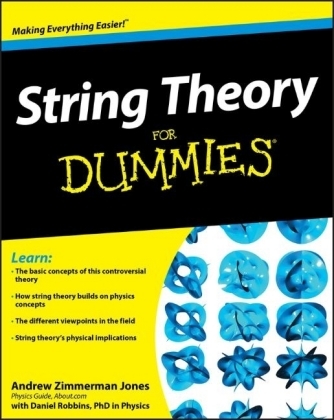
String Theory For Dummies
For Dummies (Verlag)
978-0-470-46724-4 (ISBN)
- Titel erscheint in neuer Auflage
- Artikel merken
A clear, plain-English guide to this complex scientific theory
String theory is the hottest topic in physics right now, with books on the subject (pro and con) flying out of the stores. String Theory For Dummies offers an accessible introduction to this highly mathematical "theory of everything," which posits ten or more dimensions in an attempt to explain the basic nature of matter and energy. Written for both students and people interested in science, this guide explains concepts, discusses the string theory's hypotheses and predictions, and presents the math in an approachable manner. It features in-depth examples and an easy-to-understand style so that readers can understand this controversial, cutting-edge theory.
Andrew Zimmerman Jones received his physics degree and graduated with honors from Wabash College, where he earned the Harold Q. Fuller Prize in Physics. He is the Physics Guide for the New York Times' About.com Web site. Daniel Robbins received his PhD in physics from the University of Chicago and currently studies string theory and its implications at Texas A&M University.
Introduction 1
About This Book 1
Conventions Used in This Book 2
What You’re Not to Read 3
Foolish Assumptions 3
How This Book Is Organized 4
Part I: Introducing String Theory 4
Part II: The Physics Upon Which String Theory Is Built 4
Part III: Building String Theory: A Theory of Everything 5
Part IV: The Unseen Cosmos: String Theory on the Boundaries of Knowledge 5
Part V: What the Other Guys Say: Criticism and Alternatives 5
Part VI: The Part of Tens 5
Icons Used in this Book 6
Where to Go from Here 6
Part I: Introducing String Theory 7
Chapter 1: So What Is String Theory Anyway? 9
String Theory: Seeing What Vibrating Strings Can Tell Us about the Universe 9
Using tiny and huge concepts to create a theory of everything 10
A quick look at where string theory has been 11
Introducing the Key Elements of String Theory 12
Strings and branes 12
Quantum gravity 14
Unification of forces 14
Supersymmetry 15
Extra dimensions 15
Understanding the Aim of String Theory 16
Explaining matter and mass 16
Defining space and time 17
Quantizing gravity 18
Unifying forces 18
Appreciating the Theory’s Amazing (and Controversial) Implications 19
Landscape of possible theories 19
Parallel universes 20
Wormholes 20
The universe as a hologram 21
Time travel 21
The big bang 21
The end of the universe 22
Why Is String Theory So Important? 22
Chapter 2: The Physics Road Dead Ends at Quantum Gravity 25
Understanding Two Schools of Thought on Gravity 26
Newton’s law of gravity: Gravity as force 26
Einstein’s law of gravity: Gravity as geometry 28
Describing Matter: Physical and Energy-Filled 28
Viewing matter classically: Chunks of stuff 29
Viewing matter at a quantum scale: Chunks of energy 29
Grasping for the Fundamental Forces of Physics 30
Electromagnetism: Super-speedy energy waves 30
Nuclear forces: What the strong force joins, the weak force tears apart 31
Infinities: Why Einstein and the Quanta Don’t Get Along 32
Singularities: Bending gravity to the breaking point 33
Quantum jitters: Space-time under a quantum microscope 33
Unifying the Forces 35
Einstein’s failed quest to explain everything 35
A particle of gravity: The graviton 36
Supersymmetry’s role in quantum gravity 37
Chapter 3: Accomplishments and Failures of String Theory 39
Celebrating String Theory’s Successes 39
Predicting gravity out of strings 40
Explaining what happens to a black hole (sort of) 40
Explaining quantum fi eld theory using string theory 41
Like John Travolta, string theory keeps making a comeback 41
Being the most popular theory in town 42
Considering String Theory’s Setbacks 43
The universe doesn’t have enough particles 43
Dark energy: The discovery string theory should have predicted 44
Where did all of these “fundamental” theories come from? 45
Looking into String Theory’s Future 45
Theoretical complications: Can we figure out string theory? 46
Experimental complications: Can we prove string theory? 46
Part II: The Physics upon Which String Theory is Built 49
Chapter 4: Putting String Theory in Context: Understanding the Method of Science 51
Exploring the Practice of Science 52
The myth of the scientific method 52
The need for experimental falsifiability 53
The foundation of theory is mathematics 55
The rule of simplicity 56
The role of objectivity in science 57
Understanding How Scientific Change Is Viewed 57
Old becomes new again: Science as revolution 58
Combining forces: Science as unification 59
What happens when you break it? Science as symmetry 60
Chapter 5: What You Must Know about Classical Physics 63
This Crazy Little Thing Called Physics 63
No laughing matter: What we’re made of 64
Add a little energy: Why stuff happens 66
Symmetry: Why some laws were made to be broken 67
All Shook Up: Waves and Vibrations 68
Catching the wave 69
Getting some good vibrations 70
Newton’s Revolution: How Physics Was Born 72
Force, mass, and acceleration: Putting objects into motion 73
Gravity: A great discovery 74
Optics: Shedding light on light’s properties 75
Calculus and mathematics: Enhancing scientific understanding 75
The Forces of Light: Electricity and Magnetism 75
Light as a wave: The ether theory 76
Invisible lines of force: Electric and magnetic fields 76
Maxwell’s equations bring it all together: Electromagnetic waves 79
Two dark clouds and the birth of modern physics 80
Chapter 6: Revolutionizing Space and Time: Einstein’s Relativity 81
What Waves Light Waves? Searching for the Ether 82
No Ether? No Problem: Introducing Special Relativity 84
Unifying space and time 85
Unifying mass and energy 87
Changing Course: Introducing General Relativity 89
Gravity as acceleration 89
Gravity as geometry 91
Testing general relativity 92
Applying Einstein’s Work to the Mysteries of the Universe 95
Kaluza-Klein Theory — String Theory’s Predecessor 96
Chapter 7: Brushing Up on Quantum Theory Basics 99
Unlocking the First Quanta: The Birth of Quantum Physics 100
Fun with Photons: Einstein’s Nobel Idea of Light 102
Waves and Particles Living Together 105
Light as a wave: The double slit experiment 105
Particles as a wave: The de Broglie hypothesis 106
Quantum physics to the rescue: The quantum wavefunction 108
Why We Can’t Measure It All: The Uncertainty Principle 109
Dead Cats, Live Cats, and Probability in Quantum Physics 111
Does Anyone Know What Quantum Theory Means? 112
Interactions transform quantum systems: The Copenhagen interpretation 113
If no one’s there to see it, does the universe exist? The participatory anthropic principle 113
All possibilities take place: The many worlds interpretation 114
What are the odds? Consistent histories 115
Searching for more fundamental data: The hidden variables interpretation 115
Quantum Units of Nature — Planck Units 116
Chapter 8: The Standard Model of Particle Physics 119
Atoms, Atoms, Everywhere Atoms: Introducing Atomic Theory 120
Popping Open the Atomic Hood and Seeing What’s Inside 121
Discovering the electron 122
The nucleus is the thing in the middle 123
Watching the dance inside an atom 123
The Quantum Picture of the Photon: Quantum Electrodynamics 125
Dr. Feynman’s doodles explain how particles exchange information 125
Discovering that other kind of matter: Antimatter 127
Sometimes a particle is only virtual 128
Digging into the Nucleus: Quantum Chromodynamics 129
The pieces that make up the nucleus: Nucleons 129
The pieces that make up the nucleon’s pieces: Quarks 130
Looking into the Types of Particles 131
Particles of force: Bosons 131
Particles of matter: Fermions 132
Gauge Bosons: Particles Holding Other Particles Together 133
Exploring the Theory of Where Mass Comes From 134
From Big to Small: The Hierarchy Problem in Physics 135
Chapter 9: Physics in Space: Considering Cosmology and Astrophysics 137
Creating an Incorrect Model of the Universe 138
Aristotle assigns realms to the universe 138
Ptolemy puts Earth at the center of the universe (and the Catholic Church agrees) 139
The Enlightened Universe: Some Changes Allowed 141
Copernicus corrects what’s where in the universe 141
Beholding the movements of heavenly bodies 142
Introducing the Idea of an Expanding Universe 143
Discovering that energy and pressure have gravity 143
Hubble drives it home 145
Finding a Beginning: The Big Bang Theory 146
Bucking the big bang: The steady state theory 147
Going to bat for the big bang: Cosmic microwave background radiation 148
Understanding where the chemical elements came from 150
Using Inflation to Solve the Universe’s Problems of Flatness and Horizon 150
The universe’s issues: Too far and too flat 151
Rapid expansion early on holds the solutions 152
Dark Matter: The Source of Extra Gravity 153
Dark Energy: Pushing the Universe Apart 153
Stretching the Fabric of Space-Time into a Black Hole 156
What goes on inside a black hole? 156
What goes on at the edge of a black hole? 157
Part III: Building String Theory: A Theory of Everything 159
Chapter 10: Early Strings and Superstrings: Unearthing the Theory’s Beginnings 161
Bosonic String Theory: The First String Theory 161
Explaining the scattering of particles with early dual resonance models 162
Exploring the first physical model: Particles as strings 164
Bosonic string theory loses out to the Standard Model 165
Why Bosonic String Theory Doesn’t Describe Our Universe 166
Massless particles 166
Tachyons 167
No electrons allowed 168
25 space dimensions, plus 1 of time 168
Supersymmetry Saves the Day: Superstring Theory 170
Fermions and bosons coexist sort of 171
Double your particle fun: Supersymmetry hypothesizes superpartners 172
Some problems get fixed, but the dimension problem remains 173
Supersymmetry and Quantum Gravity in the Disco Era 174
The graviton is found hiding in string theory 174
The other supersymmetric gravity theory: Supergravity 176
String theorists don’t get no respect 176
A Theory of Everything: The First Superstring Revolution 177
But We’ve Got Five Theories! 178
Type I string theory 179
Type IIA string theory 179
Type IIB string theory 179
Two strings in one: Heterotic strings 179
How to Fold Space: Introducing Calabi-Yau Manifolds 180
String Theory Loses Steam 182
Chapter 11: M-Theory and Beyond: Bringing String Theory Together 183
Introducing the Unifying Theory: M-Theory 183
Translating one string theory into another: Duality 184
Using two dualities to unite five superstring theories 188
The second superstring revolution begins: Connecting to the 11-dimensional theory 188
Branes: Stretching Out a String 190
The discovery of D-branes: Giving open strings something to hold on to 190
Creating particles from p-branes 192
Deducing that branes are required by M-theory 192
Uniting D-branes and p-branes into one type of brane 193
Using branes to explain black holes 194
Getting stuck on a brane: Brane worlds 195
Matrix Theory as a Potential M-Theory 196
Gaining Insight from the Holographic Principle 197
Capturing multidimensional information on a flat surface 197
Connecting the holographic principle to our reality 198
Considering AdS/CFT correspondence 199
String Theory Gets Surprised by Dark Energy 200
Considering Proposals for Why Dimensions Sometimes Uncurl 201
Measurable dimensions 202
Infinite dimensions: Randall-Sundrum models 202
Understanding the Current Landscape: A Multitude of Theories 204
The anthropic principle requires observers 204
Disagreeing about the principle’s value 207
Chapter 12: Putting String Theory to the Test 209
Understanding the Obstacles 210
Testing an incomplete theory with indistinct predictions 210
Test versus proof 211
Testing Supersymmetry 211
Finding the missing sparticles 212
Testing implications of supersymmetry 212
Testing Gravity from Extra Dimensions 213
Testing the inverse square law 214
Searching for gravity waves in the CMBR 214
Disproving String Theory Sounds Easier Than It Is 215
Violating relativity 215
Mathematical inconsistencies 216
Could Proton Decay Spell Disaster? 217
Looking for Evidence in the Cosmic Laboratory: Exploring the Universe 218
Using outer space rays to amplify small events 218
Analyzing dark matter and dark energy 222
Detecting cosmic superstrings 222
Looking for Evidence Closer to Home: Using Particle Accelerators 223
Relativistic Heavy Ion Collider (RHIC) 224
Large Hadron Collider (LHC) 224
Colliders of the future 226
Part IV: The Unseen Cosmos: String Theory on the Boundaries of Knowledge 227
Chapter 13: Making Space for Extra Dimensions 229
What Are Dimensions? 229
2-Dimensional Space: Exploring the Geometry of Flatland 230
Euclidean geometry: Think back to high school geometry 231
Cartesian geometry: Merging algebra and Euclidean geometry 231
Three Dimensions of Space 233
A straight line in space: Vectors 233
Twisting 2-dimensional space in three dimensions: The Mobius strip 234
More twists in three dimensions: Non-Euclidean geometry 236
Four Dimensions of Space-Time 237
Adding More Dimensions to Make a Theory Work 238
Sending Space and Time on a Bender 239
Are Extra Dimensions Really Necessary? 240
Offering an alternative to multiple dimensions 241
Weighing fewer dimensions against simpler equations 242
Chapter 14: Our Universe — String Theory, Cosmology, and Astrophysics 245
The Start of the Universe with String Theory 245
What was before the bang? 246
What banged? 247
Explaining Black Holes with String Theory 250
String theory and the thermodynamics of a black hole 250
String theory and the black hole information paradox 252
The Evolution of the Universe 253
The swelling continues: Eternal inflation 253
The hidden matter and energy 255
The Undiscovered Country: The Future of the Cosmos 257
A universe of ice: The big freeze 257
From point to point: The big crunch 257
A new beginning: The big bounce 258
Exploring a Finely Tuned Universe 258
Chapter 15: Parallel Universes: Maybe You Can Be Two Places at Once 261
Exploring the Multiverse: A Theory of Parallel Universes 261
Level 1: If you go far enough, you’ll get back home 264
Level 2: If you go far enough, you’ll fall into wonderland 265
Level 3: If you stay where you are, you’ll run into yourself 267
Level 4: Somewhere over the rainbow, there’s a magical land 269
Accessing Other Universes 270
A history of hyperspace 270
How quantum mechanics can get us from here to there 272
Chapter 16: Have Time, Will Travel 275
Temporal Mechanics 101: How Time Flies 276
The arrow of time: A one-way ticket 276
Relativity, worldlines, and worldsheets: Moving through space-time 278
Hawking’s chronology protection conjecture: You’re not going anywhere 279
Slowing Time to a Standstill with Relativity 280
Time dilation: Sometimes even the best watches run slow 281
Black hole event horizons: An extra-slow version of slow motion 282
General Relativity and Wormholes: Doorways in Space and Time 282
Taking a shortcut through space and time with a wormhole 284
Overcoming a wormhole’s instability with negative energy 286
Crossing Cosmic Strings to Allow Time Travel 286
A Two-Timing Science: String Theory Makes More Time Dimensions Possible 287
Adding a new time dimension 287
Reflecting two-time onto a one-time universe 288
Does two-time physics have any real applications? 289
Sending Messages through Time 290
Time Travel Paradoxes 290
The twin paradox 291
The grandfather paradox 292
Where are the time travelers? 292
Part V: What the Other Guys Say: Criticisms and Alternatives 295
Chapter 17: Taking a Closer Look at the String Theory Controversy 297
The String Wars: Outlining the Arguments 298
Thirty years and counting: Framing the debate from the skeptic’s point of view 299
A rise of criticisms 300
Is String Theory Scientific? 301
Argument No. 1: String theory explains nothing 301
Argument No. 2: String theory explains too much 302
Turning a Critical Eye to String Theorists 305
Hundreds of physicists just can’t be wrong 305
Holding the keys to the academic kingdom 306
Does String Theory Describe Our Universe? 308
Making sense of extra dimensions 309
Space-time should be fluid 309
How finite is string theory? 310
A String Theory Rebuttal 311
Chapter 18: Loop Quantum Gravity: String Theory’s Biggest Competitor 313
Taking the Loop: Introducing Another Road to Quantum Gravity 313
The great background debate 314
What is looping anyway? 314
Making Predictions with Loop Quantum Gravity 317
Gravity exists (Duh!) 317
Black holes contain only so much space 317
Gamma ray burst radiation travels at different speeds 318
Finding Favor and Flaw with Loop Quantum Gravity 318
The benefit of a finite theorem 318
Spending some time focusing on the flaws 319
So Are These Two Theories the Same with Different Names? 320
Chapter 19: Considering Other Ways to Explain the Universe 323
Taking Other Roads to Quantum Gravity 324
Causal dynamical triangulations (CDT): If you’ve got the time, I’ve got the space 324
Quantum Einstein gravity: Too small to tug 325
Quantum graphity: Disconnecting nodes 326
Internal relativity: Spinning the universe into existence 327
Newton and Einstein Don’t Make All the Rules: Modifying the Law of Gravity 328
Doubly special relativity (DSR): Twice as many limits as ordinary relativity 328
Modified Newtonian dynamics (MOND): Disregarding dark matter 328
Variable speed of light (VSL): Light used to travel even faster 329
Modified gravity (MOG): The bigger the distance, the greater the gravity 331
Rewriting the Math Books and Physics Books at the Same Time 332
Compute this: Quantum information theory 333
Looking at relationships: Twistor theory 334
Uniting mathematical systems: Noncommutative geometry 334
Part VI: The Part of Tens 337
Chapter 20: Ten Questions a Theory of Everything Should (Ideally) Answer 339
The Big Bang: What Banged (and Inflated)? 340
Baryon Asymmetry: Why Does Matter Exist? 340
Hierarchy Issues: Why Are There Gaps in Forces, Particles, and Energy Levels? 341
Fine-Tuning: Why Do Fundamental Constants Have the Values They Do? 341
Black Hole Information Paradox: What Happens to Missing Black Hole Matter? 341
Quantum Interpretation: What Does Quantum Mechanics Mean? 342
Dark Mystery No. 1: What Is Dark Matter (and Why Is There So Much)? 343
Dark Mystery No. 2: What Is Dark Energy (and Why Is It So Weak)? 343
Time Symmetry: Why Does Time Seem to Move Forward? 344
The End of the Universe: What Comes Next? 344
Chapter 21: Ten Notable String Theorists 345
Edward Witten 345
John Henry Schwarz 346
Yoichiro Nambu 347
Leonard Susskind 347
David Gross 348
Joe Polchinski 348
Juan Maldacena 348
Lisa Randall 349
Michio Kaku 349
Brian Greene 350
Index 351
| Erscheint lt. Verlag | 13.11.2009 |
|---|---|
| Co-Autor | Daniel Robbins |
| Sprache | englisch |
| Maße | 185 x 231 mm |
| Gewicht | 499 g |
| Themenwelt | Sachbuch/Ratgeber ► Natur / Technik ► Naturwissenschaft |
| Naturwissenschaften ► Physik / Astronomie | |
| ISBN-10 | 0-470-46724-X / 047046724X |
| ISBN-13 | 978-0-470-46724-4 / 9780470467244 |
| Zustand | Neuware |
| Informationen gemäß Produktsicherheitsverordnung (GPSR) | |
| Haben Sie eine Frage zum Produkt? |
aus dem Bereich